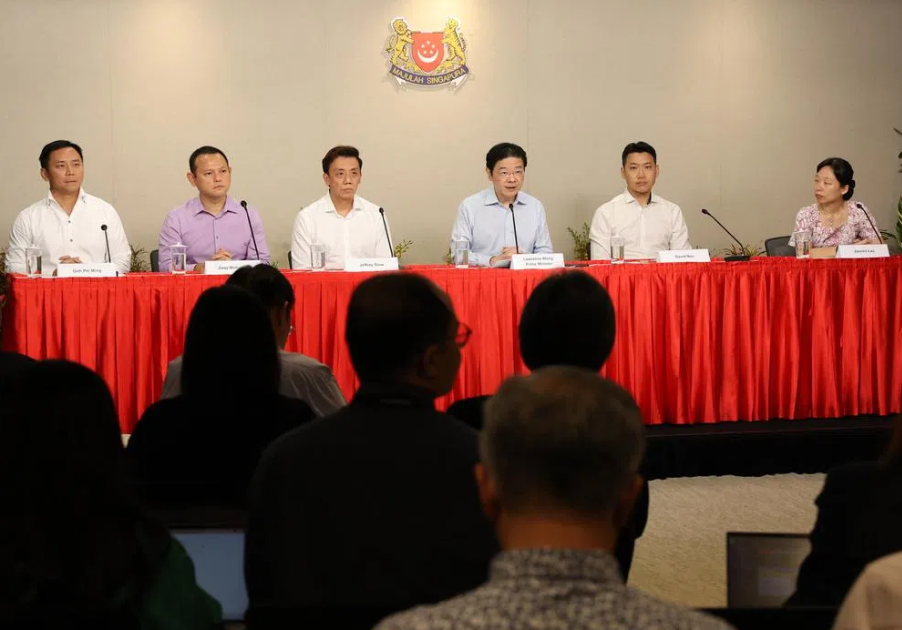
Prime Minister Lawrence Wong has announced a significant restructuring of Singapore's Cabinet designed to thrust newer lawmakers into more prominent positions while retaining the country's most experienced political figures to guide the transition. The reshuffle, unveiled on July 22, comes against the backdrop of two high-profile resignations within the ruling People's Action Party this year and reflects the Government's commitment to systematic leadership renewal—a hallmark of Singapore's political succession strategy.
The most prominent promotions involve two politicians newly elected in the 2025 general election. Jeffrey Siow and David Neo have been elevated from acting minister roles to full ministerial status, cementing their positions within Cabinet hierarchy. Both men will continue overseeing their respective portfolios: Siow remains Minister for Transport while Neo heads Culture, Community and Youth. Their progression from backbench roles to substantive Cabinet positions signals the Government's confidence in their readiness to handle major policy domains, a decision PM Wong attributed to their demonstrated competence over the past year.
A third GE2025 newcomer, Sim Ann, has been appointed Second Minister for both Foreign Affairs and Home Affairs, a dual responsibility that reflects the cross-cutting nature of contemporary security and diplomatic challenges. The appointment of first-term politicians to these strategically sensitive ministries indicates that Singapore's political hierarchy believes the next generation possesses the capability to manage complex national security and international relations issues. This confidence is not lightly bestowed in Singapore's merit-based political system, where progression through government ranks traditionally occurs incrementally.
The Cabinet changes also address vacancies created by unexpected resignations. Jasmin Lau, another first-term MP, will assume the role of acting minister for the Ministry of Manpower, stepping into a position vacated by Tan See Leng. The transition reflects a deliberate strategy to test and develop emerging talent through executive responsibility. Lau's appointment to helm the manpower portfolio places her at the forefront of Singapore's labour policy and workforce development—domains crucial to the island nation's economic competitiveness and social stability in an era of automation and demographic shifts.
Tan See Leng has been repositioned rather than sidelined, transitioning to Minister for Trade and Industry with specific responsibility for energy and industry portfolios. This lateral move preserves his ministerial status while allowing the Government to deploy his expertise in different areas. The restructuring exemplifies Singapore's pragmatic approach to Cabinet management: individuals are moved to roles matching their capabilities and the Government's needs rather than simply promoted or removed.
Two experienced figures return to or assume senior positions within Cabinet. Labour movement chief Ng Chee Meng rejoins the Cabinet as Minister in the Prime Minister's Office, bringing his background in union affairs and worker representation to the inner circle of government. Meanwhile, K. Shanmugam has been elevated to Senior Minister, a position that recognises his extensive experience and positions him as a mentor to younger office-holders. PM Wong explicitly noted that Shanmugam and Senior Minister Lee Hsien Loong form the Cabinet's most experienced pair, underscoring the Government's intention to leverage their knowledge during this transition period.
Two backbench MPs and former senior civil servants, Foo Cexiang and Shawn Loh, have been appointed ministers of state. Both are first-term parliamentarians, yet their prior experience in the civil service provides them with institutional knowledge of government operations. Their elevation bridges the gap between political and bureaucratic spheres, potentially facilitating smoother policy implementation and reducing friction between elected officials and permanent administrators.
The Cabinet reshuffle was necessitated by two resignations in 2026. Faishal Ibrahim, who served as Acting Minister-in-charge of Muslim Affairs and Senior Minister of State for Home Affairs, resigned on July 20 citing a lapse of judgment regarding interactions with a woman. Before that, senior minister of state Koh Poh Koon stepped down on June 1 for family reasons. These departures, while distinct in their circumstances, created vacancies that the Government needed to address and forced an earlier-than-scheduled review of ministerial arrangements.
PM Wong framed the reshuffle within Singapore's broader leadership succession paradigm. He acknowledged that while Cabinet composition is reviewed annually, unexpected departures necessitate contingency planning. The Prime Minister stressed that building a robust political pipeline extends beyond identifying future ministers; it requires cultivating strong backbenchers and nurturing younger office-holders capable of eventually stepping into larger roles. This cascading approach to talent development reflects Singapore's concern about ensuring political continuity and institutional stability across generations of leadership.
A notable aspect of the reshuffle involves the decision not to appoint a second deputy prime minister. With Gan Kim Yong serving as the sole Deputy Prime Minister, PM Wong indicated that the current structure provides sufficient senior leadership capacity. He noted that three coordinating ministers—including Shanmugam, Chan Chun Sing, and Ong Ye Kung—oversee different governmental domains, creating a senior leadership team that compensates for the single deputy prime minister arrangement. This structure may be revisited as leadership renewal progresses, suggesting the Government remains flexible in its institutional design.
PM Wong confirmed his continued stewardship of the Finance Ministry since 2021, describing his search for a successor as a work in progress. The statement reveals that even in Singapore's competitive political system, identifying and developing a finance minister requires extended observation periods. The Prime Minister acknowledged that political figures develop at different paces, and his role involves assessing readiness, entrusting individuals with responsibilities when appropriate, and positioning them where they can best contribute to national objectives.
For the Southeast Asian region, Singapore's Cabinet reshuffle offers insights into how a small, wealthy city-state manages leadership transitions while maintaining political continuity and institutional effectiveness. The emphasis on balancing youth with experience, on systematic talent development, and on retaining institutional memory through senior figures reflects pragmatic governance. As other regional nations grapple with succession questions and generational change, Singapore's model of incremental but deliberate advancement merits close observation. The reshuffle takes effect progressively from July 27, with some changes implemented later, allowing the Government to manage transitions smoothly across different ministerial portfolios.
Ultimately, PM Wong's restructuring represents Singapore's commitment to what he termed the "Singapore way of leadership renewal"—a continuous, calibrated process that neither abruptly displaces experienced hands nor stalls the advancement of capable new generation politicians. This balancing act, if executed successfully, positions Singapore to navigate future challenges while maintaining the institutional stability that has characterised its rise from colonial trading post to developed nation.

