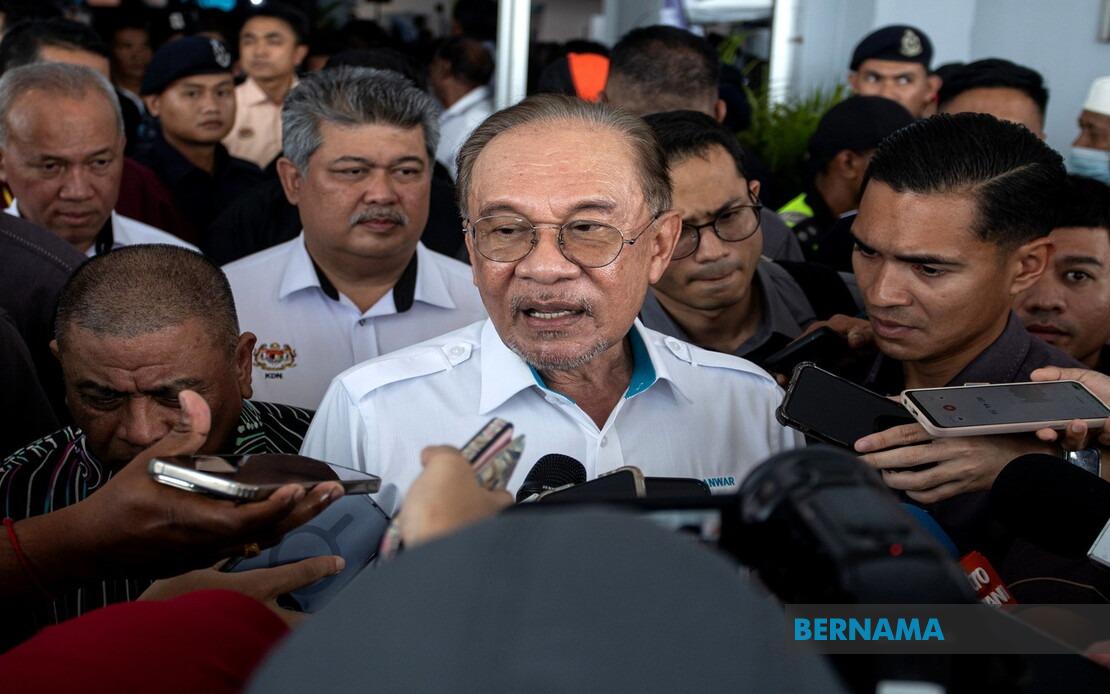
Prime Minister Datuk Seri Anwar Ibrahim has issued a stern reminder to all government officials that they must maintain strict discipline and refrain from criticising the Federal Government whilst campaigning during state elections, emphasising that failure to comply should result in their resignation from office. The warning came during a visit to Ipoh for a community engagement programme, where Anwar spoke candidly about the tensions that arise when coalition partners find themselves competing directly against one another at the state level whilst remaining allies at the federal centre.
The Prime Minister's intervention signals growing concern within the government about the conduct of officials who hold dual roles as both federal appointees and state-level campaigners. His remarks reflected an attempt to establish clear boundaries around what constitutes acceptable political behaviour during electoral contests involving Unity Government partners. By framing the issue in terms of discipline rather than restriction, Anwar sought to appeal to the sense of professional responsibility among ministers and deputies whilst simultaneously laying down consequences for those who transgress.
Anwar acknowledged the peculiar challenge faced by Malaysia's coalition system, where parties aligned at the federal level frequently find themselves in direct competition at state level. He affirmed that this arrangement, whilst creating obvious tensions, remains entirely consistent with democratic principles and represents a normal feature of Malaysia's political landscape. What distinguishes acceptable competition from unacceptable behaviour, according to his position, is whether officials use their governmental platforms and resources to undermine not just rival parties, but the federal administration itself.
The distinction drawn by the Prime Minister centred on the nature of campaign criticism. He indicated that state-focused messaging and criticism of state-level issues falls well within permissible bounds, even when directed at rival coalition partners fielding candidates in state contests. However, he made clear that weaponising one's federal position to attack the Federal Government whilst simultaneously holding ministerial rank or heading federal agencies crosses an ethical and professional line. This formulation attempts to preserve the competitive space necessary for democratic elections whilst protecting the integrity of federal governance structures.
Anwar highlighted that he had already discussed these matters directly with his two deputies, Datuk Seri Dr Ahmad Zahid Hamidi and Datuk Seri Fadillah Yusof, indicating that the message forms part of a broader understanding among senior leadership about maintaining coalition cohesion. The fact that the Prime Minister saw fit to brief his immediate subordinates suggests the issue has surfaced in practical terms, with instances of problematic behaviour or concerning rhetoric prompting intervention at the highest levels. This behind-the-scenes coordination reflects the delicate management required to keep diverse political partners aligned despite their surface-level antagonism.
Beyond individual discipline, Anwar broadened his remarks to encompass the entire Unity Government coalition structure, urging all member parties to prioritise maintaining cordial relations at both federal and state administrative levels. His argument rested on a pragmatic foundation: that effective service delivery to citizens depends upon functional working relationships between coalition partners, irrespective of electoral competition. This framing attempts to elevate the issue beyond narrow partisan advantage to appeal to a shared commitment to governance effectiveness, positioning coalition discipline as a prerequisite for fulfilling the government's mandate to serve Malaysian citizens.
The timing of these remarks, delivered whilst Anwar was actively engaging with constituents, underscores the real-world pressures created when senior officials campaign in states where their coalition partners contest elections. Such visits inevitably attract media attention and provide platforms for political messaging that might veer into territory the Prime Minister finds problematic. By making his expectations explicit and public, Anwar signalled that he would be monitoring officials' conduct during campaign season and stood ready to enforce consequences.
The principle articulated by the Prime Minister reflects broader governance challenges facing Malaysia's Unity Government arrangement. Unlike systems where a single dominant party controls most state governments, Malaysia's federal-state dynamic creates constant friction as coalition partners jockey for position and electoral advantage. The government's success depends partly on finding mechanisms to channel this competitive instinct within sustainable bounds, preventing state-level rivalry from metastasising into federal-level instability or paralysis.
For Malaysian observers and the business community, Anwar's intervention carries significance beyond internal coalition management. Uncertainty about government stability or coherence can affect investor confidence and the implementation of policy initiatives. By publicly addressing the discipline issue and demonstrating that senior leadership takes coalition integrity seriously, the Prime Minister sought to reassure stakeholders that the government remains fundamentally functional despite electoral competitions among member parties. This messaging becomes particularly important during campaign periods when political rhetoric tends to intensify and official statements can be misinterpreted as signs of deeper fracture.
The framework Anwar established also carries implications for how Malaysian politics might evolve as coalition systems become increasingly entrenched. By establishing the principle that government officials cannot use their positions to attack the very government they serve, even whilst campaigning against coalition partners, he articulated a standard that could shape expectations around political conduct more broadly. This standard does not prevent robust electoral competition; rather, it attempts to preserve a distinction between legitimate political rivalry and institutional sabotage.

