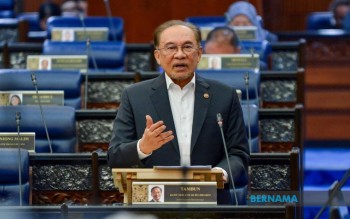
Prime Minister Datuk Seri Anwar Ibrahim has signalled an uncompromising stance towards any form of corruption or fraud connected to the Retirement Fund (Incorporated)'s substantial investment in eFishery, an emerging player in aquaculture technology. Speaking during parliamentary proceedings at the Dewan Negara, Anwar underscored the government's determination to safeguard the integrity of national retirement fund investments whilst acknowledging that preliminary assessments have not revealed such misconduct.
The investment in question has drawn heightened scrutiny in recent months, prompting questions about governance and due diligence within KWAP's decision-making apparatus. Anwar, who doubles as Finance Minister, has stressed the critical importance of transparency throughout the investment vetting process, recognising that public confidence in pension fund management directly affects millions of Malaysian workers and their financial security in retirement. His remarks came as an emphatic reminder that accountability remains non-negotiable, particularly when state-controlled funds are deployed into emerging technology ventures that carry inherent business risks.
During his parliamentary response, Anwar disclosed that he has personally engaged with KWAP's leadership to ensure unreserved cooperation with investigating authorities. This direct ministerial involvement underscores the seriousness with which the government regards the matter and reflects broader concerns about investment governance across Malaysia's institutional sector. The Prime Minister's emphasis on full transparency suggests that routine compliance checks have given way to deeper institutional scrutiny, designed to examine not merely the investment outcome but the entire decision-making architecture that preceded it.
The Malaysian Anti-Corruption Commission (MACC) has been tasked with conducting a comprehensive examination spanning the entire investment process, from initial appraisal through to board-level approval. This expanded investigative remit extends well beyond simple financial auditing to encompass the methodologies employed by the investment panel, the criteria used to evaluate eFishery's viability, and the specific reasoning documented in board resolutions. Anwar's insistence on this thoroughness reflects recognition that institutional integrity depends on robust procedural safeguards at every stage, not merely final approval mechanisms.
The broader context of this development involves sustained global uncertainty affecting financial markets and investment returns. Against this backdrop, Malaysia's two principal retirement funds—the Employees Provident Fund (KWSP) and KWAP—face mounting pressure to generate competitive returns whilst managing escalating geopolitical volatility. This tension between yield aspirations and prudential caution has historically driven institutional investors toward higher-risk emerging technology sectors, precisely where governance complexities proliferate. eFishery's position within this landscape exemplifies the modern dilemma confronting pension fund trustees: how to pursue growth opportunities without compromising the fundamental security of beneficiaries' savings.
Senator Mohd Hasbie Muda had prompted Anwar's remarks by raising the government's overarching strategy for ensuring that national retirement funds deliver optimal dividends despite external economic headwinds. The question implicitly acknowledged the competing pressures facing fund managers, who must balance fiduciary prudence with return objectives. Anwar's response reframed this tension by emphasizing that no legitimate return justification could override basic integrity requirements—a position reassuring to the millions of Malaysian workers whose retirement savings remain invested across KWAP and KWSP portfolios.
Further parliamentary queries from Senator Wan Martina Wan Yusoff probed the government's broader transformation initiatives affecting investment destination selection and the protective mechanisms safeguarding ordinary Malaysians' contributions. These supplementary questions essentially demanded clarity regarding systemic safeguards and the decision-making frameworks governing where pension funds deploy capital. Anwar's responses, while reiterating commitment to rigorous investigation, implicitly acknowledged that institutional transformation remains an ongoing endeavour within Malaysia's fund management sector.
The eFishery investment dispute represents a microcosm of larger challenges facing emerging market pension funds globally. As Southeast Asian economies pursue diversification into technology-driven sectors, institutional investors must navigate unfamiliar risk profiles, evaluate founders with limited track records, and make capital deployment decisions under conditions of substantial uncertainty. Malaysia's experience with eFishery, whatever its eventual outcome, will likely influence how local pension funds approach future technology sector investments and what additional governance layers prove necessary.
The government's stance also reflects evolving expectations around institutional accountability in Malaysia. Public discourse increasingly demands transparency from state-controlled entities managing taxpayer assets, whilst simultaneously recognising that some level of investment risk-taking remains essential for long-term returns. Anwar's comments position the administration as attempting to navigate this delicate equilibrium—defending fiduciary risk-taking as legitimate whilst maintaining that no degree of potential return justifies compromising on fundamental ethical standards or procedural integrity.
Looking forward, the MACC's investigation will serve as a crucial test case for how thoroughly Malaysia's anti-corruption apparatus can examine complex investment decisions involving emerging technology ventures. The inquiry's findings may reshape how KWAP and similar institutions approach technology sector investments, potentially introducing additional layers of external oversight or revised approval procedures. For Malaysian workers whose retirement security depends on these funds' performance, the government's emphatic commitment to investigating thoroughly whilst tolerating zero corruption offers some reassurance, even as questions remain about systemic improvements needed to prevent similar controversies.

