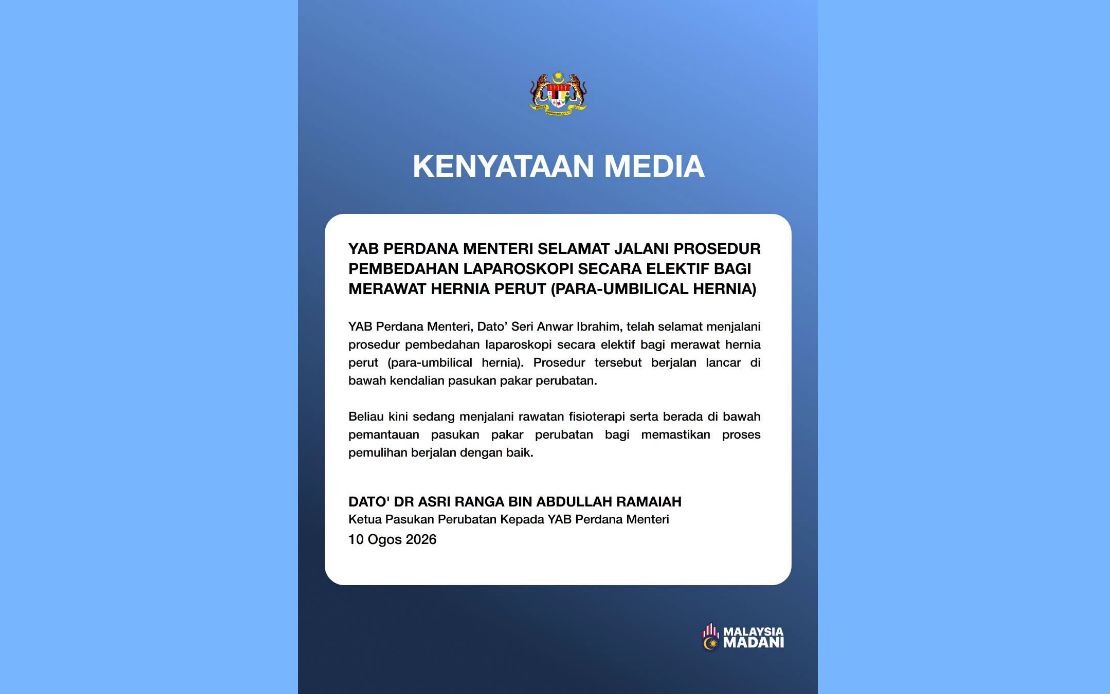
Prime Minister Datuk Seri Anwar Ibrahim has completed an elective laparoscopic surgical procedure to address an abdominal hernia, with his medical team confirming the operation proceeded without complication on August 10. The minimally invasive approach to treating the para-umbilical hernia, performed by a team of specialist surgeons, represents a routine yet necessary intervention to prevent potential complications from the condition.
Abdominal hernias occur when tissue protrudes through a weakness in the surrounding muscle wall. The para-umbilical variety, which develops near the navel, can grow over time and occasionally cause discomfort or digestive issues if left untreated. By opting for elective surgery rather than waiting for symptoms to worsen, the Prime Minister follows medical best practice for managing such conditions, particularly important given the demands of his high-pressure role requiring sustained physical wellbeing.
The head of the Prime Minister's Medical Team, Datuk Dr Asri Ranga Abdullah Ramaiah, provided reassurance about the procedural outcome through an official statement released via Anwar's social media channels. The confirmation of successful completion helps manage public concern about the nation's leadership during a delicate period of political and economic transition. Laparoscopic techniques, which use small incisions and camera guidance rather than open surgery, typically offer faster recovery times and reduced postoperative discomfort compared to conventional approaches.
Following the procedure, Anwar transitioned immediately into structured rehabilitation, with physiotherapy commencing to restore muscular function and mobility. The medical team has maintained continuous monitoring protocols to identify any complications early and optimise the recovery trajectory. This proactive approach to postoperative care reflects the resources and expertise available to the Prime Minister, though it also underscores how even routine surgery requires diligent supervision during the critical initial healing phase.
Tunku Nashrul Abaidah, the Prime Minister's senior press secretary, communicated that Anwar would remain under medical observation for approximately two days following the intervention. This extended monitoring period allows specialists to assess pain management, wound integrity, and the patient's response to rehabilitation exercises. For a national leader, such careful observation serves dual purposes: ensuring genuine medical safety while providing documented evidence of appropriate care that reassures both government and citizens alike.
The timing of this procedure carries significance beyond Anwar's personal health considerations. Malaysia's political landscape has experienced considerable turbulence in recent years, with questions about leadership continuity and stability occasionally surfacing among international observers and domestic commentators. By addressing this health matter promptly and transparently, the Prime Minister demonstrates decisiveness and confidence in his ability to manage both personal wellbeing and national responsibilities. The public communication strategy emphasises routine, professional medical care rather than framing the surgery as crisis management.
For Southeast Asian governments accustomed to opacity regarding leader health matters, Malaysia's transparency represents a marked departure from historical precedent. This openness reflects evolving standards of democratic accountability, where citizens increasingly expect factual information about their leaders' physical capacity to govern. The straightforward announcement contrasts with regional examples where health concerns have been shrouded in speculation and rumour, ultimately damaging public trust and creating unnecessary uncertainty about succession planning.
The public call for prayers and well-wishes, conveyed through official channels, engages Malaysia's deeply religious population while maintaining secular professional standards. This cultural sensitivity in communicating about the Prime Minister's health demonstrates awareness of the diverse constituencies Anwar must balance in governing a multi-faith nation. The framing emphasises hopes for good health enabling continued service rather than dramatising either the condition or the procedure.
Anwar's expected swift return to full duties within days reflects the advantages of minimally invasive surgical techniques and his apparently good baseline health status. The laparoscopic approach minimises damage to surrounding tissue and typically permits faster resumption of normal activities compared to open surgery. For a prime minister managing economic recovery initiatives, strategic foreign relations, and domestic political management, even brief absences create administrative gaps. The medical team's confidence in rapid functional recovery suggests the interruption to formal duties will remain minimal.
The incident also contextualises broader conversations about leadership succession and institutional resilience in Malaysian politics. While Anwar's recovery appears straightforward, the episode raises questions about protocol and delegation during any leader's temporary incapacity. Clear communication about government continuity during the Prime Minister's recovery period helps prevent market jitters, international concern, or domestic political opportunism that could exploit perception of power vacuum.
Regionally, the handling of this situation may influence how other Southeast Asian nations approach transparency regarding leader health. Malaysia's approach, balancing privacy with public accountability, offers a potential model for governments seeking to modernise communication while respecting traditional expectations of discretion. As citizens across the region increasingly demand evidence-based governance and transparent decision-making, the precedent of factual, timely health communication becomes increasingly significant for political legitimacy.

