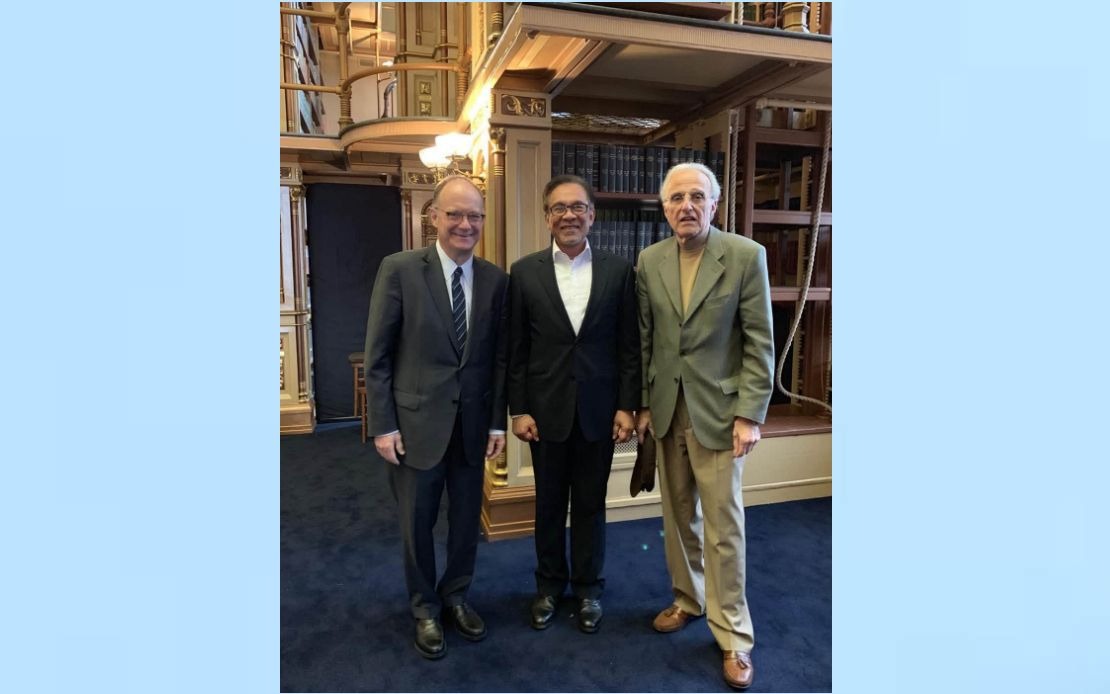
Prime Minister Datuk Seri Anwar Ibrahim has mourned the passing of Professor John L. Esposito, one of the world's foremost authorities on Islamic studies, expressing profound sadness at the loss of a lifelong friend and intellectual mentor. Through a Facebook statement released on July 16, Anwar highlighted Esposito's extraordinary contributions to fostering mutual understanding between Islam and the West during a period when such dialogue faced significant obstacles and widespread misunderstanding.
The relationship between Malaysia's Prime Minister and the acclaimed scholar extended back more than five decades, originating in the early 1970s when the two first encountered one another professionally. This enduring connection transcended the typical academic acquaintance, evolving into a deep personal friendship that weathered decades of geopolitical shifts and intellectual evolution. Anwar's public acknowledgement of this bond underscores the significant influence Esposito wielded over Malaysia's leadership circles and, by extension, the broader Muslim world's engagement with Western institutions and thought.
Esposito distinguished himself through pioneering scholarship that fundamentally reshaped how Western universities approached Islamic studies. Rather than perpetuating orientalist frameworks or reductive characterisations, he established rigorous, nuanced examinations of Islamic history, theology, and contemporary practice. His intellectual legacy extended beyond academic papers into institutional infrastructure—most notably through his establishment of Georgetown University's Centre for Muslim-Christian Understanding, which became a global hub for interfaith scholarship and dialogue. This centre provided critical infrastructure for serious engagement across religious and cultural divides during an era increasingly marked by polarisation.
Among Esposito's scholarly contributions, his co-authored work Makers of Contemporary Islam stands as a particularly influential examination of modern Muslim thinkers and their shaping of contemporary Islamic discourse. The book provided essential context for understanding how diverse Muslim societies and intellectuals grappled with modernity, secularism, and the challenges of the late twentieth century. For Malaysian policymakers and thought leaders, such works offered frameworks for understanding the complex intellectual currents flowing through Muslim-majority societies, including Malaysia itself.
Beyond academic circles, Esposito's most significant impact may have come through his publicly accessible works that brought scholarly rigour to mass audiences. Titles such as What Everyone Needs to Know About Islam and Who Speaks for Islam? addressed widespread ignorance and stereotyping, particularly in Western contexts where misinformation about Islamic faith and practice circulated unchallenged. These books proved especially vital following the September 2001 attacks, when geopolitical tensions reached fever pitch and sensationalised narratives about Islam dominated Western media discourse. Esposito's accessible yet rigorous approach provided counterweight to inflammatory rhetoric and crude generalisations.
Anwar characterised Esposito as someone who deliberately constructed intellectual and cultural bridges precisely where others sought to erect barriers between civilisations. This metaphor captures the essence of Esposito's scholarly mission—to demonstrate that genuine understanding and cooperation between Islamic and Western traditions remained not merely possible but essential. Rather than accepting the civilisational clash narrative that gained traction following Cold War's end, Esposito insisted upon the possibility and necessity of productive dialogue rooted in genuine historical knowledge and mutual respect.
The Prime Minister emphasised that Esposito proved equally formidable in private correspondence and conversation as he was in published work. This observation speaks to an often-overlooked dimension of scholarly influence—the mentoring, guidance, and personal support extended to younger thinkers and leaders navigating complex intellectual and political terrain. Anwar's reference to Esposito standing by him through various personal and professional challenges suggests a relationship of genuine warmth and loyalty rather than merely transactional academic contact.
Esposito's work carried particular resonance for Malaysian audiences and leadership. Malaysia, as a Muslim-majority nation deeply integrated into global economic and political systems, required intellectuals capable of articulating Islamic perspectives while engaging authentically with diverse global traditions. Esposito modelled precisely such engagement—neither apologetic about Islamic history and thought nor dismissive of Western intellectual traditions. His scholarship demonstrated that rigorous engagement with Islamic texts and history could coexist with sophisticated dialogue with non-Muslim scholars and publics.
The Prime Minister extended formal condolences to Esposito's wife Jean and to his broader family and academic community, speaking on behalf of the Malaysian nation. This official government acknowledgement of Esposito's death reflects the esteem in which he was held within Malaysian diplomatic and intellectual circles. His passing represents a genuine loss not only to Islamic studies as a discipline but to the broader project of interfaith and intercultural understanding that remains perpetually fragile and requiring committed guardians.
Anwar concluded by expressing hope that Esposito's scholarship and the dialogue he dedicated his life to building would continue bearing fruit across generations. This sentiment captures the enduring impact of intellectual work that transcends immediate contexts and political circumstances. Though Esposito's voice has been silenced, the institutional structures he helped establish, the students he mentored, and the intellectual foundations he laid remain vital resources for those continuing the work of building genuine understanding across religious and cultural boundaries in an increasingly fractious world.

