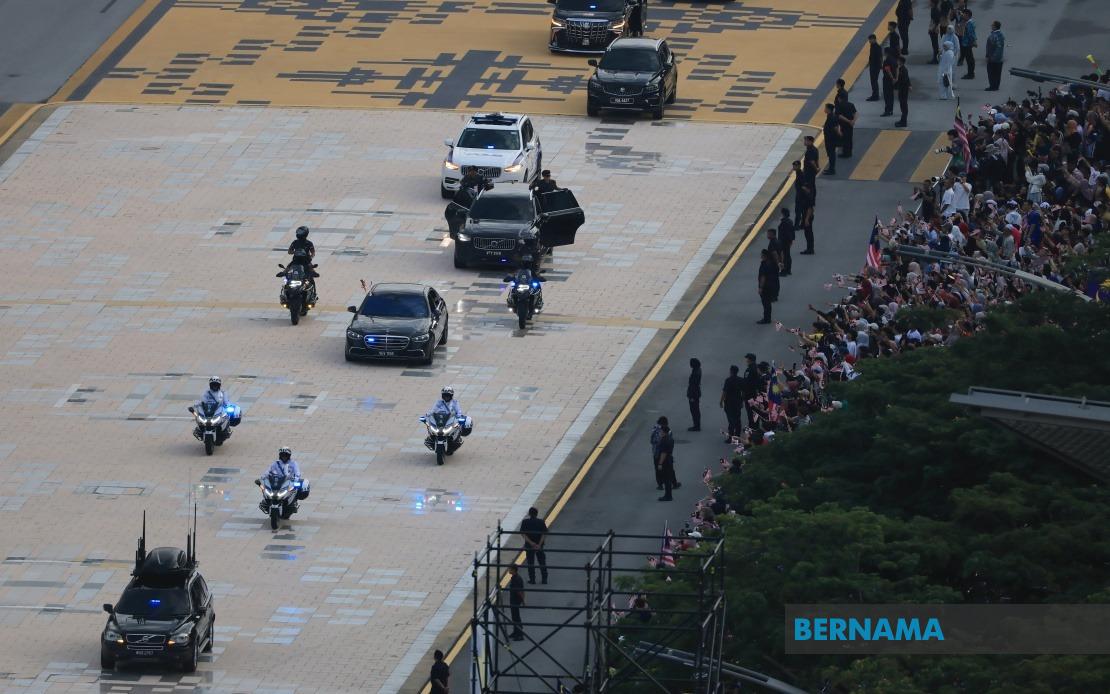
Prime Minister Datuk Seri Anwar Ibrahim, accompanied by his wife Datuk Seri Dr Wan Azizah Wan Ismail, graced the 69th National Day celebration at Dataran Putrajaya on August 31, where they took the royal stage as the Hormat Perdana song resonated through the venue at 7.53 am. The presence of Malaysia's top leadership underscored the significance of the occasion, which drew tens of thousands of citizens and dignitaries to the nation's administrative heart to mark another year of the country's independence journey. Anwar, who holds the dual portfolios of Prime Minister and Finance Minister, arrived shortly after Deputy Prime Minister Datuk Seri Dr Ahmad Zahid Hamidi had taken his position at 7.45 am, setting the tone for a carefully orchestrated ceremonial programme.
The Cabinet's full representation at Dataran Putrajaya demonstrated a unified leadership presence, with key ministers prominently featured throughout the event. Communications Minister Datuk Seri Fahmi Fadzil, who simultaneously chairs the main committee overseeing preparations for the 2026 National Day and Malaysia Day (HKHM) celebrations, attended alongside Home Minister Datuk Seri Saifuddin Nasution Ismail and Defence Minister Datuk Seri Mohamed Khaled Nordin. This broad ministerial turnout reflected the government's commitment to national commemorations and served to reinforce messaging around collective governance during a period when the administration has been navigating multiple policy priorities and economic challenges.
The scale of the national day spectacle underscored Malaysia's capacity for large-scale public ceremonialism. Organisers mobilised 10,819 participants drawn from 76 distinct contingents and engaged 22 marching bands to deliver a comprehensive display of national pride and organisational capacity. The procession incorporated 11 specially decorated vehicles that conveyed thematic messaging, whilst the armed forces and related services deployed 328 assets spanning land, sea and air domains. This substantial military and security presence—alongside 112 working animals deployed for ceremonial purposes—reflected both the logistical complexity of securing a major public gathering and the symbolic importance of defence and order in national identity celebrations.
Innovation featured prominently in this year's staging, with organisers incorporating 22 electric vehicle assets into the parade. This inclusion signalled government messaging around environmental sustainability and technological modernisation, themes increasingly important to Malaysia's positioning within the region and globally. The integration of EV elements into a traditional national day framework reflected evolving priorities within the administration regarding climate commitments and green transition messaging, though their precise role and visibility within the broader ceremony remained understated in ceremonial terms.
The celebration's official theme, "Malaysia MADANI: Kesejahteraan Dinikmati," centred on Anwar's flagship policy framework emphasising shared prosperity and enhanced societal wellbeing. This thematic emphasis connected the ceremonial aspects of national day to broader governance objectives, positioning independence day observance not merely as historical commemoration but as opportunity to project the administration's development vision. The choice to foreground prosperity and welfare concerns reflected contemporary political preoccupations, particularly as Malaysia navigates post-pandemic economic recovery and manages public expectations around cost of living and employment opportunities across the federated states.
Diplomatic participation through foreign delegation attendance added an international dimension to proceedings, enhancing Malaysia's regional standing and reinforcing bilateral relationships at a moment when Southeast Asian geopolitics remain fluid. The presence of international representatives at major national celebrations serves multiple functions: it provides symbolic validation of Malaysia's sovereignty and standing, offers opportunities for informal diplomatic engagement, and demonstrates to domestic audiences the country's integration within wider networks of nations and institutions. Such representations, though often routine, carry cumulative significance in maintaining Malaysia's regional profile.
The comprehensive participation of deputy ministers and various dignitaries alongside the Cabinet created a layered ceremonial structure that involved multiple tiers of government hierarchy. This inclusive approach, typical of Malaysian national day observances, reinforces bureaucratic order and acknowledges the distributed nature of governance across federal and state levels. The physical gathering of these officials at a single ceremonial location temporarily symbolises national cohesion, a particularly valuable messaging opportunity during periods when political divisions or policy disagreements might otherwise dominate public discourse.
Dataran Putrajaya itself carried symbolic weight as the venue for this celebration. Located within the administrative capital, the site naturally positioned the ceremony within governmental space, reinforcing the linkage between state institutions and national identity construction. The choice to centre celebrations in Putrajaya rather than rotating to other cities or states reflected the federal government's preference for maintaining ceremonial control and messaging consistency, though this approach has occasionally generated discussions about regional representation and inclusive celebration frameworks.
The coordination required to execute an event involving over ten thousand participants, hundreds of assets, and precise timing across multiple ceremonial sequences demonstrated substantial organisational capability within government agencies responsible for national day logistics. Communications Minister Fahmi Fadzil's dual role as celebrations chairman positioned him centrally in planning not only the immediate 2024 observance but also preparations for the upcoming 2026 bicentennial celebrations marking both National Day and Malaysia Day anniversaries, suggesting that this year's event served partly as a planning exercise and capability demonstration for more elaborate future commemorations.
National day celebrations in Malaysia function beyond mere commemorative ritual, serving as occasions for governments to reinforce messaging around national identity, project unity across diverse populations, and demonstrate administrative capacity. The 69th National Day gathering at Dataran Putrajaya, with its extensive participation, technological integration, and thematic focus on prosperity and wellbeing, exemplified how Malaysia approaches these occasions as multifaceted political and cultural events. For Malaysia's leaders and citizens alike, such gatherings represent moments of collective reflection on national progress and shared aspirations, anchoring contemporary governance within historical independence achievement.

