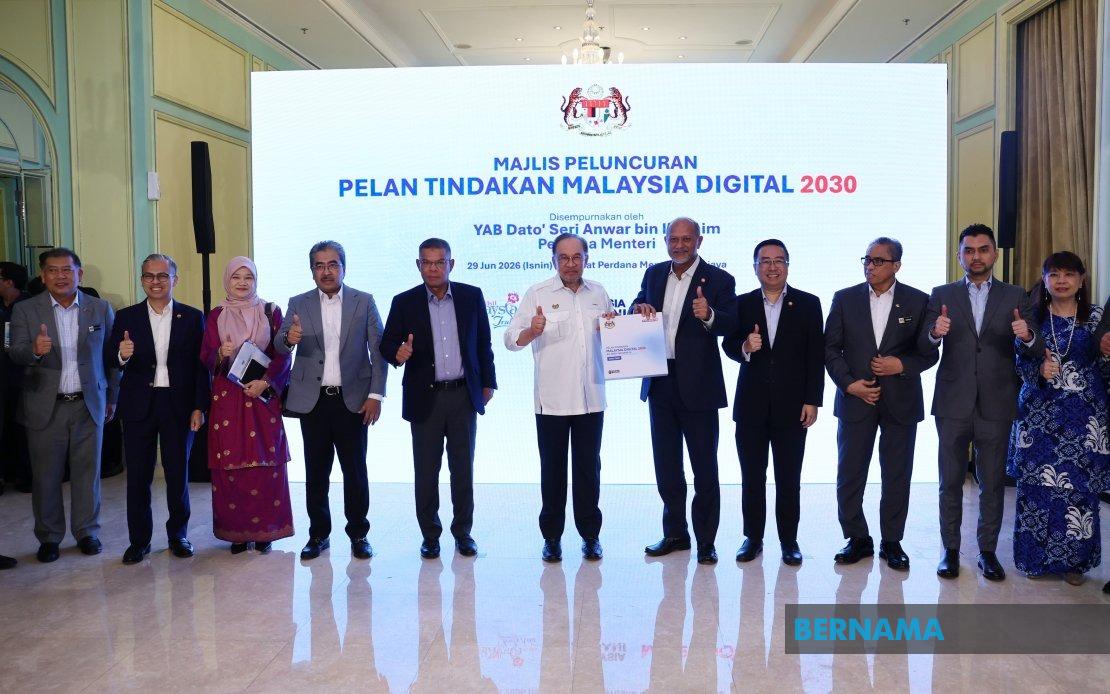
Prime Minister Datuk Seri Anwar Ibrahim has unveiled Malaysia Digital 2030 (MD2030), a comprehensive five-year action plan that represents a fundamental repositioning of the nation's digital ambitions. Rather than remaining a consumer of foreign technology, Malaysia aims to emerge as a domestic producer of innovative digital solutions, underpinned by artificial intelligence capabilities. The strategy, set to span 2026-2030, was launched at a ceremonial event in Putrajaya attended by key government figures including Digital Minister Gobind Singh Deo, Communications Minister Datuk Fahmi Fadzil and Chief Secretary to the Government Tan Sri Shamsul Azri Abu Bakar.
The targets set within MD2030 are notably ambitious and reflect the government's determination to accelerate digital transformation across multiple sectors of the economy. By 2030, officials expect the digital economy to contribute 30 per cent to gross domestic product, a substantial increase from current levels. The plan also envisions the creation of 500,000 high-value digital jobs, addressing longstanding concerns about skills gaps and employment opportunities in tech-driven sectors. Additionally, the government projects generating RM4.5 billion in savings through the digitalisation of public sector operations, while transitioning 95 per cent of government services to fully online, end-to-end delivery platforms.
The structural framework of MD2030 rests on seven interconnected strategic pillars, each addressing a distinct dimension of digital transformation. The Government pillar, overseen by Chief Secretary Shamsul Azri, will establish GovTech Malaysia to modernise public service delivery and administrative efficiency. Investment, Trade and Industry Minister Datuk Seri Johari Abdul Ghani leads the Economy pillar, which seeks to position Malaysia as a regional innovation and digital trade hub by championing "Made by Malaysia" products, accelerating technology adoption within high-growth sectors, and monetising data as a strategic asset. This approach signals recognition that intellectual property and digital assets represent untapped revenue sources for the nation.
The Infrastructure pillar, directed by Communications Minister Fahmi, prioritises expanding broadband connectivity nationwide while developing advanced digital infrastructure encompassing data centres, cloud computing services and smart city applications. This foundation proves essential for realising broader digital ambitions, particularly in underserved rural areas where connectivity gaps persist. Simultaneously, the Talent pillar, headed by Human Resources Minister Datuk Seri R. Ramanan, focuses on preparing Malaysia's workforce for digital economy participation through comprehensive policy frameworks, transition support programmes and positioning the country as a competitive destination for regional and global digital talent.
Social inclusion features prominently within the framework through the Society pillar, led by Women, Family and Community Development Minister Datuk Seri Nancy Shukri. This pillar emphasises equitable participation in the digital ecosystem through formalising a Malaysian Digital Inclusion Index, empowering rural populations and implementing digitally-enabled solutions addressing social challenges. Recognising that digital transformation risks widening inequality if not carefully managed, this dimension ensures vulnerable populations benefit from technological progress rather than being sidelined by it.
The Trust and Security pillar, overseen by Digital Minister Gobind, acknowledges that rapid digital advancement requires robust governance and security safeguards. Implementation of the National Data Commission and development of a National Digital Trust and Data Security Strategy for 2026-2030 aim to protect citizen data while maintaining an innovation-friendly environment. This balancing act proves critical in maintaining public confidence as digital systems penetrate deeper into governance, commerce and daily life. Finally, the Innovation pillar, directed by Science, Technology and Innovation Minister Datuk Chang Lih Kang, strengthens the research-to-commercialisation pipeline through building a comprehensive Research, Development, Commercialisation, Innovation and Economy ecosystem supporting Malaysia's evolution into a technology creator rather than merely an adopter.
Digital Minister Gobind stressed that MD2030 demonstrates Malaysia's readiness to transcend its historical role as a technology importer, moving instead toward becoming a respected originator of digital innovations. He emphasised that beyond achieving economic targets, the Digital Ministry remains committed to anchoring transformation upon foundations of trust, data protection and rigorous governance. The whole-of-government coordination mechanism ensures aligned implementation across all participating agencies, preventing the siloed approach that often undermines national initiatives.
The implementation ecosystem encompasses multiple specialised agencies working in concert toward MD2030 objectives. The National AI Office (NAIO) will coordinate artificial intelligence integration across sectors, whilst GovTech Malaysia handles public sector digitalisation. The Malaysia Digital Economy Corporation (MDEC) develops private sector digital capabilities, CyberSecurity Malaysia secures critical infrastructure and digital assets, MyDIGITAL Corporation manages digital entrepreneurship initiatives, and the Malaysia Centre for the Fourth Industrial Revolution (MYCentre4IR) explores emerging technologies' transformative potential. This distributed yet coordinated architecture leverages each institution's specialisation while maintaining strategic coherence.
For Malaysian stakeholders, MD2030 carries significant implications across multiple dimensions. Business entities operating in designated High Growth High Value sectors may benefit from targeted technology adoption support and favourable intellectual property frameworks. Young professionals entering the workforce gain expanded opportunities within an expanding digital job market, though acquiring relevant skills becomes increasingly essential. Rural communities and lower-income populations should experience improved digital access and services, provided implementation achieves its ambitious inclusivity goals. Internationally, the plan positions Malaysia as a serious contender within Southeast Asia's increasingly competitive digital economy landscape, potentially attracting regional talent and investment flows.
The strategic timing of MD2030's five-year horizon aligns with broader global technological trajectories, particularly accelerating artificial intelligence deployment across industries. By anchoring Malaysia within this transformation as an active participant rather than passive observer, the plan acknowledges both opportunities and risks inherent in rapid technological change. The comprehensive nature of the framework—spanning economic positioning, workforce development, infrastructure, governance, social inclusion and security—suggests sophisticated understanding that digital transformation extends far beyond technological procurement or adoption.
Successful realisation of MD2030's ambitious targets depends substantially on sustained political commitment, adequate resource allocation, effective inter-agency coordination and adaptive implementation mechanisms. The plan's emphasis on creating a favourable environment for Malaysian-origin innovation through intellectual property protections and venture capital mechanisms represents a meaningful departure from earlier strategies emphasising foreign direct investment attraction. Whether Malaysia can transition from consumer to creator of digital technologies—against competition from established innovation hubs and neighbouring Southeast Asian economies—will determine the plan's ultimate significance for the nation's economic trajectory and global technological standing.

