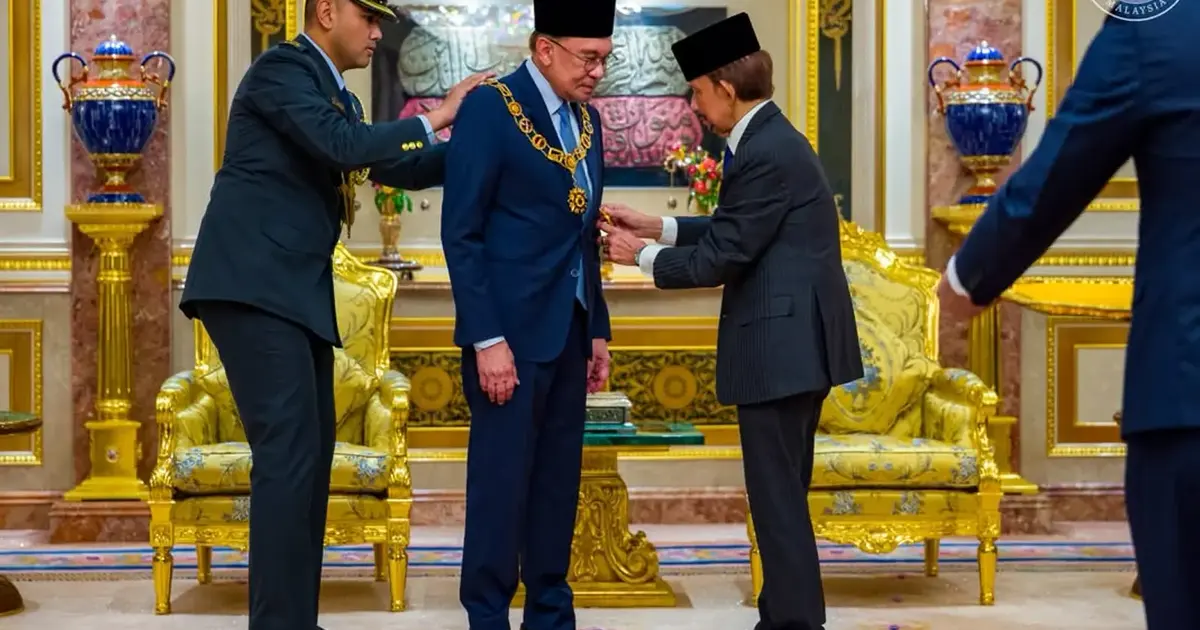
Prime Minister Anwar Ibrahim has received one of Brunei Darussalam's most distinguished honours from Sultan Hassanal Bolkiah, underscoring the strength of diplomatic relations between Malaysia and its neighbour across the South China Sea. The award, the Darjah Kerabat Laila Utama Yang Amat Dihormati (D.K.), represents the highest tier of royal recognition that Brunei extends to foreign dignitaries and reflects the sultanate's respect for Malaysia's leadership.
The conferment of this order carries significant diplomatic weight in Southeast Asia's protocol hierarchy. Such royal honours are typically reserved for heads of government and senior statespersons who have demonstrated exceptional commitment to fostering bilateral relationships. For Anwar, this recognition comes at a time when Malaysia is recalibrating its approach to regional partnerships following the government's policy shifts over the past two years.
Brunei, a small yet strategically important oil and gas-rich sultanate, has long maintained close ties with Malaysia despite their distinct governance structures. The two nations share maritime boundaries, economic interdependencies, and historical connections dating back centuries. Sultan Hassanal Bolkiah, who has ruled since 1967, is known for his measured approach to regional diplomacy and careful cultivation of relationships with neighbouring states, making his choice to honour Anwar a deliberate political statement.
The significance of this award extends beyond ceremonial courtesy. It suggests Brunei's confidence in Malaysia's current leadership trajectory and potentially signals mutual interest in deepening cooperation on regional security matters, trade, and people-to-people exchanges. The sultanate's foreign policy, while often understated compared to its larger neighbours, carries considerable weight given its economic resources and strategic location in Southeast Asia.
Anwar's tenure as prime minister has been marked by efforts to rehabilitate Malaysia's international standing following a period of domestic political turbulence. His administration has prioritised restoring confidence among regional partners and advancing cooperation through ASEAN frameworks. Honours such as this from Brunei validate those diplomatic efforts and provide tangible evidence of Malaysia's reintegration into the regional community's leadership circles.
The Darjah Kerabat Laila Utama Yang Amat Dihormati is part of Brunei's comprehensive honours system, which reflects the sultanate's Islamic monarchy structure. The specific distinction granted to Anwar places him alongside other regional and international figures whom Sultan Hassanal Bolkiah has deemed worthy of such recognition over his lengthy reign. This positioning within Brunei's formal honours framework carries practical implications for Malaysia's bilateral agenda.
For Malaysian readers and observers of regional geopolitics, this development illustrates how ceremonial recognition often precedes or accompanies substantive policy collaboration. Royal honours frequently signal preparedness to deepen engagement on matters ranging from defence cooperation to economic integration. Given the proximity of Malaysian and Brunei territories and their shared maritime interests in the region, such ceremonial affirmation may foreshadow expanded cooperation in areas like energy security and regional stability.
The award also reflects Brunei's subtle but consistent approach to maintaining balanced relationships across Southeast Asia. By honouring Malaysia's prime minister, Sultan Hassanal Bolkiah demonstrates that despite any regional power dynamics or competing interests, his sultanate values stable and cordial relations with its immediate neighbour. This is particularly significant given contemporary geopolitical tensions in the broader region.
Anwar's receipt of this honour positions Malaysia favourably within Brunei's diplomatic orbit at a time when Southeast Asian nations are navigating complex relationships with major powers. The recognition may also encourage other regional partners to engage more actively with Malaysia's current government, creating positive momentum for Anwar's broader diplomatic initiatives across ASEAN and beyond.
Historically, such royal honours have preceded important bilateral agreements or cooperative frameworks. Malaysian officials will likely view this conferment as an opportune moment to advance shared interests with Brunei, whether in trade negotiations, security arrangements, or cultural exchanges. The symbolic value of the award thus translates into practical diplomatic currency that both nations can leverage for mutual benefit.
For the broader Southeast Asian context, the honouring of Malaysia's prime minister by a fellow ASEAN member reinforces the principle that regional stability and respectful engagement between neighbours remain paramount concerns. It demonstrates that despite differences in governance models and scales of economies, the region's sovereigns recognise the importance of maintaining ceremonial respect and formal diplomatic protocols.
The timing and nature of this award suggest that bilateral Malaysia-Brunei relations are entering a potentially productive phase. Both nations share interests in maritime security, counterterrorism cooperation, and economic development in their respective regions. Sultan Hassanal Bolkiah's decision to bestow this honour upon Anwar thus serves as both recognition of past diplomatic efforts and an invitation to expand future cooperation, providing a constructive framework for the two nations to advance their shared regional interests.

