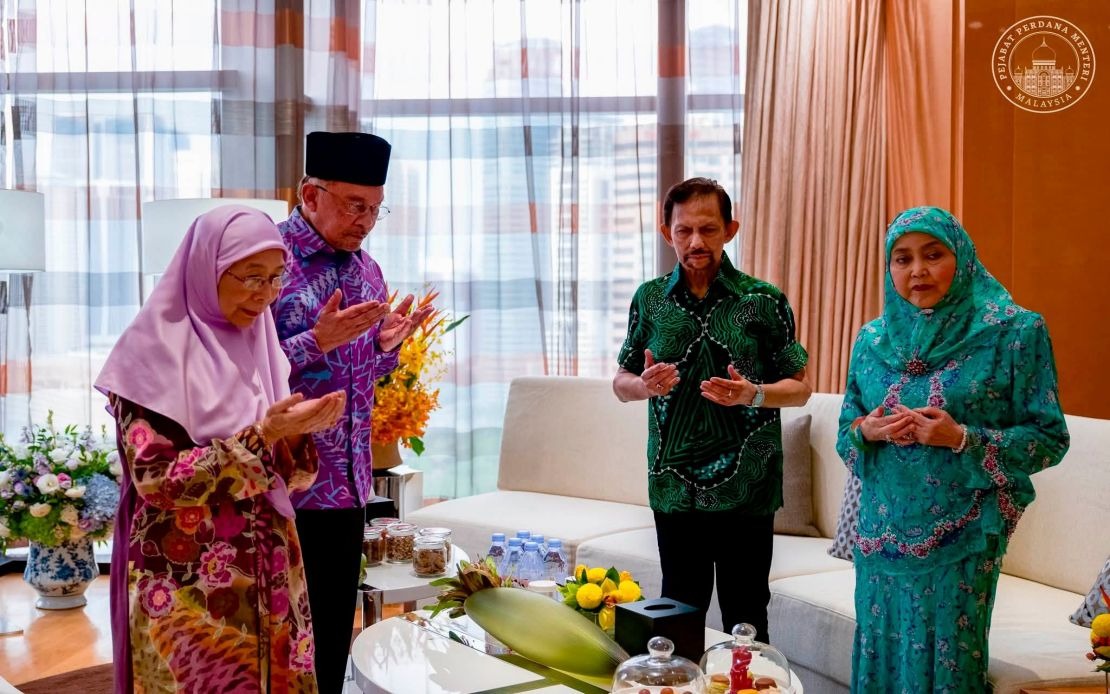
Prime Minister Datuk Seri Anwar Ibrahim has extended formal congratulations to Sultan Hassanal Bolkiah, the reigning monarch of Brunei Darussalam, marking the Sultan's 80th birthday on July 15. The greeting, shared via social media, represents Malaysia's official acknowledgement of a significant personal milestone for one of Southeast Asia's longest-serving rulers and underscores the diplomatic importance Kuala Lumpur places on its relationship with its smaller neighbour.
In his Facebook message, Anwar conveyed wishes not merely in his personal capacity but explicitly representing the Malaysian Government and its citizens. This broader framing elevates the statement from routine diplomatic courtesy to a formal expression of bilateral goodwill, signalling that Malaysia views the occasion as worthy of national-level recognition. The Prime Minister invoked spiritual blessing through the phrase "Insya-Allah," reflecting the Islamic dimension that characterises Malaysia-Brunei relations, both nations being predominantly Muslim monarchies with shared cultural and religious heritage.
The substance of Anwar's message focused on Sultan Hassanal Bolkiah's stewardship of Brunei Darussalam, with explicit hope that His Majesty would "continue to rule Brunei Darussalam with wisdom and prudence." This phrasing carries particular weight given Brunei's position as a resource-rich petrostate navigating complex regional geopolitics, climate pressures, and economic diversification challenges. The emphasis on wisdom and prudence reflects recognition of the Sultan's track record and the expectations placed upon continued measured governance during a potentially turbulent period for Southeast Asian stability.
Central to Anwar's message was a commitment to deepening the Malaysia-Brunei partnership. The Prime Minister explicitly stated his aspiration that "the ties and cooperation between Malaysia and Brunei Darussalam continue to be strengthened for the benefit of both countries and their people." This resonates beyond ceremonial language; Malaysia and Brunei collaborate on maritime boundary issues, economic integration through ASEAN frameworks, and shared security concerns including counter-terrorism operations in the waters separating the two nations. Enhanced bilateral cooperation directly impacts both economies and regional stability.
Sultan Hassanal Bolkiah ascended to the Brunei throne on August 5, 1967, making him the 29th Sultan in Brunei's dynastic lineage. His reign spans nearly six decades, a period witnessing profound global transformation including Brunei's 1984 independence from British protection, the development of its hydrocarbon industry into a major regional economic force, and the nation's evolution into a wealthy micro-state with outsize diplomatic influence. His birthday on July 15 commemorates his birth in 1946 in Bandar Brunei, the capital subsequently renamed Bandar Seri Begawan.
Sultan Hassanal Bolkiah's status acquired new international prominence following the death of Queen Elizabeth II in September 2022. That event triggered a succession mechanism that elevated the Brunei monarch to the position of world's longest-reigning sovereign currently reigning. This distinction carries symbolic significance far beyond ceremonial precedence; it positions Brunei's ruler as a repository of institutional memory and diplomatic experience at a time when regional leadership transitions occur with increasing frequency. The Sultan's longevity provides continuity and institutional knowledge increasingly rare among global leaders.
From a Malaysian perspective, maintaining robust relations with Brunei serves multiple strategic interests. Economically, the nations share trade relationships and participate in ASEAN economic integration mechanisms that benefit both populations. Strategically, Brunei's position on the island of Borneo, where it borders Sarawak, creates natural points of cooperation on border administration, resource management, and counter-insurgency operations. Diplomatically, both nations operate within ASEAN and ASEAN Regional Forum structures, where coordinated positions strengthen collective voice in regional affairs.
The bilateral relationship carries religious and cultural dimensions particularly important in contemporary Southeast Asia. Both Malaysia and Brunei are Islamic monarchies whose constitutional frameworks embed Islamic law and principles. Regular high-level exchanges, including birthday acknowledgements like Anwar's message, reinforce these connections and demonstrate commitment to shared values in an increasingly polarised global environment. Such gestures, while seemingly ceremonial, accumulate to build diplomatic capital and goodwill essential for resolving inevitable friction points between neighbouring states.
Looking forward, the emphasis in Anwar's message on continued cooperation acquires added significance given mounting regional challenges. Climate change threatens both nations' economies and populations, requiring coordinated environmental responses. Maritime security concerns in the South China Sea and waters around Borneo demand close intelligence and operational coordination. Economic diversification pressures, particularly acute in resource-dependent economies like Brunei, create incentives for deeper integration and knowledge-sharing. The Prime Minister's message implicitly acknowledges that the coming years will test both nations' commitment to partnership and that continued dialogue at the highest levels remains essential.

