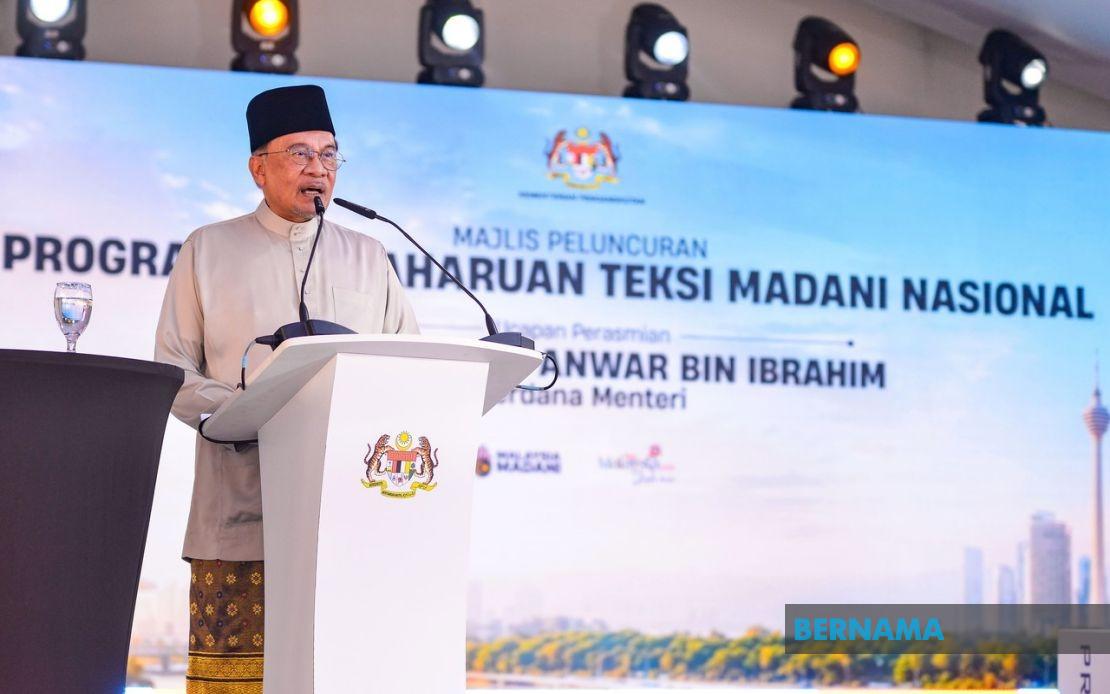
Prime Minister Datuk Seri Anwar Ibrahim has committed an extra RM10 million towards the Vehicle Replacement Matching Grant Programme, marking a significant escalation in the government's push to modernise Malaysia's taxi industry. The announcement, made at the launch of the National MADANI Taxi Reform Programme at Dataran Merdeka, brings total funding for the initiative to RM20 million and signals the administration's determination to address the pressing issue of ageing vehicles operating on Malaysian roads.
Anwar, who also holds the portfolio of Finance Minister, attributed the additional investment to the robust uptake of the scheme since its initial RM10 million allocation was unveiled in Budget 2026. The strong response from taxi operators across the country provided sufficient impetus for the government to immediately approve supplementary funds, underscoring the genuine demand within the sector for modernisation support. This swift follow-up action demonstrates the government's responsiveness to industry feedback and its recognition that taxi drivers require tangible financial assistance to transition away from older vehicles that pose safety and environmental concerns.
The transport sector has long grappled with the prevalence of older taxis on Malaysian roads, many of which have exceeded their optimal operational lifespan. Beyond safety considerations, aging vehicles contribute disproportionately to emissions and reduce service quality for the travelling public. The government's intervention through the matching grant scheme aims to reverse this trend by making vehicle replacement financially viable for individual operators who might otherwise lack capital for such investments. By covering a portion of replacement costs, the scheme effectively reduces the financial burden on drivers while encouraging fleet renewal across the country.
A particularly noteworthy element of the reform package involves a dedicated partnership with Proton and the Transport Ministry to develop customised financing arrangements for taxi drivers interested in the Proton S70 model. This collaboration creates a direct pathway for operators to access both affordable credit and a vehicle specifically suited to commercial taxi operations. The move represents a strategic attempt to bolster the local automotive industry whilst simultaneously delivering practical solutions to taxi operators. By tying the financing scheme to a locally produced model, the government also signals its commitment to supporting domestic manufacturing and maintaining the competitiveness of Malaysia's automotive sector in the face of regional competition.
The National MADANI Taxi Reform Programme encompasses more than mere vehicle replacement incentives. It reflects a comprehensive approach to addressing structural challenges within the taxi industry, which has faced mounting pressure from ride-hailing platforms and changing consumer preferences over the past decade. The government's willingness to invest substantial resources suggests recognition that the traditional taxi sector remains strategically important for last-mile connectivity, employment, and public mobility, particularly in areas where ride-hailing services remain limited or unavailable.
Several senior government figures attended the launch event, including Transport Minister Anthony Loke, Minister in the Prime Minister's Department (Federal Territories) Hannah Yeoh, and Chief Secretary to the Government Tan Sri Shamsul Azri Abu Bakar. This high-level attendance underscores the political importance attributed to taxi industry reform within the broader MADANI economic framework. The collective presence of these officials signals cross-ministry coordination and demonstrates that the initiative enjoys support across multiple government portfolios, a prerequisite for effective implementation.
For Malaysian taxi drivers, the expanded allocation provides tangible relief from the financial constraints that have long hindered vehicle modernisation. Many operators continue driving vehicles that are over a decade old, partly due to limited access to financing and partly owing to the erratic income patterns characteristic of taxi work. The matching grant scheme, coupled with dedicated Proton financing arrangements, substantially lowers the barrier to entry for vehicle replacement. This two-pronged approach—direct grants combined with accessible credit—recognises the heterogeneous financial circumstances within the taxi driver community and attempts to accommodate different pathways to vehicle ownership.
The timing of this announcement is particularly significant given Malaysia's broader economic context. As the government pursues MADANI-aligned objectives centred on enhancing living standards and supporting lower-income workers, investments in taxi driver welfare align with these stated priorities. Taxi operators, many of whom operate as self-employed individuals or small proprietors, constitute an economically vulnerable segment that has experienced mounting pressures from technological disruption and shifting mobility patterns. Government support of this nature can help stabilise livelihoods whilst simultaneously addressing legitimate public concerns regarding road safety and environmental quality.
From a regional perspective, Malaysia's approach to taxi industry modernisation provides a potential model for other Southeast Asian nations grappling with similar issues. While ride-hailing services have disrupted traditional taxi markets across the region, wholesale abandonment of taxi sector support risks creating employment crises and exacerbating mobility gaps in underserved areas. Malaysia's strategy of coupling financial incentives with partnerships between government, automotive manufacturers, and transport operators suggests a more nuanced approach that seeks coexistence rather than displacement.
The success of this expanded initiative will depend substantially on implementation efficiency. Distribution mechanisms must ensure that funds reach intended beneficiaries smoothly, and Proton's financing scheme must offer terms genuinely accessible to drivers operating on modest margins. Monitoring mechanisms will also be necessary to verify that replacement vehicles are actually entering service rather than being redirected to secondary markets or speculation. Beyond immediate vehicle replacement, sustained support for driver training, vehicle maintenance standards, and fare regulation frameworks will likely prove essential for achieving the broader objectives of taxi industry revitalisation.
Looking forward, this investment signals the government's recognition that traditional transport modes require proactive support to remain viable in an increasingly competitive mobility landscape. Rather than allowing market forces alone to determine the taxi industry's future, the Malaysian government has chosen active intervention through capital infusion and financing partnerships. Whether this proves sufficient to ensure long-term sector sustainability will become apparent as the scheme matures and measurable outcomes become observable across Malaysian cities.

