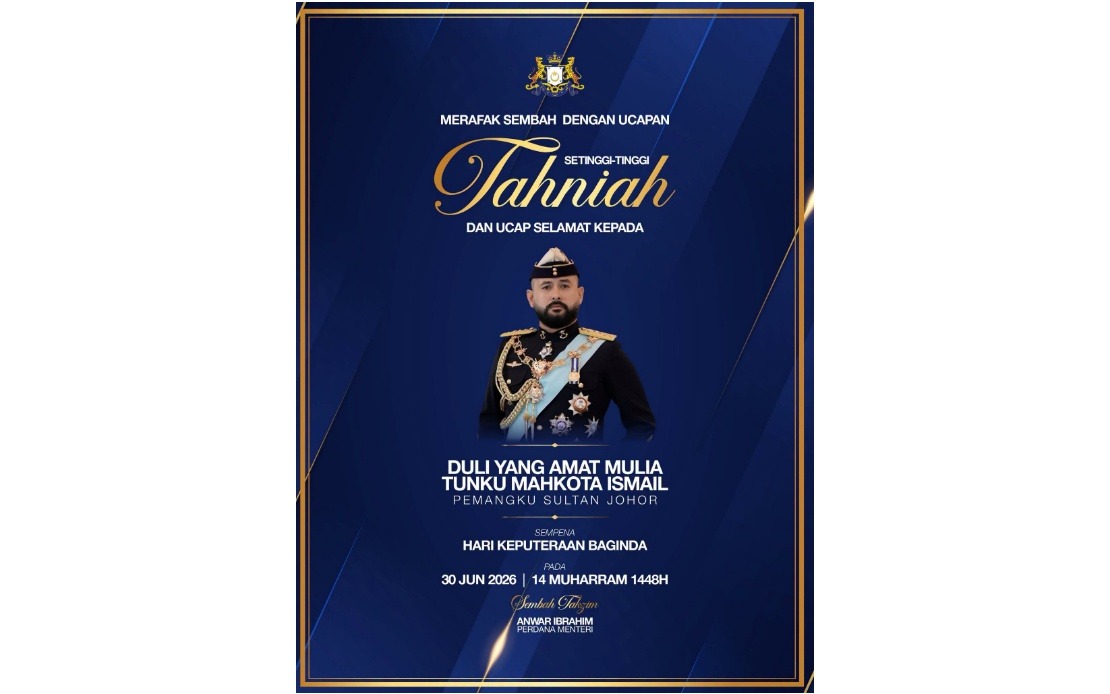
Prime Minister Datuk Seri Anwar Ibrahim and Deputy Prime Minister Datuk Seri Dr Ahmad Zahid Hamidi have offered their birthday congratulations to Tunku Mahkota Ismail, the Regent of Johor, marking the occasion with public messages of goodwill and spiritual blessings on June 30.
Through a Facebook announcement, Anwar conveyed his formal felicitations to the royal dignitary, accompanied by prayers for the Regent's sustained physical health and continued prosperity. The Prime Minister's gesture reflects the customary practice of senior government officials acknowledging important dates within Malaysia's royal establishments, reinforcing the constitutional relationship between the executive branch and the institution of royalty.
Ahmad Zahid Hamidi similarly took to social media to express his well-wishes, framing his message within a religious context by invoking divine favour for the Regent's wellbeing. The Deputy Prime Minister's statement went further by explicitly referencing the Regent's role in governing Johor Darul Ta'zim and serving the interests of Bangsa Johor, thereby linking personal birthday acknowledgement with recognition of official responsibilities and leadership.
Tunku Mahkota Ismail holds significant constitutional standing within Malaysia's federal system. As Regent of Johor, one of the country's largest and most economically important states, he exercises considerable influence over state affairs and represents continuity within the royal hierarchy. His position carries particular relevance given Johor's strategic location in the southern peninsula, its substantial economic contributions, and its historical role in Malaysian governance.
The public nature of these birthday greetings underscores the diplomatic importance attached to maintaining harmonious relations between the federal government and state-level royal institutions. In Malaysia's constitutional monarchy framework, regular expressions of respect and goodwill between prime ministers and state rulers serve as important ceremonial reinforcements of the social contract that underpins the nation's political system.
For Malaysian readers, such courtesies represent more than mere formality. They demonstrate adherence to protocol and cultural values that emphasize respect for traditional institutions. These gestures carry significance particularly in Johor, where royal authority commands deep-rooted public support and where the Regent's position intersects with both state governance and national affairs.
The timing of these birthday messages also reflects broader patterns in Malaysian political communication. Senior government figures routinely acknowledge significant dates connected to royal family members, religious observances, and national commemorations through official statements. This consistent practice helps maintain the delicate balance between executive authority and monarchical institutions that characterizes Malaysian democracy.
Ahmad Zahid Hamidi's specific mention of the Regent's role in providing governance wisdom and protection to Johor residents adds a substantive dimension to what might otherwise be purely ceremonial acknowledgement. By connecting personal wishes with recognition of official duties, the Deputy Prime Minister frames the birthday greeting as part of a broader narrative about effective leadership and state administration.
Tunku Mahkota Ismail's position within the royal hierarchy has evolved significantly over recent years, with his profile increasing both within Johor and at the national level. Recognition of his birthday by the country's top political figures reflects his importance to Malaysia's institutional architecture and signals continued government commitment to working constructively with state-level rulers across all thirteen Malaysian states.
For observers of Malaysian politics, these birthday messages offer insight into the contemporary state of centre-state relations and the degree to which federal leadership actively maintains symbolic connections with royal institutions. The fact that both the Prime Minister and Deputy Prime Minister felt compelled to offer formal greetings suggests they place meaningful value on cultivating positive relationships with Johor's leadership, an orientation that carries implications for broader federal-state cooperation on policy matters ranging from economic development to infrastructure investment.

