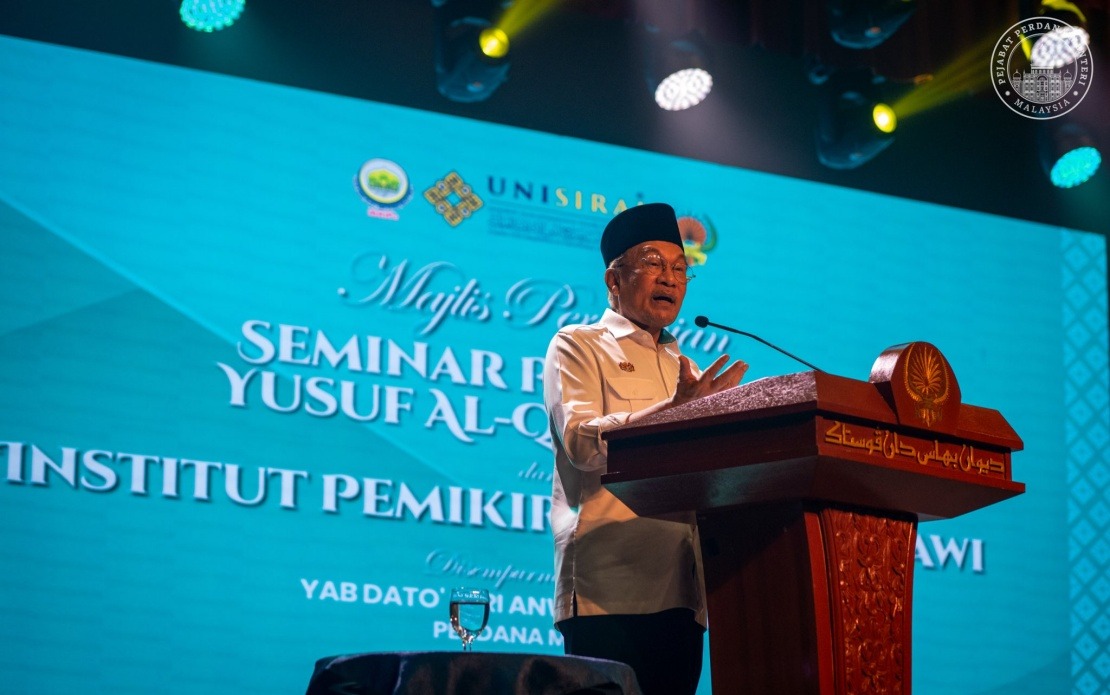
Prime Minister Datuk Seri Anwar Ibrahim has committed RM2 million in MADANI Government funding to the Al-Qaradawi Thought Institute, marking a significant investment in preserving and advancing the scholarly legacy of Sheikh Dr Yusuf Al-Qaradawi. The announcement came during the inaugural ceremony of both the Yusuf Al-Qaradawi Thought Seminar and the formal establishment of the institute at Wisma Dewan Bahasa dan Pustaka in Kuala Lumpur on July 21, underscoring the government's recognition of the Islamic scholar's enduring influence on Malaysian Islamic intellectual discourse.
The funding allocation reflects the Prime Minister's personal veneration for Al-Qaradawi and the profound intellectual debt he acknowledges owing to the prominent Islamic theorist. Through a statement shared on social media, Anwar expressed his gratitude for the scholar's ideological contributions, moral encouragement, and the bonds of genuine friendship that transcended geographical and institutional boundaries. The Premier framed the initiative as part of broader efforts to ensure that Al-Qaradawi's body of work continues to enrich contemporary Islamic thought and provide guidance to the Muslim community in navigating modern complexities.
Anwar's formative engagement with Al-Qaradawi's thinking traces back to his involvement with the Malaysian Islamic Youth Movement (ABIM) during the 1980s, a transformative period when Islamic revivalism was gaining considerable momentum across the Muslim world. The Prime Minister reflected on how the Islamic scholar's intellectual interventions proved instrumental in shaping the trajectory of Islamic discourse in Malaysia during this critical juncture, when competing ideologies and methodologies were vying for influence within religious circles. This historical context helps explain why the government views the establishment of a dedicated research institute as both a scholarly endeavour and a matter of national intellectual significance.
Particularly noteworthy is Al-Qaradawi's counsel to ABIM leadership during the early 1980s surge of Islamic activism, when he advocated for moderation and intellectual openness as counterweights to increasingly rigid interpretations of Islamic teaching. The Islamic scholar's treatise to ABIM deliberately emphasised the principle of wasatiyyah—often translated as the middle path or balanced approach—urging the movement to resist hardline tendencies and remain receptive to diverse perspectives. Anwar has characterised this guidance as strategically vital during an era when fervent ideological commitments sometimes fostered insularity and resistance to intellectual pluralism within Islamic movements across the region.
The concept of wasatiyyah that Al-Qaradawi championed represents a foundational philosophical orientation that continues to resonate throughout Malaysian Islamic policy and pedagogy. Rather than viewing Islamic teaching as monolithic or immune to contextual adaptation, the moderate framework encourages scholars and religious leaders to engage seriously with contemporary challenges while remaining rooted in Islamic principles. For Malaysia specifically, this intellectual tradition has provided theological grounding for the state's efforts to position itself as a moderate Islamic nation in an increasingly complex geopolitical landscape where narratives of Islamic authenticity often compete with demands for social pluralism and pragmatic governance.
Anwar characterised Al-Qaradawi as an agent of transformation and a true embodiment of intellectual zeitgeist—a mover and shaper of the spirit of the age who managed to synthesise Islamic tradition with forward-thinking reform impulses. Rather than treating Islamic scholarship as an exercise in antiquarian preservation, the late scholar demonstrated how careful engagement with original Islamic sources could generate fresh insights applicable to modern dilemmas ranging from economic justice to interfaith relations. This interpretive approach has proven influential among Malaysian Islamic intellectuals and policymakers who seek to establish Islam's relevance without abandoning theological integrity or cultural particularity.
The establishment of the Al-Qaradawi Thought Institute carries implications extending beyond academic circles into broader questions of how Southeast Asian Muslim-majority societies articulate their identities in relation to global Islamic movements. Malaysia, with its multiethnic and multireligious composition, has long needed robust intellectual frameworks that combine Islamic authenticity with inclusive governance principles. Al-Qaradawi's intellectual legacy, particularly his insistence on adaptability and openness to competing viewpoints, provides resources for navigating these challenges in ways that affirm Muslim identity while respecting constitutional pluralism and democratic norms.
The timing of this government investment also signals continuity in Malaysia's commitment to promoting moderate Islamic thought within the region and beyond. As Southeast Asia grapples with diverse challenges ranging from religious extremism to questions about Islam's role in pluralist democracies, having well-resourced research institutions dedicated to studying moderate Islamic scholars becomes increasingly important. The Al-Qaradawi institute will presumably generate publications, host seminars, and facilitate scholarly networks that can influence intellectual discourse in Malaysian universities, religious institutions, and government policy circles.
Funding allocations of this scale typically reflect government priorities and societal values, and the RM2 million commitment demonstrates official recognition that investing in Islamic intellectual history constitutes an investment in Malaysia's cultural and political future. Rather than viewing support for Islamic scholarship as peripheral to national concerns, the government positions engagement with moderate Islamic thought as central to maintaining social cohesion and preventing ideological extremism. This perspective aligns with broader international trends where many Muslim-majority governments have expanded state support for institutions studying Islamic history, jurisprudence, and ethics as part of comprehensive counter-extremism and nation-building strategies.
The Institute's research agenda will likely focus on unpacking Al-Qaradawi's voluminous contributions to Islamic jurisprudence, ethics, and social philosophy, making these materials accessible to contemporary audiences facing novel questions that the scholar himself may not have directly addressed. By systematically studying his methodological approaches and intellectual principles, researchers can extract frameworks applicable to emerging issues in areas such as bioethics, environmental stewardship, and digital society governance. This type of theoretical and applied research creates intellectual capital that Malaysian and regional Islamic institutions can draw upon when formulating responses to contemporary challenges.
For Malaysian readers and regional observers, this initiative represents a notable moment in how the country positions itself at the intersection of global Islamic thought and Southeast Asian political realities. The commitment to establish an institute dedicated to a cosmopolitan Islamic scholar known for intellectual flexibility and emphasis on moderation sends clear signals about the kind of Islamic identity Malaysia aspires to cultivate and promote internationally. As the region continues to navigate complex questions about religious identity, democratic governance, and economic modernisation, the resources devoted to understanding and advancing Al-Qaradawi's intellectual legacy may prove consequential for shaping how Malaysian and Southeast Asian Muslims engage with both their religious traditions and their societies' plural character.

