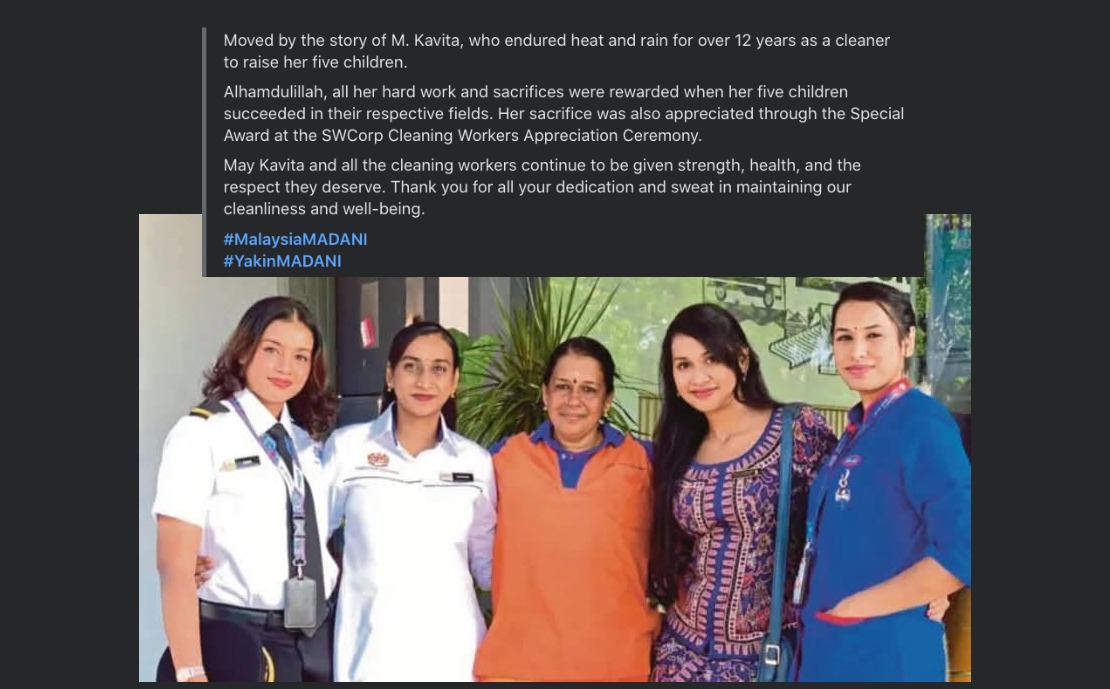
Prime Minister Datuk Seri Anwar Ibrahim has highlighted the remarkable story of M. Kavita, a street sweeper whose unwavering dedication to her family while maintaining a demanding sanitation job has become an inspiring example of parental sacrifice and perseverance in Malaysia. Through a public Facebook post, Anwar acknowledged how Kavita's more than 12 years of labour in harsh weather conditions enabled her five children to achieve success across various professional fields, a testament to her commitment despite the physical and emotional toll of her work.
Kavita's narrative gained widespread attention across social media platforms when her daughters orchestrated a touching surprise celebration during her 50th birthday last month. The children, who have since established themselves in respected careers, arranged to visit their mother at her workplace in Seremban while wearing their professional uniforms. The display of their achievements—ranging from a pilot and cabin crew member to a registered staff nurse—visibly moved Kavita, who was overwhelmed with emotion at witnessing the tangible results of her years of sacrifice and determination.
The Prime Minister's public recognition carries significant weight in a society where sanitation workers often remain invisible despite their essential contribution to public health and urban cleanliness. Anwar's statement emphasised that Kavita's extended period of labour across all weather conditions represented not merely employment but a profound commitment to her children's future opportunities. By contextualising her work within the broader framework of family welfare and personal development, the Prime Minister elevated the narrative from a simple success story to a commentary on the dignity inherent in all forms of labour that sustains communities.
Beyond the Prime Minister's acknowledgment, Kavita received formal recognition when SWCorp presented her with a Special Award during its Cleaning Workers' Day Appreciation ceremony. This institutional recognition, occurring alongside Anwar's tribute, signals an official shift toward acknowledging the contributions of Malaysia's sanitation workforce—individuals whose daily efforts directly impact public health infrastructure yet frequently labour without visible appreciation or acknowledgment from leadership. The timing of these recognitions underscores a growing awareness of the crucial role cleaning workers play in maintaining urban environments.
Kavita's employment with SWM Environment in Seremban exemplifies the pathway available through Malaysia's structured sanitation services, where municipal contracts provide stable employment for individuals seeking reliable income sources. Her tenure spanning more than a decade demonstrates not only her personal resilience but also the viability of sanitation work as a sustainable career option, particularly for those with limited alternative employment opportunities. The stability of her position enabled her to invest consistently in her children's education and development, illustrating how regular municipal employment can serve as a foundation for intergenerational advancement.
The success of Kavita's five children across diverse professional sectors—aviation, nursing, and other fields—reflects both her individual determination and the broader Malaysian education system's accessibility to talented students from economically disadvantaged backgrounds. Each daughter's achievement in sectors requiring formal qualifications and professional certification demonstrates that socioeconomic circumstances at birth need not predetermine educational or career outcomes. Their professional choices also showcase the variety of opportunities available within Malaysia's developed economy for those who pursue formal training and credentials.
The emotional dimension of Kavita's story—her visible tears upon witnessing her daughters' success in their professional uniforms—resonates deeply within Malaysian cultural contexts that emphasise filial piety, family loyalty, and maternal sacrifice. The daughters' gesture of visiting their mother at her workplace while displaying their professional attire represented not merely celebration but an explicit acknowledgment of the connection between her sacrifices and their achievements. This family-centred narrative appeals to values that remain central to Malaysian society across various communities and socioeconomic groups.
The viral spread of Kavita's story through social media indicates broader public hunger for narratives that challenge stereotypes about sanitation workers and demonstrate pathways to upward mobility. In an era where social media often amplifies divisive or negative content, the widespread sharing of Kavita's achievement story suggests that Malaysian audiences actively seek and celebrate examples of perseverance and family success. The story's resonance extends beyond mere entertainment value to touch fundamental questions about work, dignity, and opportunity in contemporary Malaysia.
For Malaysian readers and policymakers, Kavita's trajectory offers several relevant considerations. Her story highlights both the possibilities and constraints within current economic structures—while her dedication achieved remarkable results for her family, it also underscores the demanding nature of sanitation work and the significant personal sacrifice required of workers in this sector. The recognition from both the Prime Minister and institutional bodies may help shift cultural perceptions toward greater respect for essential service workers, potentially influencing workplace policies, compensation structures, and social attitudes toward sanitation employment.
Anwar's public tribute specifically acknowledged not only Kavita's past achievements but also extended recognition to all street sweepers and cleaning workers, positioning her story within a broader context of systemic contribution. His statement included an explicit call for society to grant these workers the respect their essential labour deserves, alongside wishes for their continued health, strength, and wellbeing. This framing transforms Kavita's individual accomplishment into a catalyst for broader conversations about labour dignity and social recognition across Malaysia's service sectors.
The convergence of personal triumph, public recognition, and institutional acknowledgment in Kavita's story illustrates how individual narratives can illuminate larger structural realities within Malaysian society. Her journey demonstrates both the resilience of working families and the tangible rewards that educational commitment and professional development can yield. As Malaysia navigates questions of inclusive economic growth and social mobility, stories like Kavita's provide concrete evidence that advancement remains possible for those willing to invest extraordinary effort, while simultaneously suggesting that systemic support structures could make such achievements less dependent on individual sacrifice alone.

