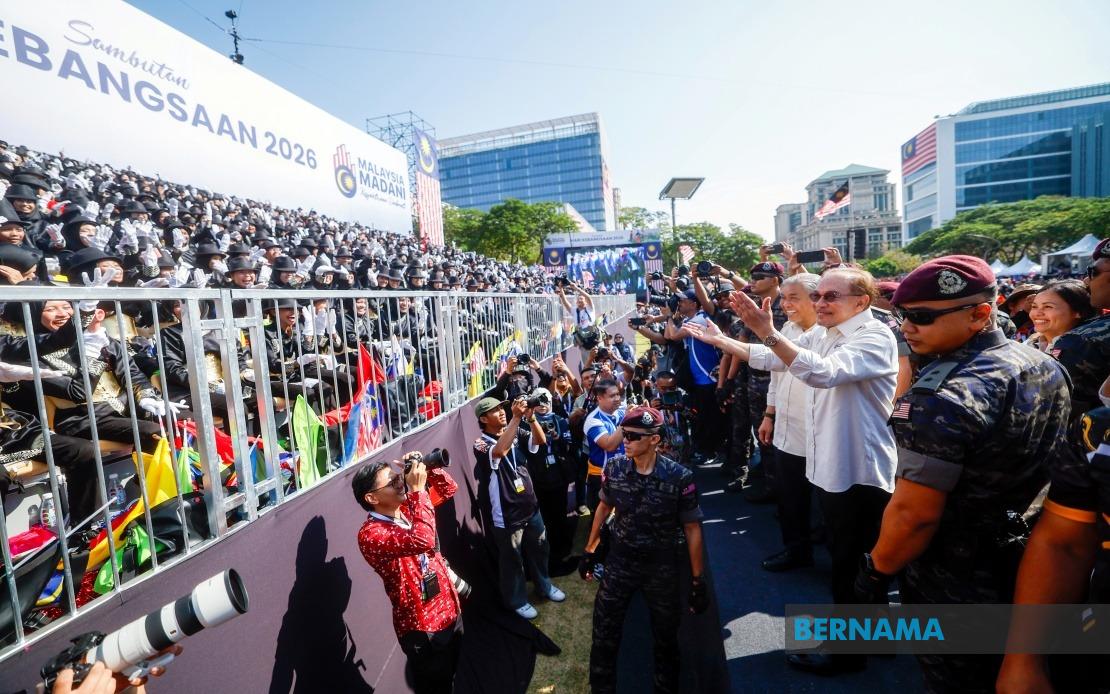
Prime Minister Datuk Seri Anwar Ibrahim lavished praise on the nation's patriotic spirit on Saturday as Malaysia observed its 69th National Day with a grand celebration at Dataran Putrajaya. Addressing reporters shortly after reviewing the elaborate military parade and street procession, Anwar expressed satisfaction with the scale and quality of the event, underscoring what he described as a demonstration of Malaysian unity and national pride. His remarks reflected the government's effort to position the National Day festivities as a barometer of public sentiment and cohesion at a time when the administration is pursuing its Malaysia MADANI agenda centred on citizen welfare.
The festivities drew an impressive turnout of over 100,000 people to the federal administrative centre, with many having camped overnight to secure vantage points along the parade route. The scale of public engagement signals sustained interest in the annual commemoration despite prevailing challenges. The celebration commenced at 8 am under the patronage of His Majesty Sultan Ibrahim and Her Majesty Raja Zarith Sofiah, who were received by Anwar and his wife, Datuk Seri Dr Wan Azizah Wan Ismail, along with Communications Minister Datuk Seri Fahmi Fadzil, who chairs the National Day organising committee.
After the formal proceedings concluded, Anwar spent considerably more than an hour mingling with spectators, walking across the Dataran grounds for distances exceeding 500 metres while stopping to engage in conversations and accommodate photography requests. This extended public interaction contrasts with the formality of the ceremonial aspects and underscores the administration's emphasis on accessibility and direct engagement with ordinary citizens. The informal segment provided a platform for grievances and appreciation to be voiced directly to the Prime Minister, with one member of the public taking the opportunity to personally thank Anwar for recent policy adjustments affecting fuel subsidies.
The parade itself constituted an elaborate display of national pageantry, with the theme "Malaysia MADANI: Kesejahteraan Dinikmati" serving as the overarching narrative. The spectacle involved 10,819 participants distributed across 76 contingents and 22 marching bands, supplemented by 11 decorated vehicles and 328 military, naval, and air force assets. The organisers also incorporated 112 service animals and an emerging element of 22 electric vehicles, reflecting governmental emphasis on environmental sustainability. A human graphics performance utilised terraces as a backdrop, introducing contemporary creative elements to the traditional parade format.
The event's showcase of the Malaysia MADANI vision represents the government's attempt to crystallise its policy framework through visual and symbolic representation at the nation's most significant annual civic celebration. The emphasis on citizen well-being and respect for diversity embedded in the theme resonates with broader policy initiatives the administration has pursued since assuming office. For many Southeast Asian observers, Malaysia's ability to stage such large-scale public events while maintaining order and inclusivity reflects its position as a relatively developed democracy in the region.
The timing of the celebration proved significant given that Anwar had delivered his National Day Prime Minister's Address just 24 hours earlier, during which he unveiled six major government initiatives aimed at improving public welfare. The announcements appeared strategically timed to maximise public awareness and positive sentiment heading into the celebrations themselves. This sequencing demonstrates coordinated messaging designed to link policy announcements directly with patriotic occasions and public engagement opportunities.
Among the most impactful announcements was the restoration of the monthly fuel subsidy quota for RON95 petrol under the BUDI MADANI RON95 programme from 200 litres to 300 litres monthly. This adjustment benefits approximately 16 million users of subsidised fuel across the nation, constituting a substantial portion of the driving population. The measure addresses longstanding complaints regarding insufficient monthly allocations and effectively increases household purchasing power for transport-dependent citizens. The positive reception from parade attendees, as evidenced by public expressions of gratitude, suggests the policy resonates with lower and middle-income earners.
Parallel to the RON95 adjustment, the government also expanded support for commercial and utility vehicle operators. From September 1 onwards, more than 500,000 eligible owners of diesel-powered pickup trucks and jeeps became eligible to receive up to 400 litres of BUDI Diesel monthly. This initiative targets agricultural and small business operators who depend on diesel-powered vehicles for their livelihoods, representing an attempt to broaden subsidy benefits beyond passenger vehicle users. The staggered implementation date allowed the government to spread administrative deployment of the initiative.
For Malaysian readers, particularly those in lower-income brackets dependent on fuel subsidies, these policy adjustments carry immediate and tangible implications for household budgets and operational costs. In the broader Southeast Asian context, Malaysia's continuation of substantial fuel subsidy programmes distinguishes it from neighbours pursuing market-based approaches, reflecting distinctive political economy choices rooted in the nation's resource endowments and democratic contestation.
Anwar's visible engagement with crowds and his emphasis on direct public interaction suggest the administration recognises the importance of maintaining momentum in public perception management, especially as inflationary pressures and cost-of-living concerns persist across household budgets. The National Day occasion provided a platform to simultaneously celebrate national identity while reinforcing recent policy achievements designed to address economic pressures facing ordinary citizens.
The elaborate parade production, involving coordination across military services, civilian agencies, and volunteer contingents, also demonstrates the continued capacity of Malaysia's state apparatus to mobilise resources and personnel for large-scale national events. The integration of emerging technologies such as electric vehicles within the traditional parade format signals an attempt to position Malaysia as simultaneously respectful of heritage and forward-looking in environmental consciousness.
Looking ahead, the combination of policy announcements, high public turnout, and visible political leadership engagement suggests the government intends to leverage the National Day period as a strategic opportunity to rebuild public confidence in economic stewardship. Whether these subsidy restorations translate into sustained public approval will depend on their durability amidst broader fiscal pressures and whether complementary policies addressing inflation and employment prove sufficient to offset cost-of-living anxieties.

