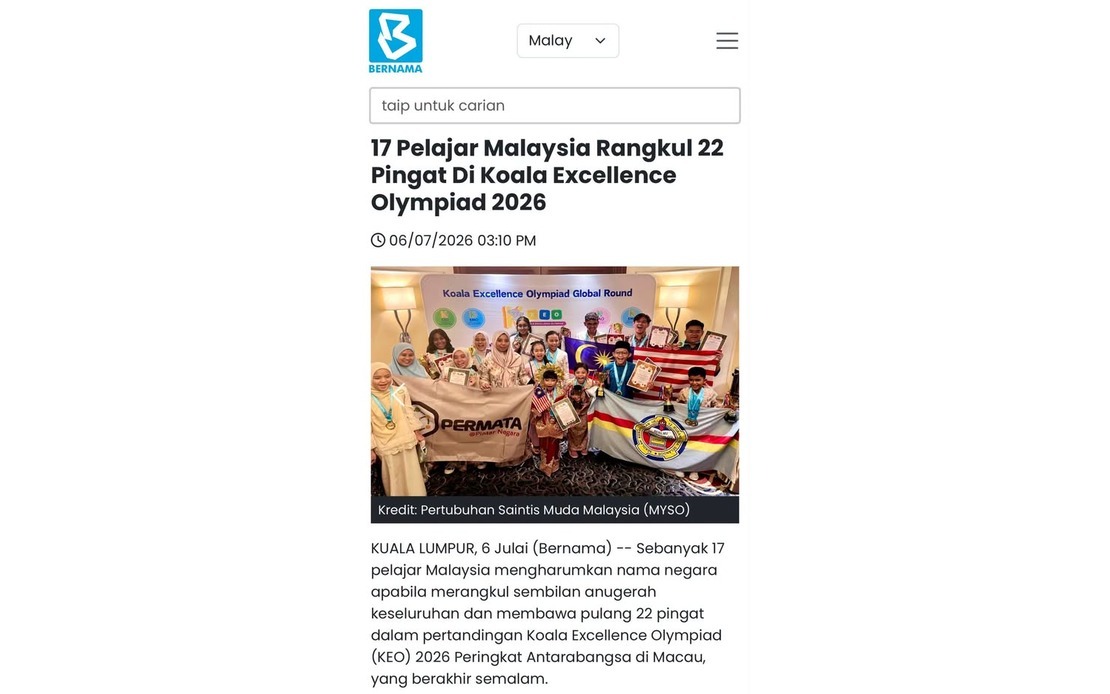
Prime Minister Datuk Seri Anwar Ibrahim has extended his congratulations to a delegation of 17 Malaysian students who delivered an impressive showing at the Koala Excellence Olympiad (KEO) 2026 Global Finals held in Macau. The competition, which wrapped up recently, saw the Malaysian contingent securing nine overall awards alongside a haul of 22 medals, marking a notable achievement for the country's young academic talent on the international stage. Anwar conveyed his remarks through social media, urging the students to maintain their commitment to excellence and pursue even greater accomplishments in their future endeavours.
The medal tally achieved by the Malaysian team comprised five gold awards, six silver medals, and eleven bronze medals across the various competition categories. According to Aidah Misran, who coordinated the Malaysian contingent and served as head of the delegation to Macau through the Malaysia Young Scientists Organisation (MYSO), this performance underscores the calibre of academic ability present within Malaysia's younger generation. The breadth of the medal distribution across different medal classifications suggests a well-rounded strength across the competing students rather than success concentrated in a single discipline.
The KEO platform operates as an international academic competition bringing together student participants from numerous countries to test their abilities across four distinct subject domains. These encompass English language proficiency, Mathematics, Science, and Arts disciplines, creating a comprehensive examination of educational achievement across diverse fields of study. This multidisciplinary approach distinguishes KEO from many specialist international competitions that focus narrowly on single subjects, instead providing a holistic assessment of student capability across humanities and scientific domains alike.
The competition itself was organised through a partnership between KEO, the Miss Man International Group, and coordinated within Malaysia by MYSO, which played a crucial role in identifying, preparing, and fielding the national contingent. MYSO's involvement reflects the organisation's ongoing mission to nurture and showcase Malaysia's scientifically and academically talented youth on global platforms. The coordination process through such established educational bodies ensures that participating students represent a credible standard of achievement and that their preparation receives appropriate institutional support.
At its core, KEO represents an educational initiative developed by a consortium of Australian experts and accomplished graduates who sought to create a rigorous international competition framework spanning four academic disciplines. The platform's genesis in Australian educational expertise brings to bear considerable experience in designing assessments that test genuine comprehension and capability rather than mere rote learning. The international scope of the competition means that Malaysian students competing on this stage are measured against peers from diverse educational systems and pedagogical traditions worldwide.
The recognition extended by Prime Minister Anwar carries significance beyond mere ceremonial acknowledgement. It signals the government's commitment to supporting and celebrating academic excellence among Malaysian youth, particularly in international contexts where such achievements bring visibility to the nation's human capital development. The public commendation through official channels serves to encourage wider participation in international academic competitions among Malaysian students, fostering a culture that values intellectual achievement and global engagement.
For Malaysian students and their educators, participation in programmes like KEO offers valuable exposure to international standards of academic rigor and the opportunity to benchmark their capabilities against global peers. Such experiences often prove formative in the development of young scholars, instilling confidence in their abilities whilst simultaneously highlighting areas for further growth. The competitive environment also provides motivation that extends beyond domestic academic achievement, connecting student success to national pride and representation.
The strong performance at KEO 2026 also reflects the quality of educational infrastructure and teaching methodologies operating within Malaysia's schooling system. Behind each medal won stands hours of preparation, capable instruction, and institutional support. The results therefore represent not only individual student achievement but also a testament to the educators, schools, and support systems that enabled these young people to reach this competitive level. Recognising this collective effort remains important in understanding how Malaysia can continue to develop and promote academic excellence.
Looking forward, this achievement at the KEO 2026 Global Finals establishes a benchmark for future Malaysian participation in international academic competitions. The visibility of the medal count and the government's enthusiastic public endorsement are likely to inspire greater interest among Malaysian students in pursuing similar opportunities. Educational institutions may similarly be motivated to allocate greater resources and planning toward identifying and preparing talented students for international competitions, recognising the value of such participation for institutional prestige and student development. The precedent established in Macau may therefore catalyse increased engagement by Malaysia in the broader ecosystem of international academic competitions across multiple disciplines and platforms.

