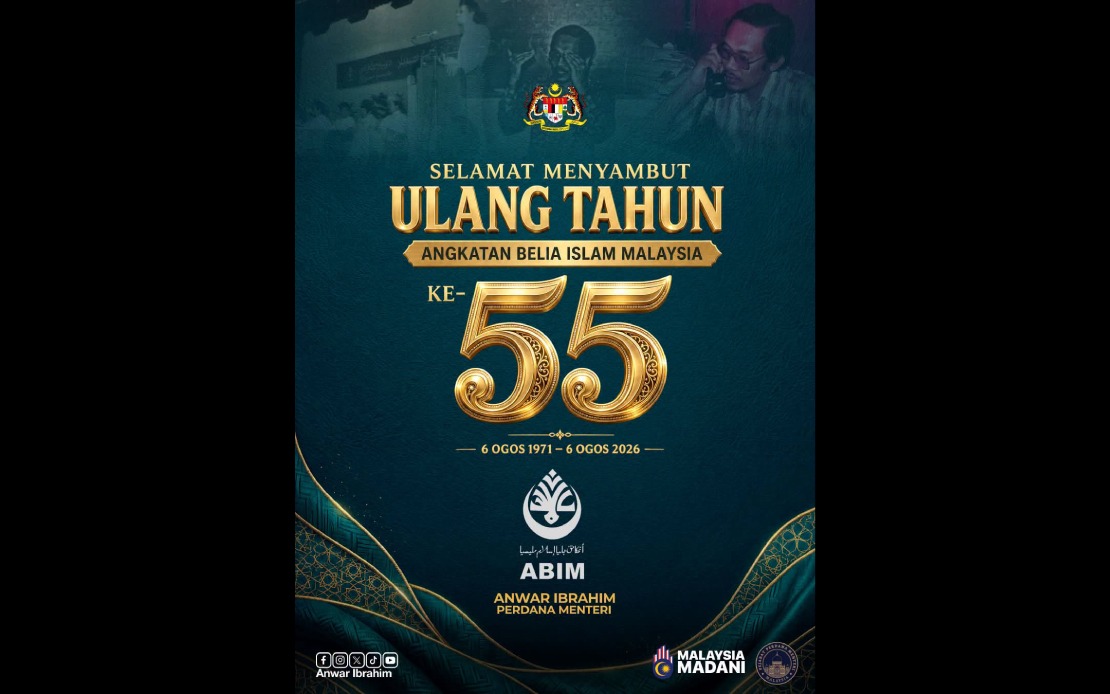
Prime Minister Datuk Seri Anwar Ibrahim has marked the Muslim Youth Movement of Malaysia's 55th anniversary by acknowledging the organisation's enduring influence on student activism and Islamic engagement in the country. Speaking through a social media statement released on August 6, the Prime Minister reflected on ABIM's journey since its establishment on the same date in 1971, underscoring the movement's evolution from a student-led initiative into a significant force shaping Malaysia's Islamic civil society landscape.
Anwar's recognition of ABIM carries particular weight given his personal history with the organisation. As a former president of the movement, the Prime Minister understands intimately the values that have sustained ABIM through five decades of social and religious engagement. His commentary went beyond ceremonial acknowledgement, instead framing the anniversary as a moment to reflect on the organisation's foundational principles and their contemporary relevance. He characterised ABIM's journey as reflecting layers of commitment—sacrifice, integrity, compassion, and faith—suggesting that longevity alone does not define the movement's significance, but rather the quality of its contributions to Malaysian society.
The scope of ABIM's influence extends well beyond traditional religious education and preaching. According to the Prime Minister's assessment, the organisation has functioned as a comprehensive community institution, strengthening the fabric of Malaysia's Muslim population while deliberately targeting vulnerable segments of society. This broader mandate reveals how ABIM has positioned itself not merely as a religious authority but as a social actor invested in welfare, dignity, and educational advancement. The movement's focus on supporting marginalised communities indicates a deliberate ideological stance that links Islamic values to practical social justice.
Education represents a cornerstone of ABIM's mission, particularly in shaping successive generations of Malaysian Muslims. The Prime Minister's reference to the organisation's educational contributions suggests that ABIM has invested significantly in intellectual and moral formation of young people, preparing them to navigate a complex society while maintaining ethical moorings. This educational function carries implications for how Malaysia's Muslim youth understand their faith, their responsibilities to community, and their engagement with plural Malaysian society. By emphasising education as central to ABIM's legacy, Anwar highlights the movement's belief that Islamic outreach must be intellectually rigorous, not merely devotional.
The Prime Minister's metaphor of ABIM as a tree—firmly rooted in values, resilient against adversity, and providing shelter to the community—encapsulates a vision of institutional stability and social utility. This imagery suggests that ABIM's strength derives from its principled foundations rather than from external circumstances or political convenience. The notion of roots symbolises historical continuity and values consistency, while the reference to branches offering shelter indicates practical service to constituencies beyond the movement's formal membership. This metaphorical language reflects how Malaysian political and social discourse frequently invokes organic imagery to describe institutional legitimacy and community bonds.
ABIM's persistence through five decades has coincided with significant transformations in Malaysian politics, society, and Islamic discourse. The movement has navigated periods of political transition, economic change, and shifting attitudes toward religious expression within a multi-ethnic nation. Its continued relevance suggests an adaptive capacity—the ability to maintain core principles while responding to contemporary challenges. This balance between consistency and responsiveness represents a significant challenge for religious and civil society organisations in Malaysia, where legitimacy often depends on demonstrating both principled commitment and practical engagement with current issues.
The Prime Minister's explicit reference to ABIM's role in sustaining hope amid confusion addresses a persistent concern within Malaysian Islamic circles. The phrase suggests recognition that modern societies generate disorientation and competing value systems, and that ABIM positions itself as providing moral clarity and direction. This framing acknowledges broader anxieties about cultural change, globalisation, and religious identity that resonate across Malaysia's Muslim population. By highlighting ABIM's steadying influence, Anwar validates the organisation's claim to offer coherent guidance during periods of social uncertainty.
The timing of this public commendation carries political implications worth considering. Prime Ministers rarely issue statements celebrating organisational anniversaries without recognising the broader constituencies and networks those organisations represent. ABIM's membership base, institutional reach, and ideological influence extend throughout Malaysian society, particularly among educated urban Muslims and students. Anwar's prominent recognition signals alignment with ABIM's agenda and, implicitly, respect for the constituencies the movement represents and mobilises.
For Southeast Asian readers, ABIM's trajectory offers instructive lessons about how Islamic civil society organisations function within plural democracies. Unlike some regional movements that have pursued political power directly, ABIM has maintained institutional independence while exercising significant cultural and moral influence. This approach has allowed the movement to speak on Islamic matters with credibility while remaining available as a dialogue partner for governments across different political complexions. ABIM's success in maintaining this balance suggests a model of Islamic activism that other Southeast Asian countries observe carefully.
Looking forward, ABIM faces the challenge of maintaining relevance as Malaysian society continues evolving demographically and culturally. Digital technology, changing family structures, shifting employment patterns, and new forms of community formation present both opportunities and challenges. The organisation's ability to articulate Islamic values in ways that address contemporary concerns—environmental sustainability, economic justice, technological ethics—will determine whether it remains a vital force in Malaysian Islamic thought and practice, or gradually becomes viewed as a historical institution.
The Prime Minister's commemoration ultimately serves multiple functions: it acknowledges ABIM's institutional contributions, validates the organisation's claimed legitimacy, and positions the government as supportive of Islamic civil society. For ABIM itself, the recognition from Malaysia's highest political office represents affirmation of its foundational mission and suggests continued government openness to its agenda and perspectives. This relationship between government and independent Islamic organisations remains a defining feature of Malaysia's governance model, distinguishing it from some regional approaches that view religious movements with greater suspicion or seek greater direct control.

