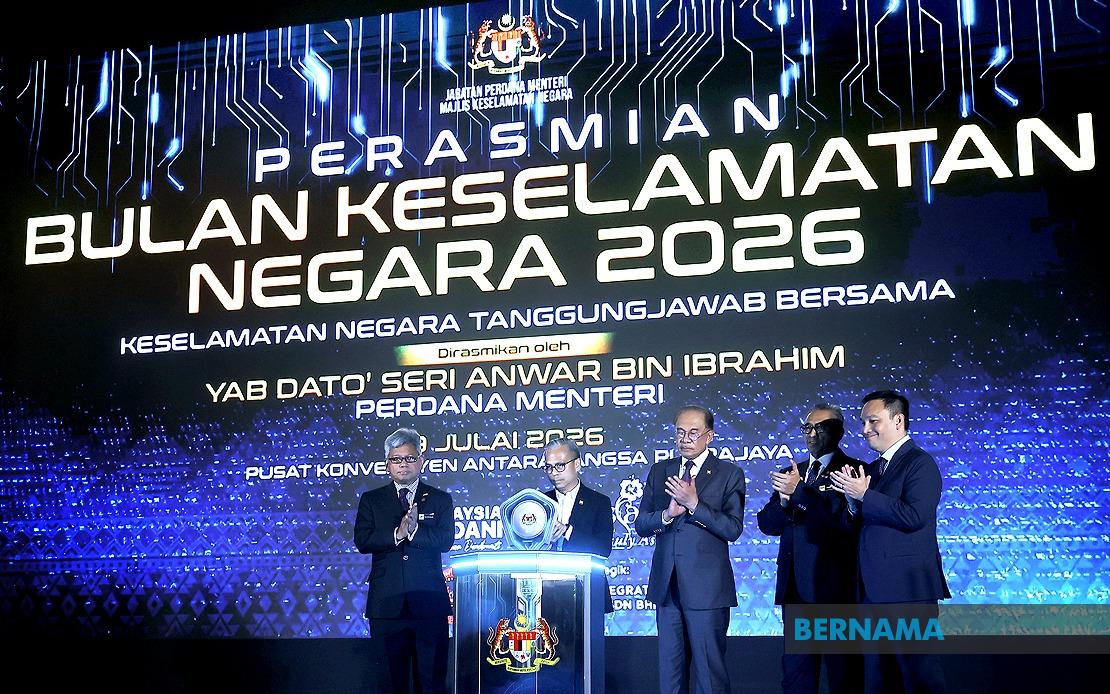
Prime Minister Datuk Seri Anwar Ibrahim has voiced alarm at the persistent politicisation of identity-based grievances, arguing that Malaysia's fixation on longstanding racial and religious fault lines poses a strategic vulnerability as the nation grapples with far more pressing security imperatives. Speaking at the launch of National Security Month 2026 in Putrajaya, he underscored the paradox of political leaders continuing to relitigate historical divisions whilst fresh, multifaceted threats to national stability accumulate beyond their immediate attention.
The Prime Minister's intervention reflects growing frustration within the executive branch at what officials perceive as a misdirection of political energy and parliamentary discourse. Anwar characterised the recurrent invocation of state sentiment, communal identity and religious demarcation as distracting from substantive governance, particularly when adversaries and threat actors operate in domains that transcend conventional territorial or demographic boundaries. His remarks, delivered during an official ceremony attended by Communications Minister Datuk Fahmi Fadzil and Chief Secretary to the Government Tan Sri Shamsul Azri Abu Bakar, signal an administration keen to reframe national discourse around institutional resilience and technological preparedness.
The security landscape confronting Malaysia has evolved markedly in recent years, extending well beyond traditional state-on-state confrontation or internal civil unrest. Digital infrastructure, financial systems and critical utilities now constitute vectors for disruption that ignore the racial or religious composition of affected populations. Cyber-enabled espionage, disinformation campaigns coordinated across social media, and the weaponisation of emerging technologies pose challenges that demand sophisticated technical expertise and cross-institutional coordination rather than the deployment of communal solidarity narratives. By emphasising this shift, Anwar implicitly critiques opposition voices and dissident political movements that continue to mobilise constituencies around identity-based platforms, positioning such tactics as anachronistic and counterproductive to collective defence.
The invocation of divisive sentiments during parliamentary proceedings has long characterised Malaysian political culture, with opposition and backbench members frequently invoking constitutional provisions around bumiputera rights, Islamic law and territorial autonomy to mobilise their bases. Anwar's public censure of such tendencies reflects a deliberate pivot by the federal administration towards what it frames as a post-identity political paradigm centred on technocratic problem-solving and institutional modernisation. Yet the efficacy of such messaging remains uncertain in a polity where identity continues to structure electoral choice and mobilisation across the peninsula and beyond.
The emphasis on proactive governance rather than reactive crisis management addresses a structural weakness long identified by security analysts: Malaysia's tendency to address threats only after they materialise into incidents or disruptions. By exhorting leaders across government departments and agencies to anticipate emerging challenges and invest in understanding new technological domains before they become operational vulnerabilities, Anwar articulates a vision of a state apparatus less constrained by bureaucratic inertia and more aligned with the velocity of modern threat evolution. This framing also implies criticism of siloed departmental operations and insufficient knowledge transfer across institutional boundaries.
The National Security Council's elevation of digital and technological threats to parity with traditional security concerns reflects patterns observable across Southeast Asian governments struggling to balance legacy security architecture with contemporary asymmetric challenges. Malaysia, as a significant economic actor with substantial digital infrastructure and a growing technology sector, faces particular exposure to supply-chain disruption, intellectual property theft coordinated via cyber means, and the infiltration of critical systems by hostile state or non-state actors. The emphasis on technological literacy among senior officials suggests that the administration perceives current levels of cyber competency among some government departments as inadequate to the scale of emerging risks.
Anwar's framing of divisive sentiment as inherently destabilising reflects a particular worldview in which national cohesion is contingent upon elite consensus around shared technocratic objectives. Critics might contend that such a perspective marginalises legitimate expressions of communal concern and collective identity, particularly in a constitutional framework that explicitly recognises special provisions for Malays and Islam. The tension between Anwar's call for unity around security imperatives and the enduring constitutional and political salience of identity-based claims remains unresolved, with implications for how different constituencies interpret the Prime Minister's intervention.
The presence of Communications Minister Fahmi Fadzil at the National Security Month launch underscores the administration's awareness that countering divisive narratives requires active information management and strategic messaging. The communications portfolio's involvement signals an intention to contest the discursive space, positioning government-led narratives around security and national interest against opposition framing that emphasises identity and historical grievance. This represents an implicit acknowledgement that elite exhortations alone prove insufficient; sustained narrative production across media channels is necessary to shift mass political perception.
For Malaysian observers, Anwar's intervention raises questions about the viability of depoliticising security discourse in a nation where political competition has historically turned on questions of constitutional rights, religious authority and territorial fairness. Whether government can successfully redirect political attention from identity-based contestation to technocratic security management remains an open question. The apparent willingness of some opposition and civil society voices to engage with security frameworks suggests partial receptivity, yet deep currents of identity-based mobilisation continue to shape electoral behaviour and policy preferences across the population.
The implications for Southeast Asia are equally significant. As regional governments confront transnational security challenges spanning cyber threats, supply-chain vulnerabilities and disinformation, leaders across the bloc face similar pressures to unify disparate constituencies around shared security interests. Malaysia's attempt to foreground such appeals offers a case study in whether identity-based polities can successfully transition to frameworks centred on institutional resilience and technological preparedness. The success or failure of this political project will have consequences not only for Malaysia's internal cohesion but also for the region's capacity to respond collectively to shared security threats that transcend national borders and communal boundaries.

