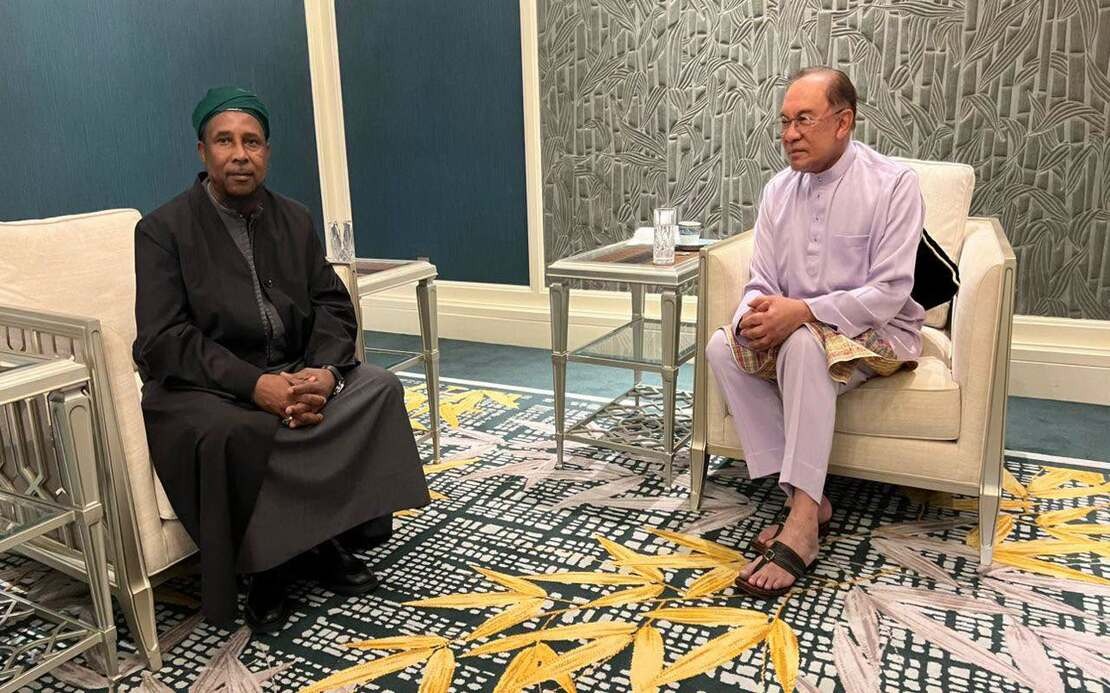
Prime Minister Datuk Seri Anwar Ibrahim received a farewell visit from Gambian Islamic scholar Sheikh Muhammad Haydara Al-Jilani on Wednesday, marking the conclusion of an extended religious mission across Malaysia. The encounter, documented through Anwar's official social media channels, underscored the premier's continued engagement with international Islamic scholars and the promotion of interfaith and knowledge-sharing initiatives that characterise his administration's approach to religious affairs.
Sheikh Muhammad Haydara Al-Jilani spent approximately four weeks in Malaysia conducting a comprehensive dakwah programme encompassing religious gatherings, Quranic study sessions, and dhikr observances at multiple locations throughout the country. The timing of his departure coincided with the Day of Ashura, a significant date in the Islamic calendar observed by Muslims globally, which fell on a Friday during his farewell meeting with the Prime Minister. This convergence of dates provided additional spiritual resonance to the occasion, as both figures recognised the religious significance of the moment.
During their meeting, Anwar requested that the Gambian scholar offer special prayers seeking divine blessings for Malaysia and its people. The Prime Minister specifically sought supplications for national prosperity, enduring peace, and the continued spiritual protection of the country through Allah's mercy and grace. This gesture reflects a broader pattern of Anwar's diplomatic and spiritual engagement, whereby international religious figures are invited to participate in Malaysia's religious and cultural landscape whilst simultaneously serving as conduits for cross-cultural Islamic dialogue.
The visit of scholars such as Sheikh Muhammad Haydara represents part of a deliberate strategy to strengthen Malaysia's position as a hub for Islamic knowledge and contemporary religious discourse in Southeast Asia. By hosting prominent religious educators from the wider Muslim world, particularly from West Africa where Islamic scholarship carries deep historical roots, Malaysia reinforces its credentials as a destination for serious Islamic study and practice. The Gambian scholar's month-long tenure across the country suggests an itinerary carefully coordinated with local Islamic institutions and communities.
Gambia, located in West Africa, has a predominantly Muslim population and a rich Islamic scholarly tradition. The presence of scholars from this region underscores the interconnected nature of global Islamic intellectual networks and Malaysia's role within these broader educational ecosystems. Inviting such figures to conduct knowledge-sharing programmes domestically elevates the spiritual and intellectual discourse within Malaysian Muslim communities while simultaneously projecting soft power through religious and cultural diplomacy.
The dakwah programmes conducted by Sheikh Muhammad Haydara throughout his Malaysian sojourn would have encompassed various audience demographics, from students and scholars to community members seeking spiritual enrichment. Dhikr gatherings, which involve rhythmic remembrance of God through repetitive phrases, constitute an important component of Sufi Islamic practice and have gained considerable popularity in contemporary Malaysian Islamic spaces. The accessibility of these programmes across multiple nationwide locations suggests an intentional effort to reach diverse geographical and demographic segments of the Malaysian Muslim population.
Anwar's personal receipt of the visiting scholar, rather than delegating the farewell to a junior minister or institutional representative, signals the government's prioritisation of religious and cultural exchange at the highest levels of administration. This approach aligns with the Prime Minister's previous emphasis on promoting pluralism, interfaith understanding, and the advancement of Islamic scholarship as cornerstones of Malaysian national identity. The public nature of the encounter, documented through official channels, ensures broader visibility and legitimacy for both the visiting scholar's work and the government's sponsorship of such initiatives.
For Malaysian Muslim communities, the visit of internationally recognised Islamic scholars provides opportunities for direct engagement with varied pedagogical approaches, spiritual methodologies, and interpretative frameworks within Islamic tradition. Such exposure fosters intellectual vitality and prevents insularity within domestic religious discourse. The emphasis on knowledge-sharing rather than proselytisation reflects a mature approach to religious engagement, acknowledging that intellectual dialogue and voluntary spiritual participation yield more sustainable outcomes than coercive religious messaging.
The convergence of Sheikh Muhammad Haydara's departure with the Day of Ashura also carries symbolic weight within Islamic tradition. Ashura, commemorating significant historical events in Islamic history, represents a moment of collective spiritual reflection and renewal for Muslim communities. The Prime Minister's invocation of special prayers during this auspicious occasion elevates the personal farewell into a communal spiritual exercise, one in which the nation's welfare becomes central to the religious observance. This integration of state leadership with religious observance exemplifies how contemporary Malaysian governance seeks to honour Islamic traditions whilst promoting their contemporary relevance.
The broader implications of such scholarly exchanges extend beyond immediate religious and cultural considerations. They contribute to Malaysia's positioning within regional and global Islamic networks, enhance diplomatic relations with West African nations, and demonstrate commitment to supporting Islamic education and intellectual advancement. For Southeast Asia's Muslim-majority nations, the visit exemplifies how targeted engagement with international Islamic scholars can enrich domestic religious life whilst strengthening transnational ties within the Islamic world.
As Sheikh Muhammad Haydara departs Malaysia, the knowledge and spiritual insights shared during his month-long tenure will likely continue reverberating through the communities and institutions he engaged with domestically. The Prime Minister's personal farewell, coupled with his invocation of special prayers for national wellbeing, provides a ceremonial closing to the visit whilst affirming government support for such religious and educational initiatives. This engagement pattern will probably continue shaping Malaysia's approach to Islamic scholarship, interfaith relations, and the cultivation of the country's reputation as a centre for Islamic learning and practice in the Southeast Asian context.

