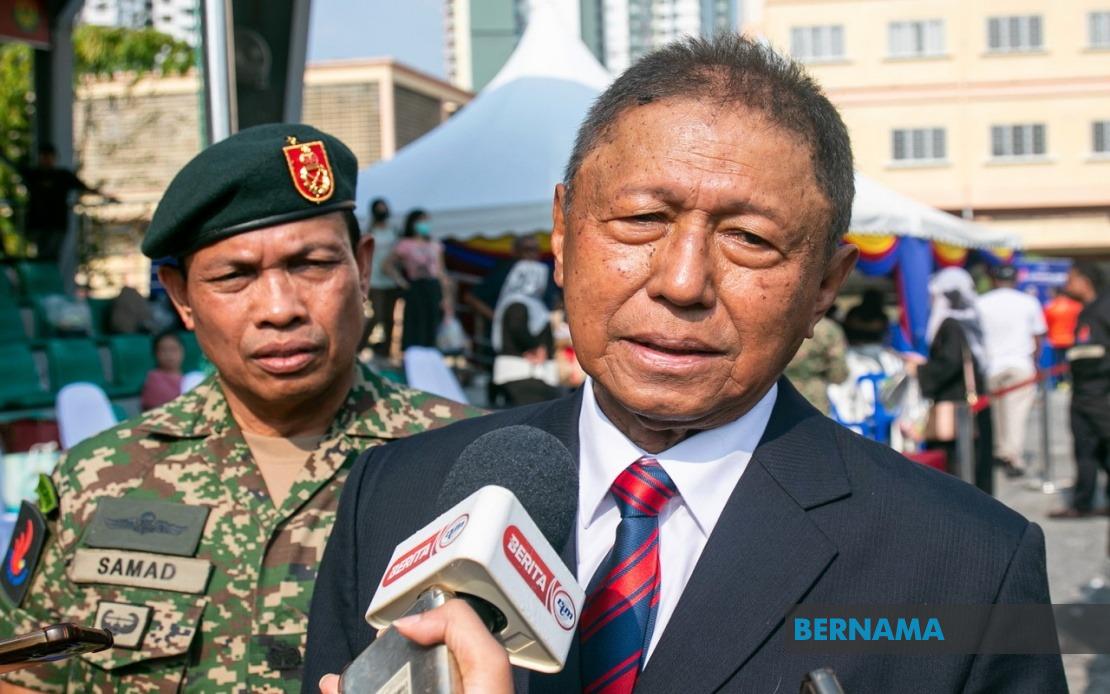
Malaysia's reinvigorated National Service Training Programme, known as PLKN 3.0, will achieve a symbolic milestone when 200 of its trainees march in the National Day parade in Putrajaya on August 31. The participation represents a watershed moment for the programme, as it will be the first instance of PLKN 3.0 graduates performing before the King, Prime Minister, Cabinet members, and the broader public during the nation's most significant annual celebration. General (Retired) Tan Sri Dr Abdul Aziz Zainal, chairman of the National Service Training Council (MLKN), highlighted the historic nature of this participation when addressing reporters at a passing-out ceremony held at the 515 Territorial Army Camp in Kuala Lumpur.
The selected trainees are currently undertaking intensive preparation in Putrajaya in anticipation of their parade debut. This rehearsal phase underscores the government's commitment to ensuring that the young participants present themselves with professionalism and discipline befitting the occasion. The MLKN has framed this participation as more than ceremonial pageantry—rather, it serves as a public showcase demonstrating the tangible outcomes of the PLKN 3.0 training regimen and positioning its graduates as the nation's emerging youth champions. By placing these young individuals front and centre at a national-level event, policymakers hope to elevate public awareness of the programme's objectives and reinforce its significance within the broader framework of national development and youth engagement.
The latest cohort to complete training, designated Series 3/2026, concluded a comprehensive 45-day programme that commenced on July 11. This particular series involved 795 trainees distributed across three dedicated training camps located strategically across the peninsula. Camp 504 AW in Bukit Keteri, Perlis, accommodated 106 female trainees, while Camp 505 AW in Pekan, Pahang, trained 442 male participants. A third facility, Camp 515 AW in Kuala Lumpur, hosted 247 female trainees. The geographic spread of these training centres reflects deliberate efforts to make the programme accessible to young Malaysians from different regions and backgrounds.
Recognition of outstanding performance within each camp underscores the competitive and merit-based dimension embedded in the PLKN 3.0 structure. An'nur Najiha Muhammad, an 18-year-old from Ipoh, Perak, was named the best trainee at Camp 504 AW. Muhammad Firdaus Muhammad Said, also 18 and hailing from Kuantan, Pahang, achieved similar distinction at Camp 505 AW. Cheyenne Alessandra Michael, 18, from Kuala Lumpur, emerged as the top performer at Camp 515 AW. These individual achievements highlight the programme's capacity to identify and cultivate exceptional young leadership talent from across the country.
Expansion plans for PLKN 3.0 Series 4/2026 signal the government's confidence in scaling the initiative and its commitment to reaching substantially larger numbers of Malaysian youth. The National Service Training Council plans to establish five newly operational camps, complementing the three existing facilities already in operation. These new camps will be located at Hutan Melintang in Perak, Sungai Durian in Kelantan, and Bukit Pinang in Kedah. Additionally, the programme will utilise two Public Training Institute (ILA) centres—one in Sungai Petani, Kedah, and another in Tuaran, Sabah—to serve as satellite training venues.
A particularly significant development involves the integration of the Malaysian Volunteer Corps Department (RELA) training infrastructure into the PLKN 3.0 framework. General Aziz Zainal emphasised that by leveraging RELA training centres alongside existing facilities, the programme's capacity will expand substantially, enabling the simultaneous training of more than 1,000 participants in future series. The incorporation of RELA represents a pragmatic approach to resource optimisation and demonstrates institutional coordination at the federal level. Moreover, the council intends to recruit additional qualified trainers to maintain instructional quality while accommodating larger cohorts—a critical consideration for programmes emphasising discipline and standards.
The testimonial accounts of participants reveal the profound personal impact of the PLKN 3.0 experience. Cheyenne Alessandra Michael, the top performer at Camp 515 AW, voluntarily enrolled in the programme driven by aspirations toward military service. She characterised her 45-day immersion as transformative, describing it as a catalyst that intensified her patriotic consciousness and deepened her emotional connection to Malaysia's national narrative. Her insights underscore how structured military training environments can foster psychological and civic development beyond mere physical conditioning or drill instruction.
Alexandra's observations about her exposure to Wataniah (Territorial Army) personnel stationed at the training camp illustrate the educational value embedded in proximity to professional military culture. Daily interaction with serving soldiers cultivated her appreciation for the sacrifices undertaken by defence personnel in securing Malaysia's independence and stability. This exposure fostered in her a heightened sense of intergenerational responsibility—a recognition that her generation inherits not merely the fruits of independence but also the obligation to sustain national peace and security. Such reflective engagement distinguishes PLKN 3.0 from purely technical training programmes, positioning it within a holistic framework of civic education and national consciousness-building.
The initiative carries particular resonance for Malaysia's geopolitical context and regional standing. Southeast Asia faces evolving security challenges, demographic transitions, and questions about social cohesion and national identity. By investing in structured national service for youth, Malaysia signals institutional commitment to building a generation equipped with discipline, patriotic conviction, and cross-community understanding. The inclusion of trainees from diverse ethnic and geographic backgrounds within integrated training environments creates informal spaces for inter-communal relationship-building—a subtle but consequential dimension often underappreciated in formal policy discourse.
The PLKN 3.0 framework also addresses contemporary anxieties about youth disengagement and the perceived decline of civic participation among young Malaysians. Rather than treating patriotism and national service as outdated concepts, the programme repackages them within a contemporary idiom that appeals to idealistic youth seeking purpose and meaning. The prominence accorded to top performers and their participation in the National Day parade amplifies this messaging, potentially inspiring peer cohorts to view service as a desirable and honourable endeavour rather than an onerous obligation.
As Malaysia navigates rapid economic transformation and social change, strategic investment in youth development programmes demands careful calibration. The expansion trajectory outlined by the MLKN—tripling training capacity through the addition of camps and the incorporation of RELA infrastructure—suggests confidence that demand exists and that institutional mechanisms can accommodate growth without compromising quality. The success of PLKN 3.0 Series 3/2026, culminating in a high-profile public appearance at National Day celebrations, provides preliminary validation of this approach and sets a foundation for the more ambitious targeting of subsequent cohorts.

