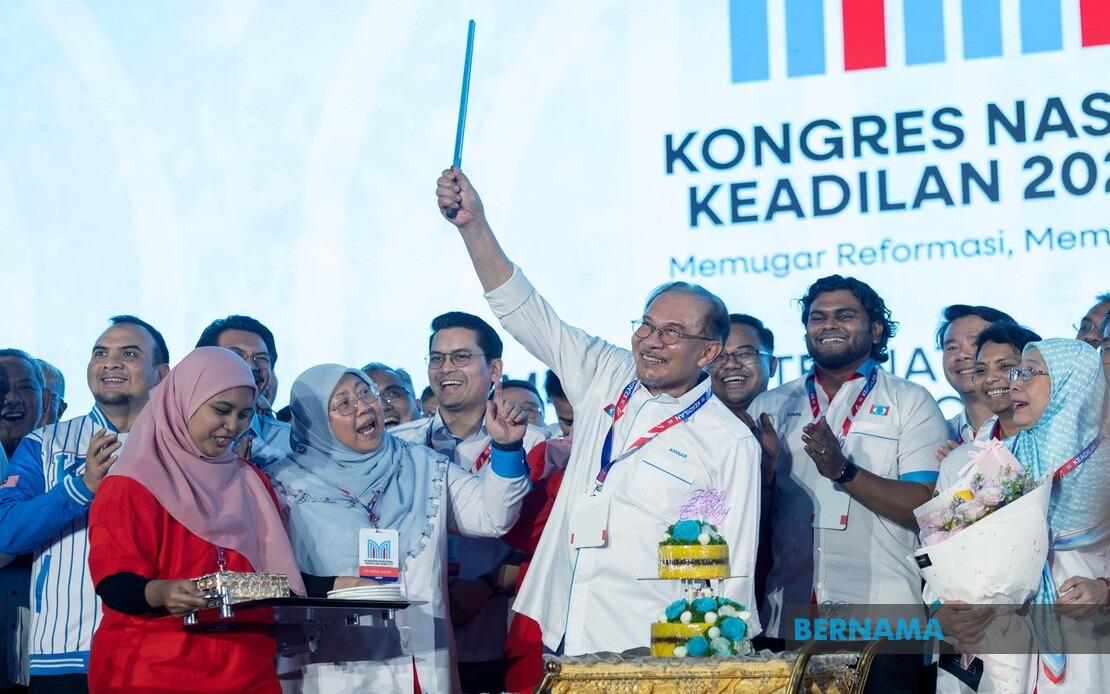
The PKR National Congress 2026 concluded in Melaka with the party reiterating its commitment to both political stability and progressive reform, positioning itself as a force capable of balancing governance responsibilities with its foundational reform ideals. Party president Datuk Seri Anwar Ibrahim used his closing remarks to underscore the importance of maintaining the Unity Government framework, arguing that the current political arrangement serves as essential groundwork for delivering economic growth and prosperity to ordinary Malaysians. The emphasis on stability reflects PKR's awareness that, as a coalition partner within government alongside UMNO and Barisan Nasional, the party's continued political influence depends on demonstrating competent stewardship rather than destabilising the broader administration.
Anwar's message carried a dual audience: internal party members seeking reassurance that PKR has not abandoned its reformist roots, and coalition partners who need confidence that the party will not pursue disruptive agendas. He explicitly cautioned all parties against taking steps that could jeopardise the Unity Government's cohesion, framing stability as a prerequisite for the kind of sustained policy implementation that genuine reform requires. This rhetorical positioning attempts to resolve a fundamental tension within PKR's current role—the challenge of driving change from within an establishment that historically resisted such pressures. For Malaysian readers accustomed to coalition politics, this balancing act represents a familiar but delicate dance, one that determines whether reform-minded parties retain credibility among supporters while remaining palatable to conservative coalition partners.
Crucially, Anwar stressed that the future trajectory of Unity Government cooperation depends significantly on leadership decisions within UMNO and Barisan Nasional, effectively signalling that PKR's commitment to the arrangement is conditional on reciprocal good faith from its largest coalition partner. This caveat is telling—it suggests the party leadership recognises underlying tensions within the coalition and wishes to preserve political flexibility should circumstances shift. For regional observers, such statements highlight the fragile nature of Malaysian political coalitions, where formal unity often masks competing interests and divergent policy preferences. The statement also serves a domestic political function, reassuring PKR members that any future realignment would not represent a failure of principle but rather a rational response to altered circumstances.
PKR deputy president Nurul Izzah Anwar articulated a complementary message, insisting that the party's reform mandate must persist even as it exercises governmental power. She pointed to the repeal of the Universities and University Colleges Act (AUKU) 1971 as concrete evidence that reform remains achievable within government, citing this legislative victory as proof that PKR has not merely become an establishment party content with the status quo. The AUKU repeal carries symbolic weight beyond university governance—it represents a tangible win for student activism and freedoms, constituencies that PKR has historically championed. Anwar's government commitment to avoid replacing AUKU with restrictive successor legislation, and his assertion that existing criminal laws adequately address misconduct, reflects an attempt to sustain PKR's credibility with younger voters and civil society groups that might otherwise view the party's governmental role as compromising.
The congress gave particular prominence to gender representation and women's empowerment within the party structure. Fadhlina Sidek, serving as both PKR Wanita chief and Education Minister, advocated for expanded space for women in leadership and decision-making roles, simultaneously calling for greater openness to criticism within both party and government settings. This emphasis on internal accountability represents an attempt to address longstanding concerns about hierarchical governance within Malaysian political organisations. For female party members and Malaysian women observing from outside, such commitments signal genuine intent to reshape party culture, though historical scepticism regarding the gap between stated commitments and operational implementation remains justified. Sidek's dual roles also illustrate PKR's strategy of placing women in substantive ministerial positions, using such appointments to validate rhetorical commitments to gender equity.
Angkatan Muda Keadilan's focus on youth participation highlighted emerging economic and social challenges distinct from previous generations' concerns. The youth wing raised issues surrounding gig economy recognition, enhanced social protections, skills development pathways, mental health support, and general social wellbeing—issues reflecting the precarious employment circumstances and psychological pressures facing Generation Z in Malaysia. Simultaneously, AMK emphasised efforts to enable Bumiputera participation in cutting-edge technology sectors including artificial intelligence, semiconductors, and biotechnology. This dual-track approach attempts to address both immediate economic anxiety among young workers and longer-term structural participation in high-value industries, recognising that technological advancement will increasingly determine economic opportunity.
The party's emphasis on organisational preparedness independent of parliamentary dissolution or candidate announcements suggests PKR leadership anticipates political fluidity in the medium term. By signalling internal readiness to navigate whatever political developments emerge, the party positions itself as capable and stable—attributes particularly valuable in Malaysian politics, where unexpected shifts in coalition arrangements or parliamentary majorities have become more frequent. This message also serves to motivate grassroots party members, framing them as active participants in shaping political developments rather than passive observers awaiting leadership direction. For constituencies with historically strong PKR support, such rhetoric reinforces the perception that the party remains dynamic and forward-thinking.
The congress outcomes reveal PKR's strategic calculation that its political survival depends on simultaneously satisfying multiple constituencies with potentially conflicting preferences. The party must reassure government coalition partners that it will not pursue overly radical agendas that might alienate conservative constituencies. Concurrently, PKR must demonstrate to its reform-minded base and younger supporters that governmental participation has not rendered the party functionally identical to establishment rivals. This balancing act reflects broader challenges facing progressive parties operating within coalition governments in Southeast Asia, where reformist credentials and pragmatic governance often pull in opposing directions.
The emphasis on political stability should not be misinterpreted as passivity. Rather, PKR appears to be arguing that meaningful, durable reform requires institutional stability and economic foundation-building, not dramatic gestures that might destabilise governance. Whether this argument persuades PKR's reform constituency or merely frustrates those seeking bolder action remains an open question. The coming years will test whether the party can credibly maintain this dual identity or whether the tension between reform aspiration and coalition responsibility ultimately proves irreconcilable. For Malaysian voters and regional observers, the PKR Congress 2026 clarified the party's current strategic positioning but left unresolved the fundamental question of whether such balanced positioning represents sophisticated political leadership or inevitable compromise that gradually dilutes reformist purpose.

