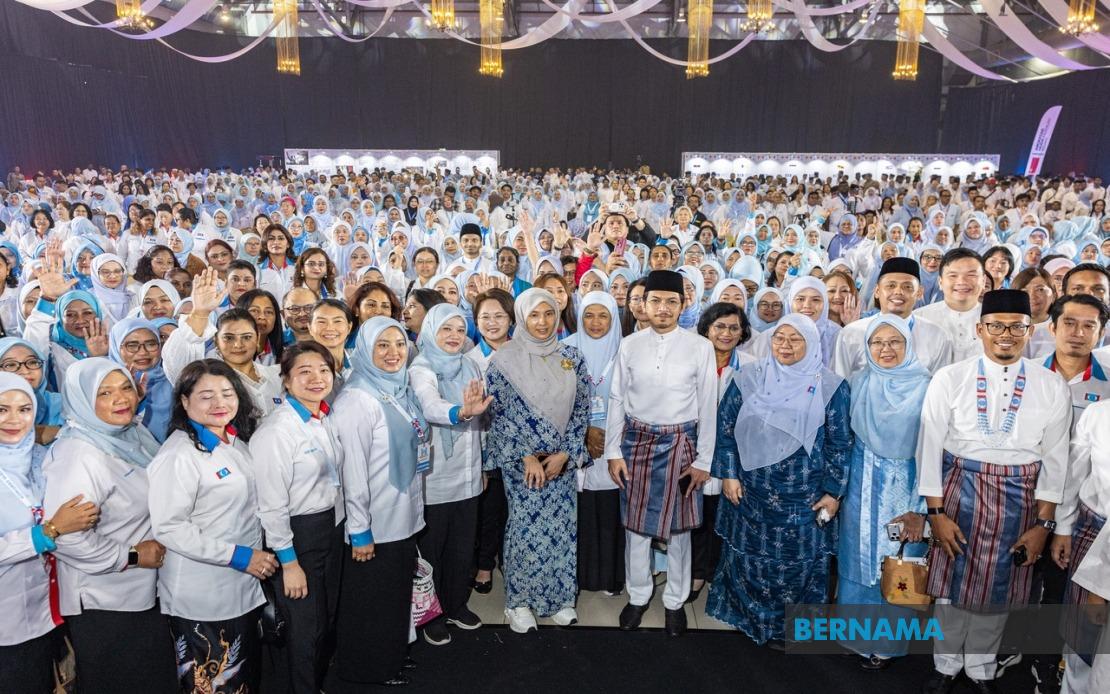
PKR's youth wing leadership has issued a candid assessment of the party's position, highlighting the need for a more robust and persuasive political message to reinvigorate public confidence ahead of the coming electoral cycle. Speaking at the Angkatan Muda Keadilan (AMK) National Congress in Melaka, Muhammad Kamil Abdul Munim, the youth wing's chief, acknowledged that despite the party's presence in government, fundamental organisational weaknesses remain unaddressed and threaten future electoral prospects.
The timing of these remarks reflects growing concerns within PKR's leadership about the party's electoral performance trajectory. Recent state elections in Sabah, Johor and Negeri Sembilan have exposed significant gaps between the party's public profile and its ability to convert grassroots activity into tangible electoral gains. Muhammad Kamil's diagnosis suggests that PKR faces not a crisis of visibility but rather one of substantive political reach—the machinery connecting party messaging to voter mobilisation has become inadequate despite the party's participation in the federal government since 2018.
Historically, PKR has relied on wave-like surges of public sentiment to propel electoral victories, with citizens organising themselves as informal party machinery during campaigns. This pattern held true from the party's formation in 1998 through to its entry into government. However, Muhammad Kamil's assessment indicates that this organic, momentum-driven model is no longer viable. The party must now construct a more deliberate, systematised approach to grassroots organising that functions independently of temporary waves of public enthusiasm.
The challenge facing PKR is particularly acute given the party's dual experience of governing and opposition politics. Reform movements typically derive energy from their outsider status, channelling public discontent into activist energy. Governing, conversely, demands compromises and necessitates making difficult policy trade-offs that inevitably disappoint segments of the party's base. PKR's leadership appears to recognise that the transition from insurgent party to establishment actor requires strategic reinvention—a fresh narrative that justifies continued public support while maintaining the reform credentials that originally mobilised the party's constituency.
Muhammad Kamil's call for renewal extends beyond mere rhetorical adjustments. He emphasised that party activities must become more organised, structured and targeted, suggesting that current operations lack sufficient coordination and strategic focus. This represents a tacit acknowledgment that PKR's internal systems—whether related to candidate selection, campaign coordination, or volunteer mobilisation—require comprehensive overhaul to function effectively in contemporary electoral conditions.
The youth wing chief's appeal for party members not to lose heart carries significance beyond motivational rhetoric. It implicitly recognises that demoralisation has set in among grassroots activists following electoral setbacks. When momentum falters and internal confidence erodes, reversing that trajectory demands both honest acknowledgment of failure and a compelling vision of future possibility. Muhammad Kamil framed electoral losses as clear signals from voters rather than random fluctuations, suggesting that PKR must accept responsibility for its current position rather than attributing difficulties to external factors.
Wanita PKR chief Fadhlina Sidek reinforced these themes by advocating that the congress serve as an institutional moment for serious self-examination. Her emphasis on acknowledgement of weaknesses and humility represents a departure from typical political gatherings, where leaders usually project confidence and highlight achievements. This deliberate pivot toward introspection suggests that PKR's upper echelon recognises the party cannot restore public confidence through conventional celebratory messaging, but rather through demonstrated commitment to genuine internal reform.
For Malaysian political observers, PKR's current trajectory merits close attention given the party's significance within the ruling coalition. As Pakatan Harapan's largest component party by membership, PKR's organisational health directly influences the coalition's electoral viability. If PKR fails to strengthen its grassroots machinery and develop a more persuasive political narrative, the entire coalition faces vulnerability heading into the next general election, potentially opening space for resurgent opposition forces.
The problem articulated by AMK leadership also reflects broader challenges affecting Malaysian political parties across the spectrum. Digital communication, changing voter preferences, and the fragmentation of traditional political constituencies have rendered older organisational models obsolete. Parties that once successfully mobilised voters through neighbourhood networks and community leaders now must compete in an environment where information flows through multiple channels and voter loyalty is more volatile. PKR's acknowledgment of these challenges suggests the party is beginning to grapple with the reality that maintaining electoral relevance requires fundamental adaptation rather than incremental adjustment.
The emphasis on translating grassroots strength into electoral victories carries particular weight given Malaysia's federal structure and the significance of state-level contests. The Sabah, Johor and Negeri Sembilan elections cited by Muhammad Kamil represent testing grounds where national party machinery must demonstrate local effectiveness. Recent underperformance in these contests indicates that PKR has not yet successfully adapted its organisation to operate effectively across Malaysia's diverse political landscape, where regional dynamics, local issues and established political networks significantly influence voter behaviour.
Moving forward, PKR's leadership faces the substantial task of converting the congress's rhetoric into concrete institutional change. This requires not merely adjusting messaging but fundamentally restructuring how the party recruits, trains and deploys party activists. The congress debates referenced by Fadhlina must translate into actionable recommendations that translate into observable changes in party operations and campaign approaches. Without such concrete follow-up, the calls for renewal risk becoming merely another iteration of self-critical speeches that fail to produce substantive transformation.
The broader implication for Southeast Asian political analysis concerns how governing parties navigate the transition from opposition movements to establishment institutions. PKR's experience offers instructive lessons about the difficulties of maintaining activist energy while managing government responsibilities, and the organisational investments required to sustain electoral competitiveness over multiple electoral cycles. As the region's democracies face questions about party institutionalisation and electoral competition, PKR's efforts to renew itself carry significance extending beyond Malaysia's immediate political context.

