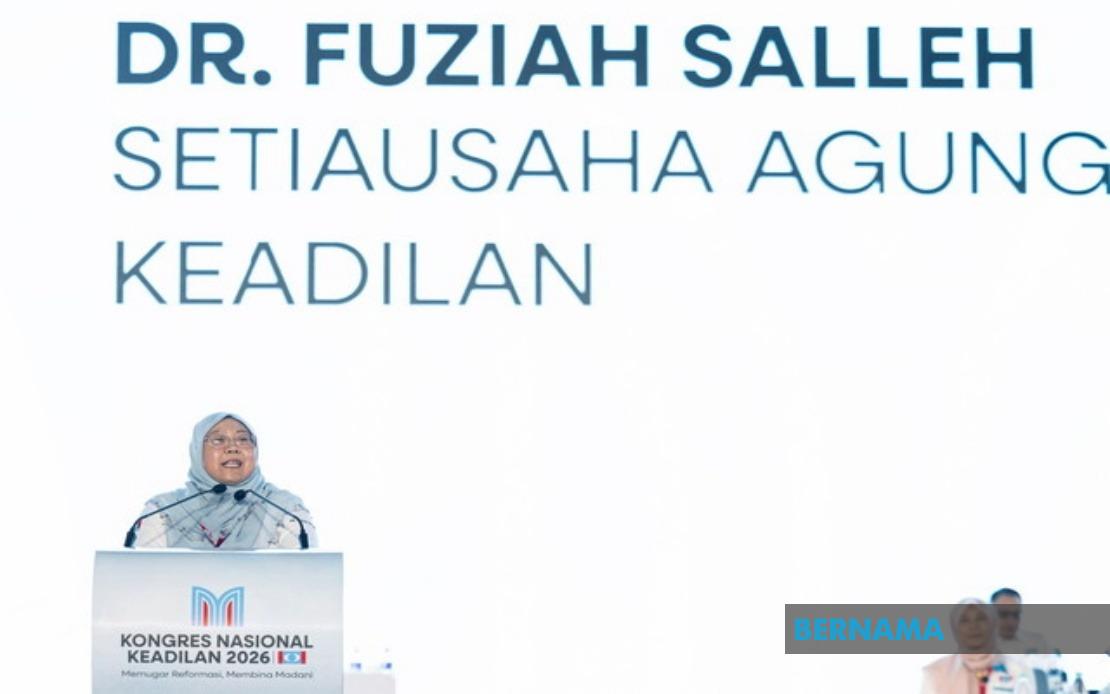
Datuk Dr Fuziah Salleh, secretary-general of Parti Keadilan Rakyat, has underscored the importance of PKR strengthening its intellectual grounding and public messaging on the MADANI Economy to convert policy ambitions into tangible improvements in citizens' lives. Speaking at the PKR National Congress 2026 in Melaka, Fuziah stressed that party personnel across all organisational levels must assume greater responsibility in operationalising the party's core political vision and translating ideological commitments into practical governance outcomes.
The challenge facing PKR, according to Fuziah, extends beyond rhetoric into the fundamentals of how the party frames its strategic direction and communicates its intentions to the electorate. She highlighted that if party delegates genuinely accept the MADANI Economy as the intellectual foundation guiding the party's trajectory, then a corresponding shift in mindset, communication strategies, and public narratives must follow accordingly. This alignment between internal conviction and external messaging represents a critical juncture for PKR as it seeks to consolidate its reform agenda and maintain political momentum.
Fuziah's remarks arrive at a moment when Malaysian political discourse increasingly centres on how ruling coalition parties translate policy frameworks into measurable benefits for ordinary citizens. The MADANI Economy, a governance initiative focused on inclusive growth and social welfare, has become a defining narrative for the current administration. However, as Fuziah's comments suggest, articulating the framework remains insufficient without corresponding institutional discipline and coherent messaging throughout the party machinery and government apparatus.
Executing institutional reforms on the scale envisioned by PKR demands unwavering commitment and rigorous self-discipline from both party structures and government agencies involved in implementation. Fuziah acknowledged the substantial effort required, noting that achieving transformative reform resembles a military campaign requiring adequate resources, strategic positioning, and coordinated action. The metaphor of "ammunition" she employed underscores the reality that political aspiration without practical tools, funding, and administrative capacity cannot succeed in reshaping policy outcomes.
Among PKR's stated priorities is maintaining an explicitly inclusive political orientation that advocates for the interests of all Malaysian demographic groups without ethnic or socioeconomic distinction. This positioning sets PKR apart in Malaysia's occasionally fractious political landscape, where identity-based political messaging frequently dominates. Fuziah reiterated that PKR's foundational principle involves championing the interests of economically disadvantaged populations across all communities, rather than organising political appeals around racial or class-specific entitlements.
The commitment to principles of justice and equitable economic frameworks has long characterised PKR's political identity since its establishment. Fuziah's emphasis on maintaining these commitments while navigating complex contemporary governance challenges reflects an effort to reconnect the party's ideological moorings with its practical policy agenda. The MADANI Economy framework appears positioned as the vehicle through which PKR intends to realise its inclusivity principles while managing competing demands within Malaysian politics.
For Southeast Asian observers, PKR's internal deliberations carry regional significance. Malaysia's ruling coalition has increasingly promoted the MADANI Economy model as a counterpoint to alternative development approaches in the region, particularly those emphasising growth without corresponding social protection mechanisms. If PKR can credibly implement reforms aligned with its stated principles, the outcomes could influence policy discussions across neighbouring states grappling with similar pressures to balance economic expansion with inclusive development.
The practical challenge confronting PKR involves bridging the gap between policy design and implementation effectiveness. Malaysian political experience demonstrates that even well-intentioned reform frameworks frequently encounter obstacles in execution, whether due to bureaucratic inertia, resource constraints, or competing political pressures. Fuziah's call for heightened discipline and commitment suggests an awareness that PKR's internal cohesion and consistency of messaging will prove critical to overcoming implementation obstacles.
Partnership dynamics within Malaysia's ruling coalition also merit consideration in evaluating PKR's reform prospects. As one component within a broader political arrangement, PKR's ability to advance its MADANI Economy agenda depends partly on alignment with coalition partners. Fuziah's emphasis on party messaging discipline may reflect recognition that coordinated communication across coalition members would strengthen public perception of reform commitment and consistency.
Looking forward, PKR's success in deepening public understanding of the MADANI Economy framework while simultaneously demonstrating tangible improvements in service delivery, economic opportunity, and social welfare provision will significantly influence both its internal cohesion and broader political credibility. The party's ability to convert high-level policy rhetoric into neighbourhood-level improvements in living standards ultimately determines whether the MADANI Economy narrative gains substantive meaning in Malaysian public consciousness.

