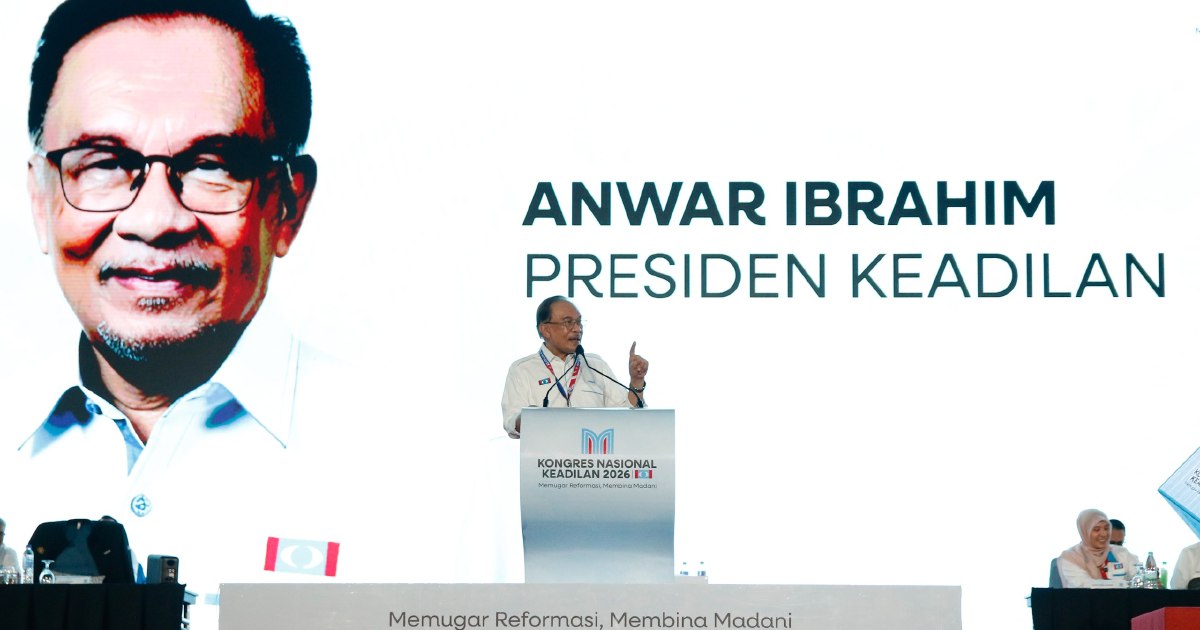
PKR President Datuk Seri Anwar Ibrahim has clarified his party's positioning within Malaysia's complex political landscape, confirming that the party intends to sustain its federal-level cooperation with Barisan Nasional and Umno even as it preserves its longstanding coalition ties to Pakatan Harapan allies DAP and Amanah. Speaking in Ayer Keroh, Anwar sought to address mounting questions about the party's dual commitments, which have increasingly drawn scrutiny as Malaysia's political terrain remains fractured and unstable.
This statement represents a significant effort by PKR leadership to manage what many analysts consider an inherently contradictory position. The party has emerged as a key player in Malaysia's post-2018 political settlement, but its role has become increasingly delicate given that its coalition partners in PH—particularly DAP—have historically positioned themselves as ideological opponents of Umno. By simultaneously maintaining engagement with both groupings, PKR has positioned itself as a centrist force capable of bridging Malaysia's deepest political divides, though such positioning carries substantial reputational risks.
The dynamics at play reflect the broader instability that has characterised Malaysian politics since the collapse of the Pakatan Harapan government in February 2020. That rupture led to shifting alliances and the eventual formation of the Perikatan Nasional government under Muhyiddin Yassin, followed by subsequent realignments. PKR's willingness to engage with Barisan Nasional signals recognition that no single coalition commands sufficient parliamentary strength to govern comfortably without negotiating across traditional dividing lines. This fragmentation has made coalition-building a matter of practical necessity rather than ideological preference.
From PKR's perspective, maintaining federal cooperation with BN-Umno provides the party with material benefits including ministerial posts, government funding for projects in areas represented by PKR members, and influence over policy implementation. These practical advantages matter significantly for a political party seeking to consolidate its base and reward supporters. However, the party simultaneously recognises that its grassroots support—particularly among urban, younger, and non-Malay voters—remains substantially influenced by its original positioning as a reformist opposition force allied with DAP's push for institutional accountability and meritocratic governance.
The relationship with DAP and Amanah presents a more ideologically coherent platform for PKR, as these parties share commitments to tackling corruption, strengthening judicial independence, and advancing multiethnic coalition politics. Abandoning this partnership would represent a significant betrayal of voters who supported PKR specifically because it stood apart from what they viewed as the patronage politics of Umno-led governments. The loss of such voter trust could prove irreversible, particularly given that DAP maintains substantial electoral leverage, particularly in urban constituencies where three-cornered contests could deliver outcomes favourable to neither PKR nor its stated allies.
Anwar's clarification attempts to establish a framework where PKR can justify its presence in both spaces. The party's leadership argues that federal-level cooperation with BN-Umno need not preclude commitment to PH at state level or in terms of policy direction and institutional reform. This distinction between federal operational engagement and coalition-level commitment may have some practical merit but remains philosophically awkward. Critics have questioned whether such compartmentalisation is genuinely sustainable, given that decisions made at the federal level inevitably cascade to influence state-level politics and resource allocation.
For Malaysian voters and political observers, this positioning raises important questions about the direction of political reform and institutional accountability. Throughout the Pakatan Harapan period from 2018 to 2020, PKR members alongside DAP and Amanah implemented various anti-corruption measures, supported judicial reforms, and pursued greater transparency in government procurement. The extent to which PKR can meaningfully advance these agendas while simultaneously cooperating with Umno—a party that faces multiple allegations of institutional self-enrichment during its long period in government—remains unclear and contested.
The regional implications also merit consideration. Southeast Asia has witnessed increasing concern about democratic backsliding and institutional deterioration, with Malaysia often cited as a cautionary case. The ability of reformist parties to maintain coherent positions on governance issues whilst navigating pragmatic coalition requirements ultimately affects not only Malaysia's trajectory but also the broader regional conversation about democratic sustainability. PKR's approach signals that pragmatism may supersede principle in Malaysian politics, a development that could influence how other Southeast Asian reformist movements approach similar dilemmas.
Looking ahead, the stability of this PKR balancing act will likely depend on several factors. Electoral performance in upcoming state elections will reveal whether the party can maintain support across its disparate voter base while managing expectations from both BN-Umno and PH partners. Economic conditions and the effectiveness of the government's policy implementation will also matter, as voters typically evaluate coalitions through a practical lens regarding service delivery and economic opportunity rather than purely ideological considerations. Additionally, internal dynamics within both BN-Umno and PH will influence whether space exists for PKR to maintain its intermediary position without facing explicit demands for exclusive loyalty.
Anwar's statement should be understood as a bid for political space and legitimacy across Malaysia's fractured landscape. Whether this approach succeeds in delivering both stability and meaningful reform remains one of the most consequential questions facing Malaysian politics in the coming years.

