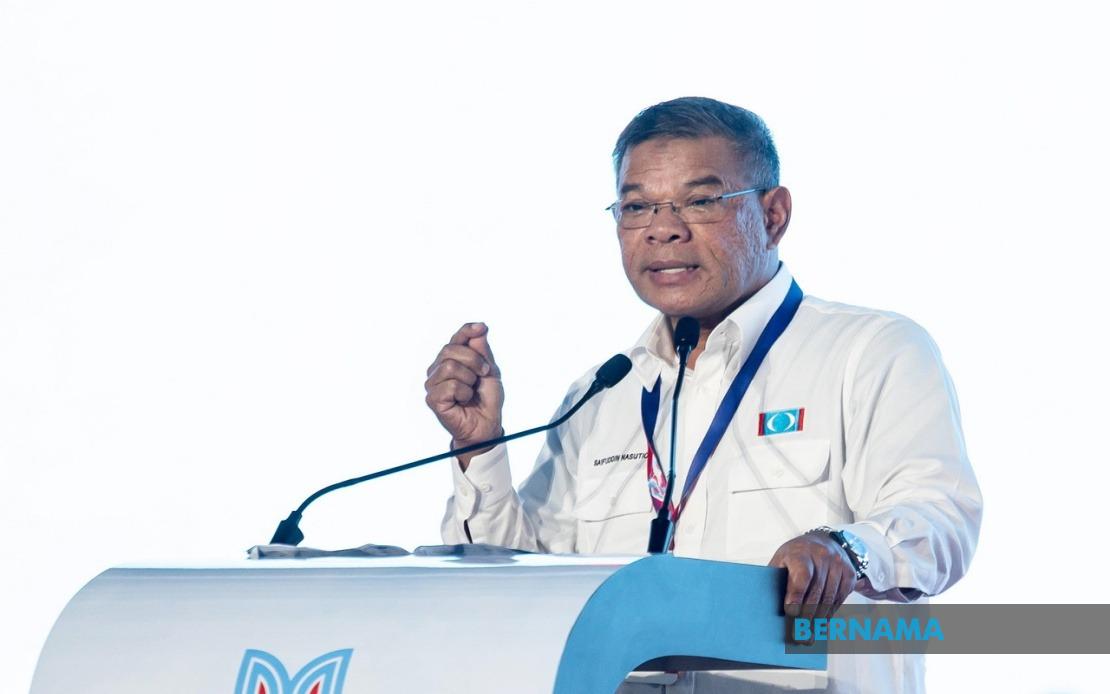
Malaysia's political landscape faces a critical choice between divisive identity-based messaging and pragmatic economics-focused governance, according to PKR leadership delivered at the party's 2026 National Congress in Melaka. Datuk Seri Saifuddin Nasution Ismail, the Home Minister discharging duties as deputy president, articulated a deliberate strategic pivot away from the racial and communal framing that has historically dominated Malaysian political discourse. His address at the Melaka International Trade Centre signalled the party's intention to reorient political competition around measurable policy outcomes rather than demographic appeals.
The PKR vice-president characterised identity-based political competition as fundamentally unproductive, describing it as a "zero-sum game" incapable of generating positive outcomes for the nation. This framing challenges the dominant operating assumption of Malaysian politics, where appeals to specific ethnic, religious, or geographic communities have proven electorally potent. Saifuddin Nasution's intervention suggests PKR believes the electorate—particularly younger voters—may be receptive to a different political calculus that emphasises material improvement over symbolic recognition of group identity.
The philosophical underpinning of PKR's position rests on an economic metaphor: expanding the overall "pie of prosperity" so that growth benefits all segments simultaneously, rather than redistributing existing resources between communities. This approach sidesteps zero-sum calculations entirely by proposing that improved economic performance and household well-being serve as the ultimate measure of government legitimacy. For Malaysian voters grappling with cost-of-living pressures, inflation, and employment uncertainty, this pivot toward delivery-based evaluation offers tangible criteria for assessing political success.
Crucially, the PKR leader acknowledged Malaysia's multiethnic and multireligious reality as an irreducible fact requiring acceptance rather than contestation. He articulated that Malay, Islamic, Chinese, Indian, Sabahan, and Sarawakian identities all constitute legitimate aspects of Malaysian society. This framework attempts to separate identity acknowledgement from identity-based political mobilisation—accepting diversity while rejecting its weaponisation for electoral advantage. Such positioning requires sophistication: recognising community distinctiveness without enabling fear-mongering or communal competition for state resources.
Saifuddin Nasution identified the genuine security threats facing Malaysian communities not as inter-ethnic tensions but as poverty, drug abuse, and social dysfunction that disproportionately affect young people across all demographic groups. By reframing the problem set, he argues that common adversaries—economic stagnation, substance abuse, governance failures—demand unified rather than fractionalised political responses. This analysis resonates with research suggesting Malaysians across ethnic lines share convergent priorities around employment, housing costs, and education quality.
The MADANI Government's stated approach encompasses three pillars aligned with this philosophy. Economic expansion through productivity and investment forms the foundation, intended to generate prosperity accessible across society. Complementing growth, need-based assistance mechanisms target support toward vulnerable populations regardless of ethnicity, recognising that multiple communities experience deprivation simultaneously. Finally, strengthened institutional integrity and anti-corruption measures protect public resources from leakage, ensuring government spending translates into genuine citizen benefit rather than elite capture.
For Southeast Asian observers, PKR's repositioning carries broader implications. The region features numerous democracies grappling with how to manage ethnic diversity while maintaining political competitiveness. Malaysia's experiment with de-emphasising identity-based appeals while delivering measurable economic improvement could influence other governments' strategic calculations. Conversely, if identity politics continues delivering electoral results despite PKR's repositioning, the approach risks appearing tone-deaf to voter preferences shaped by decades of communal political framing.
The timing of these statements reflects electoral positioning ahead of the next general election. PKR strategists evidently believe that younger voters, urban constituencies, and economically vulnerable communities across ethnic lines represent the party's growth opportunity. Emphasising performance metrics and shared material interests potentially expands PKR's coalition beyond its traditional base, particularly if the party can demonstrate tangible governance improvements. Young voters especially may welcome a political narrative prioritising their economic prospects over ancestral communal grievances.
However, translating rhetoric into electoral advantage requires PKR demonstrating that performance-based governance actually delivers superior outcomes compared to identity-focused competitors. The party must navigate the challenge of appearing inclusive without appearing indifferent to community-specific concerns. This balancing act demands that government programmes simultaneously expand overall prosperity while addressing particular disadvantages affecting specific populations, a technical and political complexity that has confounded Malaysian policymakers historically.
The statement also implicitly critiques opposition approaches while establishing ideological distance from coalition partners potentially wedded to communal mobilisation strategies. By positioning PKR as the party embracing post-identity politics, the leadership attempts to capture the demographic territory occupied by Malaysians fatigued by endless communal rhetoric and seeking governments focused on practical problem-solving. Whether this positioning reflects genuine strategic confidence or responds to electoral pressures remains an open question that the coming election will illuminate.
For regional observers and Malaysian citizens evaluating political offers, Saifuddin Nasution's address provides clarity about PKR's intended political positioning. The party explicitly rejects identity competition while affirming multiethnic coexistence and committing to need-based resource allocation. Whether this approach proves electorally sustainable or whether Malaysian voters continue preferring identity-focused messaging will significantly influence the trajectory of Malaysian political competition in coming years.

