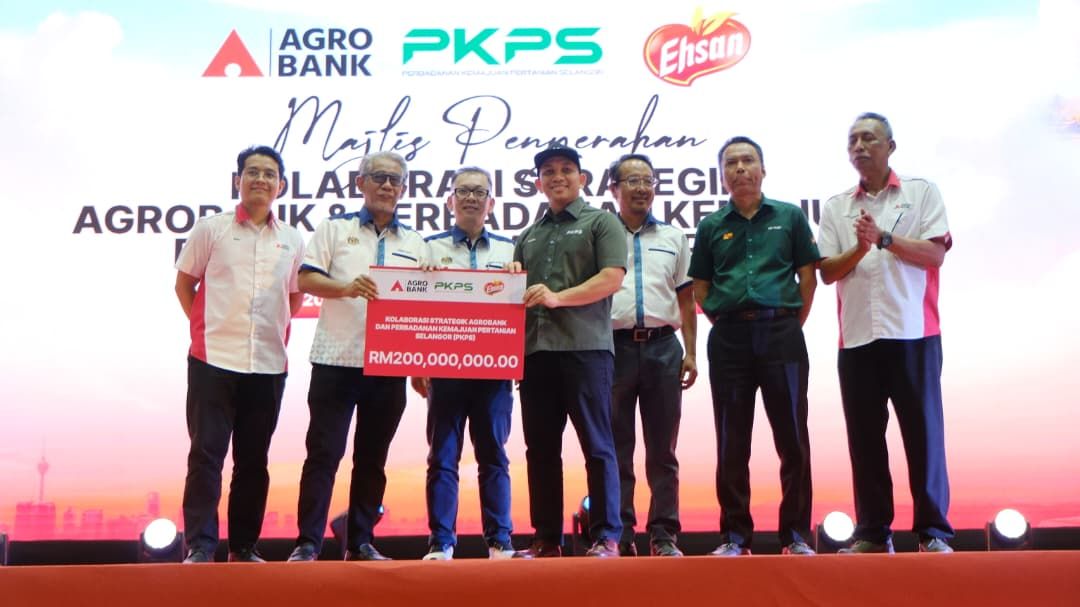
The Selangor Agricultural Development Corporation (PKPS) and Agrobank have forged a strategic financing arrangement worth RM200mil, marking a significant commitment to bolstering the state's agricultural infrastructure and food supply resilience. The collaboration addresses critical gaps in Selangor's agrifood ecosystem by providing dedicated capital for infrastructure expansion, operational expenses, and research initiatives that will reshape the region's capacity to produce, process, and distribute food products efficiently.
The partnership was publicly formalised at the Malaysia Agriculture, Horticulture and Agrotourism Exhibition (MAHA) 2026, held at Malaysia Agro Exposition Park (MAEPS) in Serdang on August 29. During the ceremonial handover, Agrobank group president and chief executive officer Datuk Tengku Ahmad Badli Shah Raja Hussin presented a symbolic cheque to PKPS group chief executive officer Datuk Dr Mohamad Khairil Mohamad Razi, with the proceedings witnessed by Deputy Agriculture and Food Security Minister Datuk Chan Foong Hin. The formal activation of the facility is scheduled for March 2027, following standard approval and implementation procedures.
The centrepiece initiative under this financing arrangement is the construction of a state-of-the-art halal food warehouse that will function as a centralised storage and logistics node. This facility represents more than bricks and mortar—it addresses a structural bottleneck in Selangor's food distribution network by providing temperature-controlled, certified halal storage capacity that meets both local regulatory standards and international export requirements. For Malaysian businesses seeking to penetrate premium halal markets across Asia and the Middle East, such infrastructure is essential competitive infrastructure.
Beyond the warehouse, PKPS plans to establish a dedicated halal chicken processing centre and an Ehsan-branded product processing facility. These additions reflect recognition that Selangor's agricultural value chain suffers not only from logistics gaps but also from limited downstream processing capabilities. Currently, much of the state's raw agricultural output is exported for processing elsewhere, with value creation occurring beyond state borders. These new facilities aim to capture that value domestically while creating employment and enhancing food safety oversight throughout the production chain.
The facility also encompasses a network of central distribution warehouses across Selangor's districts, designed to ensure that processed and raw agricultural products reach retailers and consumers with minimal spoilage and maximum efficiency. For a state with Selangor's population density and consumption patterns, fragmented distribution infrastructure has historically undermined competitiveness and contributed to food price volatility. Centralised logistics hubs reduce these inefficiencies and lower the ultimate cost to consumers.
Operational funding represents another dimension of this partnership. PKPS will utilise allocated capital for day-to-day operations at existing and new facilities, ensuring continuity of services without depending entirely on volatile government budget cycles. This operational flexibility is particularly valuable given Malaysia's seasonal agricultural patterns and the need for consistent workforce deployment across harvesting, processing, and distribution operations throughout the year.
Research and development constitutes a third pillar of the facility's deployment. PKPS will operate the Ehsan Agricultural Research Centre, focusing on smart agriculture technologies and precision farming techniques that increase yields while conserving water and soil nutrients—critical considerations as Selangor faces growing urban encroachment on productive agricultural land. Simultaneously, the Ehsan Agricultural Training Centre will develop human capital, addressing persistent skills gaps in modern agrotechnology and food safety management that have constrained productivity improvements across the sector.
The partnership extends into value-added food production, specifically ready-to-eat and ready-to-heat products marketed under the Ehsan brand. These convenience products align with evolving consumer preferences across urban Malaysia, where dual-income households and time-pressed professionals increasingly purchase prepared meal options. By positioning Selangor-grown agricultural inputs into modern, branded food products, PKPS can command premium pricing while building consumer recognition for state agricultural output.
Agritourism development at the Ehsan Resort and Convention Centre represents an innovative revenue diversification strategy that complements commodity production. This component acknowledges that modern food security encompasses not only calories and nutrition but also consumer connection to agricultural origins and practices. Visitors to such facilities gain understanding of food production systems, potentially enhancing social licence for agricultural activities and creating secondary income streams for farmers and agribusinesses operating in the region.
The facility's deployment will follow rigorous governance protocols, with disbursements tied to documented project progress rather than upfront capital releases. This structure protects both the lender and borrower by ensuring cash flow discipline and enabling course correction if projects encounter implementation obstacles. For Malaysian stakeholders evaluating this partnership, such transparency mechanisms are essential safeguards, particularly when public sector entities like PKPS deploy taxpayer-funded or publicly-aligned capital.
The timing of this announcement, coinciding with MAHA 2026, reflects deliberate strategic messaging. The exhibition's theme—"Value Creation for Food Security"—encompasses precisely the concerns this financing facility addresses: moving beyond subsistence agricultural models toward integrated value chains featuring technology adoption, quality certification, and market-driven production. Selangor's significance as Malaysia's economic engine and primary population centre makes its food security particularly consequential for national stability and consumer price management.
For Malaysian agriculture broadly, this partnership offers a replicable template. Other states grappling with agricultural modernisation challenges can examine how targeted infrastructure financing, combined with research investment and skills development, creates systemic improvements across production and distribution. Agrobank's participation signals that Malaysia's specialised agricultural lending sector views such integrated approaches as bankable propositions with acceptable risk profiles, potentially catalysing similar partnerships elsewhere across the country.
Looking forward, the success of this facility will substantially influence Selangor's trajectory toward food self-sufficiency targets and agricultural competitiveness. By March 2027, concrete progress on the halal warehouse and processing facilities will demonstrate whether this partnership translates financial commitment into tangible capacity improvements. For Malaysian consumers, policymakers, and agricultural investors, the coming months will reveal whether this RM200mil investment genuinely recalibrates the state's agrifood sector or represents merely incremental marginal adjustment.

