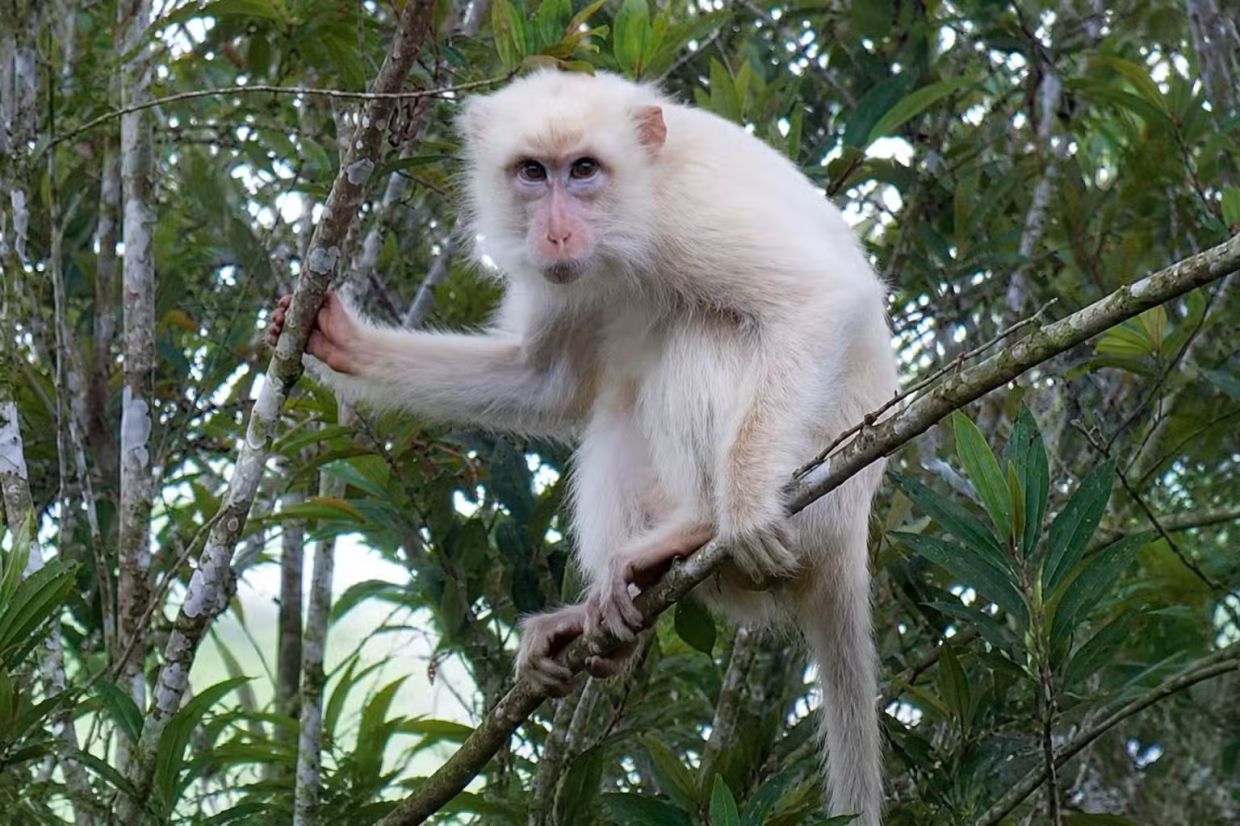
A distinctive white macaque inhabiting the forests of Sultan Kudarat province has become the focus of an intensive conservation effort, with Philippine environmental authorities moving to shield the animal from the mounting dangers posed by its sudden viral prominence. The primate, belonging to the Philippine long-tailed macaque species, has roamed the region for approximately a decade largely unnoticed by the broader public. However, the cascade of videos and photographs shared across social media platforms transformed the animal from a local curiosity into a conservation crisis, prompting the Department of Environment and Natural Resources (DENR) Region XII and the municipal government of Senator Ninoy Aquino town to implement emergency protective measures.
Initial assessments suggested the macaque suffered from albinism, the complete absence of pigmentation evident in its striking white appearance. Subsequent field investigations by DENR XII specialists, however, revealed more nuanced findings that complicate the diagnosis. The monitoring team observed that the animal possessed distinctly brown to dark brown eyes, a characteristic inconsistent with classical albinism, which typically results in pink or red eyes due to visible blood vessels. These observations point instead toward leucism or related pigmentation disorders affecting melanin production. Wildlife experts emphasise that definitive scientific verification remains necessary before researchers can conclusively categorise the macaque's condition, highlighting the complex interplay between field observation and laboratory analysis in modern wildlife assessment.
For residents of Senator Ninoy Aquino town, the white macaque represented an ordinary yet captivating feature of their natural surroundings. A local resident named Armando confirmed sightings dating back to 2016, with the animal establishing habitual patterns throughout the forested landscape. The macaque's presence appeared consistent with broader population dynamics of Philippine long-tailed macaques in the region, suggesting successful adaptation despite its distinctive phenotype. This extended coexistence between the unusual animal and local communities proceeded without significant intervention or conflict. The transformation occurred suddenly when digital documentation proliferated across social media platforms, exposing the macaque's existence and approximate location to audiences far beyond its immediate geographic range.
The expansion of online visibility created unprecedented risks for the species. DENR officials articulated grave concerns that heightened awareness and tourism interest could facilitate poaching, capture, and trafficking—threats that plague rare or distinctive wildlife throughout Southeast Asia and beyond. The prospect of collectors or traders seeking the visually striking animal prompted authorities to view social media dissemination not as mere wildlife appreciation but as a mechanism enabling exploitation. This calculation reflects broader patterns evident across the region, where viral species discoveries frequently precipitate environmental damage and animal trafficking. The Philippine government recognised that the macaque's survival depended upon immediately inverting the publicity dynamic—converting public knowledge into restricted access rather than permitting unrestricted viewing.
Biological conditions confirmed that the macaque's existing habitat remained suitable for continued residence and population sustainability. DENR assessments identified adequate secondary forest vegetation and abundant natural food sources, indicating that ecological constraints had not driven the animal's unusual colouration or compromised its fitness within the environment. This favourable habitat assessment suggested that isolation from human disturbance represented the primary requirement for species preservation, a goal achievable through access restrictions rather than costly relocation or captive management. The municipality consequently implemented a temporary closure of the specific area where the macaque had been most frequently observed, a measure designed to eliminate casual tourism and prevent opportunistic poaching while authorities developed longer-term safeguards.
Barangay Bugso, the administrative unit encompassing the macaque's range, initiated legislative processes to establish permanent protective frameworks. Local officials drafted an ordinance formalising conservation obligations applicable to the white macaque, its immediate habitat, and the broader forest ecosystem supporting the broader macaque population and associated biodiversity. Pending formal enactment of this legislation, unauthorised entry into the vicinity of reported sightings remained prohibited under temporary administrative authority. The ordinance approach represents a significant commitment, transforming ad hoc emergency measures into institutionalised policy with enforceable mechanisms and designated accountability structures.
Comprehensive habitat management extends beyond mere access restriction. Barangay officials announced plans for tree-planting initiatives and systematic habitat restoration activities, interventions designed to strengthen ecological function and enhance landscape resilience. These measures pursue dual objectives: augmenting biodiversity conservation capacity while developing frameworks supporting responsible ecotourism that generates economic benefits for local communities without compromising species protection. This balance recognises that sustainable conservation requires local support grounded in tangible economic incentives, a principle increasingly central to successful wildlife management throughout the developing world.
The legal foundation for these protective actions derives from Republic Act No. 9147, the Wildlife Resources Conservation and Protection Act, comprehensive legislation establishing the basis for wildlife safeguarding throughout the Philippines. This statute prohibits hunting, capturing, collecting, possessing, transporting, trading, or disturbing wildlife without authorised permits, provisions providing legal teeth to administrative restrictions and offering enforcement pathways for persistent violations. DENR emphasised that the protective regime applies universally to all wildlife, not merely rare species, yet acknowledged that the macaque's distinctive visibility had created particular urgency. The agency simultaneously appealed directly to media professionals, content creators, photographers, journalists, and ordinary social media participants, requesting restraint in disclosing precise locations or posting geographically tagged content that could facilitate access and exploitation.
The DENR XII has committed to ongoing documentation and systematic scientific evaluation, submitting comprehensive data on the macaque to the Biodiversity Management Bureau for technical assessment and authoritative classification. This submission initiates institutional channels that connect local field observation to national scientific capacity, integrating the macaque into broader biodiversity monitoring and research frameworks. Simultaneously, regional authorities pledged sustained habitat surveillance, enhanced coordination with stakeholder communities, and intensified public education campaigns emphasising wildlife protection responsibilities. These sustained commitments suggest recognition that the macaque's conservation represents an extended undertaking rather than a discrete crisis requiring brief intervention.
The white macaque's trajectory exemplifies contemporary conservation challenges in Southeast Asia, where rapid information dissemination through digital platforms creates unprecedented pressures on wildlife species whose unusual characteristics attract human attention. The animal's decade-long existence proceeded uneventfully because its local community maintained protective silence, a situation that globalised social media has rendered increasingly difficult to sustain. The Philippine government's intervention—combining access restriction, legal framework development, habitat enhancement, and public communication—attempts to reconstruct protective conditions within a transformed information environment. As authorities continue monitoring the forest where this distinctive macaque resides, the broader question persists: whether protective measures enacted after widespread publicity can adequately safeguard wildlife in an era where visibility constitutes profound vulnerability.

