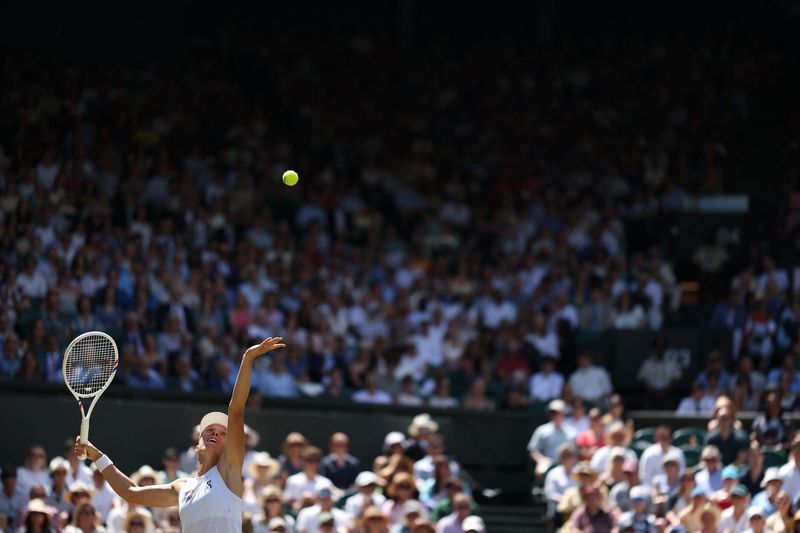
Alexandra Eala of the Philippines staged a remarkable upset at the All England Club on Saturday, dismissing third-seeded Polish champion Iga Swiatek 7-6(9) 6-2 in a thrilling third-round encounter that ended the two-time Grand Slam winner's title defence. The left-handed Filipino, playing with aggressive confidence on the rapid grass surface, proved too powerful for Swiatek, who arrived at Wimbledon seeking to replicate her triumphant 2023 campaign but instead encountered an opponent operating at peak form.
Swiatek's journey to this showdown had been marked by inconsistency. The 25-year-old Pole had weathered an early exit at the Bad Homburg warm-up tournament before advancing through her opening rounds at the All England Club, including victories over Taylor Townsend and Karolina Pliskova. Yet those earlier successes provided little momentum against an inspired Eala, whose combination of powerful baseline play and tactical acumen proved decisive under blazing summer conditions.
The opening set unfolded as a gruelling test of nerve and precision, with both players maintaining relentless intensity throughout the tiebreak. Neither competitor surrendered easy points, resulting in a brutal first-set contest that eventually favoured Eala through superior execution when it mattered most. The tiebreak victory, sealed 9-7, gave Eala a crucial psychological edge heading into the second set.
Swiatek's frustrations mounted visibly as the match progressed. Following the opening-set loss, she directed sharp words toward her coaching box while also venting her disappointment through a racket slam onto a courtside chair. These moments revealed the mental toll that Eala's relentless assault was inflicting, as Swiatek struggled to find answers to her opponent's serve-and-volley combinations and baseline aggression.
The second set demonstrated Eala's ability to capitalize on momentum. The Filipino surged to a commanding 3-0 lead by earning a double break at the start of the set, leaving Swiatek fighting from deep within a deficit. While Swiatek clawed back one break early in the set's middle stages, the momentum had fundamentally shifted. Eala's superior baseline movement and court positioning allowed her to maintain control despite her opponent's brief recovery.
Eala's powerful forehand proved a particular weapon throughout the encounter, rattling Swiatek early and frequently preventing the Polish player from establishing her usual rhythm on grass. The 22-year-old Filipino's tactical maturity—demonstrated by her willingness to attack when opportunities presented themselves while playing defensively sound grass-court tennis—showcased her development as a complete player across all surfaces.
This triumph carries particular significance for Eala's career trajectory. The Filipino has been steadily ascending the rankings and gaining experience against the sport's elite competitors, making this Wimbledon breakthrough a validation of her potential on the grass-court circuit. Her aggressive baseline play, which can appear risky on faster surfaces, proved perfectly suited to modern Wimbledon conditions that favour powerful baseline exchanges over traditional serve-and-volley tactics.
The context of their prior meetings added drama to Saturday's encounter. Eala had previously shocked Swiatek with a stunning upset at the Miami tournament, establishing that she possessed the weapons to trouble the Polish champion. However, Swiatek had gained revenge when they reconvened on the clay courts of Madrid, suggesting an uncertain dynamic heading into their Wimbledon clash. The grass-court environment proved to be Eala's preferred terrain for settling their rivalry.
Swiatek's defeat represents a significant setback in her campaign to recapture the Wimbledon crown she had claimed so impressively twelve months earlier. That 2023 victory had finally answered persistent questions about her capacity to perform on the tour's fastest surface, yet this early exit demonstrates that consistent excellence at Wimbledon remains elusive. The Polish player's early struggles at Bad Homburg preceded this third-round exit, suggesting that her preparation for the grass-court season may require examination.
Eala's advancement sets up a compelling fourth-round encounter with Jasmine Paolini, the 2024 Wimbledon runner-up who remains a formidable competitor. This matchup will test whether Eala's grass-court breakthrough represents genuine progress or a one-off upset. Paolini's pedigree, combined with Eala's emerging confidence, promises an intriguing contest that could determine whether the Filipino maintains her surprising tournament run.
For the wider Southeast Asian tennis community, Eala's performance carries inspirational weight. The region has traditionally produced strong male competitors but fewer female players consistently reaching elite Grand Slam stages. Eala's ability to defeat a three-time Grand Slam finalist demonstrates that players from the region can compete authentically against the established hierarchy. Her grass-court success, in particular, contradicts the regional perception that Southeast Asian players struggle on fast surfaces, suggesting broader opportunities for development of younger talent on diverse court types.
The All England Club crowd, known for appreciating competitive tennis and rewarding underdog performances, embraced Eala's victory enthusiastically. This partisan support, combined with her composed execution under pressure, reinforced the notion that Eala possesses not merely technical ability but also the temperament required for sustained success in high-pressure Grand Slam environments. Her resilience following previous defeats has culminated in this breakthrough moment at tennis's oldest and most prestigious tournament.

