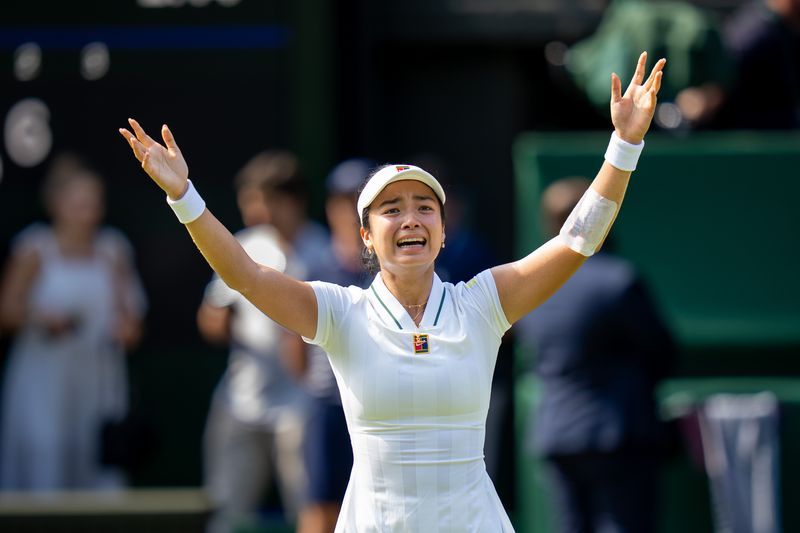
Alexandra Eala has scripted a defining moment for Philippine tennis by dismantling defending Wimbledon champion Iga Swiatek in a dominant display on Saturday, one of several seismic shifts in the women's draw at the All England Club. The 29th-seeded Filipino prevailed 7-6(9) 6-2 in a performance that announced her as a legitimate force on grass, removing one of the sport's most formidable competitors and claiming the scalp that few expected her to pursue this early in the tournament.
Swiatek entered the match as the tournament's third seed and holder of the title, yet found herself outmanoeuvred by an opponent who mixed fearless aggression with technical precision. The opening set unfolded as a gruelling affair spanning nearly 90 minutes, with Eala saving a set point during the tiebreak when Swiatek's forehand found the net. The Polish champion's frustration boiled over in that moment, the pressure of defending her crown visibly weighing upon her as she offered bitter laughter toward her coaching box. Once the opening set fell to Eala, however, the momentum proved irreversible. Swiatek had no antidote to her opponent's composed intensity, and the second set became a procession as Eala sprinted to victory with consummate ease.
For Philippine tennis, Eala's trajectory represents a watershed moment. The 29-year-old is the first player from her nation to reach the fourth round of any Grand Slam tournament, a barrier that stood for decades despite the country's 115 million inhabitants and thriving sports culture. Eala carried this historical weight into her match, as evidenced by her raw, emotional address to the Centre Court crowd after her victory. Drawing on childhood memories of training after school with her brother and grandfather, complete with ruffled socks and light-up shoes, she articulated what this achievement means beyond mere rankings and statistics. Yet she balanced vulnerability with steely determination, telling reporters that emotion alone would not satisfy her ambitions. She faces 13th seed Jasmine Paolini in the next round, a formidable opponent who dismantled Greece's Maria Sakkari 6-1 6-2.
Eala's breakthrough coincided with another stunning upset in the women's draw. Elena Rybakina, seeded second and the 2022 Wimbledon champion who won the Australian Open earlier this year, fell to Belgian Elise Mertens 7-6(4) 6-1 in a result that sent shockwaves through the tournament. The Russian-born Kazakh player had entered the Championships with genuine prospects of ascending to world number one, but Mertens' aggressive baseline game neutralised Rybakina's typically dominant serve. After losing a competitive opening set via tiebreak, Rybakina capitulated in the second, appearing drained and searching for answers. She subsequently acknowledged to reporters the necessity for fundamental reassessment, admitting that her current approach was yielding diminishing returns.
The American contingent experienced mixed fortunes on what Americans marked as the 250th anniversary of the Declaration of Independence. Madison Keys, seeded 26th and riding confidence from her title victory in Eastbourne, upset sixth-seeded Amanda Anisimova in an all-American contest, prevailing 3-6 6-2 6-3. Keys' dominance on grass surfaces has become increasingly pronounced, and her ability to find rhythm against a former Wimbledon finalist demonstrated the depth of American women's tennis. Qualifier Ashlyn Krueger similarly impressed with a commanding 6-3 6-2 dismissal of Ukraine's Daria Snigur, though 23rd seed Emma Navarro fell to Marta Kostyuk in three sets, suggesting inconsistency remains a challenge for American challengers.
By contrast, the men's draw remained notably stable, with second seed Alexander Zverev, freshly crowned French Open champion, maintaining his formidable trajectory with a 6-2 7-6(4) 6-4 victory over American Marcos Giron. Zverev's grass-court prowess continues to validate his status among tennis' elite, suggesting the German remains the primary threat to defending champion Jannik Sinner as the tournament progresses. Sinner, the Italian favourite who won last year's Wimbledon title, has already advanced to the fourth round, positioning Italy with genuine prospects of fielding four men in the last 16 of a Grand Slam for the first time since 1947.
Flavio Cobolli, the ninth seed and French Open runner-up, survived a torrid opening against Russia's Karen Khachanov, losing the first set 6-0 before orchestrating an improbable five-set recovery, ultimately triumphing 0-6 7-6(4) 6-7(5) 6-2 6-2. Such resilience under duress may prove invaluable in a tournament that frequently demands mental fortitude. He will confront Australian Alex de Minaur in the next round following de Minaur's straightforward 6-2 5-7 6-2 6-4 victory over American Zachary Svajda. However, the Italian surge received a setback when Lorenzo Sonego succumbed to sixth seed Taylor Fritz 4-6 6-3 6-4 7-6(5) despite an encouraging start.
Off the main courts, British support crystallised around Arthur Fery, whose dramatic comeback against Belgium's Zizou Bergs on Court 18 provided the day's most emotional theatre. Trailing by two sets to one and facing a double break at 1-4 in the fifth set, Fery refused capitulation, clawing back through sheer determination whilst battling three nosebleeds. His victory in the tournament's longest match to date, decided by a deciding-set tiebreaker, embodied the spirit that makes Wimbledon distinctive among tennis venues. Fery's refusal to surrender resonated with home supporters whose appetite for gutsy British performances remains undiminished.
Serena Williams, the American legend whose return to Wimbledon after four years absence had captured global imagination, withdrew from her eagerly anticipated doubles partnership with sister Venus due to injury. Having already bowed out of singles competition following a loss to Maya Joint, the withdrawal prompted Williams to express her devastation via social media, though her return itself represented a significant moment for tennis and American sport more broadly. Her continued physical struggles highlight the toll extracted by elite professional competition even for those regarded as among history's greatest athletes.
Eala's emergence as a genuine fourth-round contender carries implications beyond Philippine tennis. Her victory validates the potential within Southeast Asian tennis ecosystems, regions often overlooked by the sport's establishment despite harbouring immense talent pools. With Eala now positioned to potentially advance further and increase her ranking profile, pathways for subsequent Filipino and Southeast Asian players may widen, encouraging investment in grassroots development and professional infrastructure throughout the region. Her cap bearing the Tagalog motto "Once it grows, it cannot be stopped" appears prophetic.

