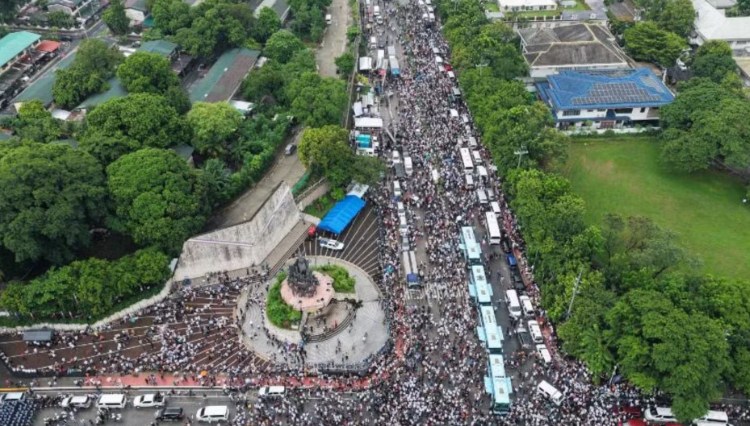
The Philippines saw a powerful demonstration of religious mobilisation on Tuesday as tens of thousands of members from the Iglesia Ni Cristo, one of the country's most influential faith organisations, descended on Manila's central thoroughfare to oppose the pending prosecution of Senator Rodante Marcoleta. The massive gathering created traffic disruptions spanning kilometres across the capital during peak commuting hours, underscoring both the logistical scale of the protest and the deep political tensions roiling the nation. Police estimates placed the crowd at 8,000 people early in the proceedings, with expectations the numbers would swell as the day progressed, making clear the church's capacity to mobilise supporters at short notice.
The timing of the rally proved strategically significant. Government ombudsman Jesus Remulla had announced the previous day that Marcoleta would face graft charges centring on his failure to declare 75 million pesos in unused election campaign contributions, allegations that carry potentially serious legal consequences. For the Iglesia Ni Cristo, however, the case represented something far broader than individual accountability—it symbolised what church leaders characterised as selective justice wielded against their community. In a video message distributed across social media, INC spokesman Edwil Zabala framed the protest as a demand for transparency and equal treatment under law, declaring that imprisoning Marcoleta would not silence the organisation's insistence on fairness in the judicial system.
Marcoleta's situation cannot be separated from the broader political upheaval engulfing the Philippine establishment. He stands as a vocal supporter of Vice President Sara Duterte, who faces impeachment proceedings beginning the following week. With 16 votes required from the 24-seat Senate for conviction and removal, political observers regard Marcoleta as virtually certain to vote against Duterte. The senator's legal jeopardy thus carries implications extending well beyond his personal fate, touching on the fundamental question of whether key votes in Duterte's trial might be influenced by prosecutorial actions against her allies. This triangulation—between religious mobilisation, judicial proceedings, and electoral politics—illustrates how Philippine governance mechanisms have become dangerously entangled.
The Iglesia Ni Cristo possesses historical significance as a voting bloc of considerable influence, maintaining longstanding associations with the Duterte political dynasty. The church's capacity to assemble thousands on short notice represents real political currency in Philippine democracy, and its deployment in Marcoleta's defence signals that the organisation views his prosecution as an attack on its institutional interests. The group's decision to occupy Manila's most visible public spaces during rush hour ensured maximum political visibility, disrupting the daily routines of ordinary commuters while amplifying the church's message about perceived injustice.
The rally also reflected deeper anxieties within Duterte-aligned circles about the prosecution's trajectory. Beyond Marcoleta, other prominent Duterte loyalists faced their own legal troubles. Senator Jose Estrada confronted corruption charges related to the massive flood control scandal that had sparked public outrage earlier in the year. Meanwhile, Senator Ronald Dela Rosa had entered hiding to avoid arrest on an International Criminal Court warrant concerning alleged crimes during Rodrigo Duterte's brutal drug war. The cumulative effect suggested a coordinated accountability drive against the previous administration's inner circle, creating a political environment where Duterte supporters increasingly felt threatened.
Interestingly, the Iglesia Ni Cristo's protest activities had already demonstrated the organisation's political engagement in prior months. In November, the church mobilised an estimated crowd numbering in the hundreds of thousands to demand accountability regarding the flood control scandal, though many speakers at that earlier rally directed criticism toward President Ferdinand Marcos rather than protecting Duterte allies. That shift—from blaming Marcos to defending Marcoleta—revealed how political calculations within the organisation had evolved as circumstances changed and different threats to its interests materialised.
The religious sect's mobilisation against Duterte's impeachment in January 2025 underscored its continued protective posture toward the former president's family despite her dramatic falling-out with Marcos. Even after the Supreme Court reversed an initial impeachment attempt, the House of Representatives proceeded with a second impeachment vote the previous month, indicating that momentum for Duterte's removal persisted within legislative circles. The upcoming trial thus represented a genuine constitutional crisis, with genuine uncertainty about whether sufficient Senate votes existed for her removal.
President Marcos's decision to cancel a scheduled luncheon with foreign press to monitor the protest situation indicated the government's awareness of the rally's political significance. The optics of Duterte loyalists mobilising massive crowds while facing prosecution created a narrative that administration critics might weaponise, complicating Marcos's position even as he pursued accountability measures against his political rivals. The cancelled diplomatic engagement suggested that Marcos considered the domestic political situation sufficiently unstable to justify altering his public schedule, a gesture recognising the rally's symbolic weight.
The graft charges against Marcoleta centre on what prosecutors characterised as inadequate financial disclosures rather than personal enrichment, a technical distinction that church supporters seized upon to argue the charges represented government overreach. Whether intentionally or not, the timing of the prosecution relative to the impeachment trial invited speculation about whether judicial processes had become politicised. For Malaysian observers, this situation illuminates the challenges facing any democracy where institutional checks have grown sufficiently weakened that religious organisations perceive the need to mobilise public pressure as their primary defense against legal proceedings affecting their members.
The street-level dimensions of this political confrontation merit particular attention. The deliberate creation of traffic disruption served multiple functions—it demonstrated organisational capability, drew media attention, and imposed costs on ordinary Filipinos, potentially building sympathy for the protesters' cause or alternatively generating resentment depending on political perspective. This tactic, increasingly common in Manila's political theatre, illustrated how direct action and institutional politics had become intertwined in ways that destabilised normal governance.
Looking forward, the Senate trial beginning July 6 would determine whether Duterte faced removal from office, with Marcoleta's vote appearing pivotal. The Iglesia Ni Cristo's public mobilisation represented an attempt to protect that crucial vote by generating political pressure against prosecutors and senators contemplating conviction. Whether such street-level pressure would ultimately influence legal outcomes or Senate calculations remained unclear, but the scale and timing of the demonstration indicated the religious organisation viewed the stakes as existential rather than merely defensive.

