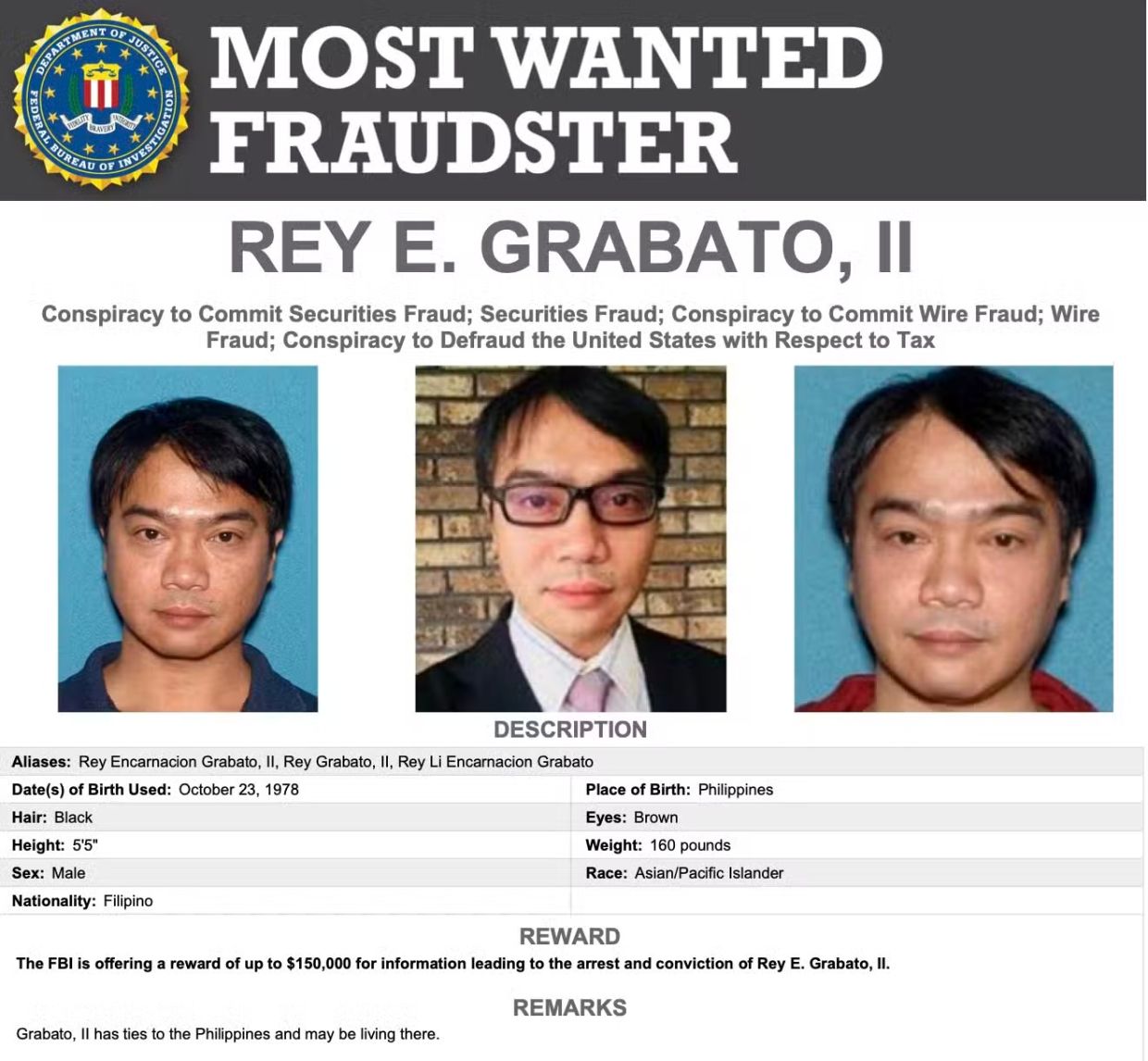
The son of Mina, Iloilo's mayor has become the latest high-profile fugitive to land on the FBI's Most Wanted Fraudsters list, accused of orchestrating one of the largest investment scams to target American investors. Rey E. Grabato II, whose father Rey P. Grabato serves as the municipality's chief executive while his mother Lydia Encarnacion Grabato previously held the same position, now faces federal charges related to what prosecutors characterise as a sweeping US$650 million Ponzi scheme that extracted savings from roughly 2,000 investors over a four-year period. The FBI has authorized a reward of up to US$150,000 for credible information resulting in his capture and conviction.
The scheme centred on NRIA Partners Portfolio Fund I LLC, a real estate investment vehicle operated by National Realty Investment Advisors LLC, where Grabato served as former president and principal owner. Working in concert with co-conspirator Thomas Nicholas Salzano, Grabato allegedly deployed a comprehensive deception strategy designed to convince potential investors that NRIA possessed a robust financial foundation capable of generating substantial returns. The perpetrators saturated the national market with marketing materials across multiple media platforms—television commercials, radio spots, roadside billboards, and coordinated email campaigns reaching thousands of recipients—complemented by in-person investor presentations conducted across the country.
The investment proposition itself was fundamentally dishonest. Grabato and Salzano reportedly misrepresented the fund's profitability and financial stability, assuring investors that their capital would generate meaningful gains through legitimate real estate ventures. In reality, prosecutors allege that NRIA generated minimal or zero profits while simultaneously becoming dependent upon a steady inflow of fresh investor capital to finance payouts to earlier participants—the defining characteristic of a Ponzi scheme. This arrangement proved unsustainable, and approximately 2,000 investors, including several hundred based in New Jersey, suffered losses between February 2018 and January 2022.
Beyond the investment fraud itself, federal authorities have documented a pattern of outright theft. Grabato and his associates are accused of systematically misappropriating millions of dollars in investor funds, diverting capital that should have been deployed in legitimate real estate projects toward personal enrichment and scheme maintenance. This layer of criminal conduct—direct embezzlement disguised within the investment structure—transformed what might have appeared as a failed business venture into calculated fraud.
The investigation has also uncovered what prosecutors describe as a sophisticated tax evasion conspiracy operating in parallel to the investment scheme. Between November 2007 and August 2022, Grabato allegedly coordinated efforts to obstruct the Internal Revenue Service's collection activities regarding approximately US$26 million in outstanding tax obligations owed to the federal government. This obstruction scheme suggests that Grabato's criminal enterprise extended beyond conventional fraud into deliberate interference with governmental tax enforcement mechanisms, compounding the severity of his alleged wrongdoing.
Grabato faces multiple serious federal charges including securities fraud, wire fraud, and conspiracy to defraud the United States in connection with tax matters. A federal arrest warrant was issued on October 12, 2022, by the US District Court for the District of New Jersey in Newark after he was formally charged. At the time of the warrant's issuance, authorities identified Grabato as residing in Hoboken, New Jersey, and maintaining ties to the Philippines—a profile suggesting the capacity to flee to the Southeast Asian region. Despite months of pursuit, Grabato has evaded capture and remained a fugitive, distinguishing himself from his co-conspirator Salzano, who was apprehended in October 2022.
The suspect has reportedly used multiple alias names—Rey Encarnacion Grabato II, Rey Grabato II, and Rey Li Encarnacion Grabato—complicating law enforcement efforts to track his movements and financial activities. This pattern of name variation typically indicates either an attempt to obscure identity for evasion purposes or an effort to compartmentalise fraud operations under different personas. The FBI's database maintains these alternate identities as part of its official fugitive profile.
Grabato's inclusion on the FBI's Most Wanted Fraudsters list reflects the bureau's expanding commitment to high-profile fraud cases. The agency established this specialised list in June 2026 specifically to elevate public awareness regarding fugitives charged or convicted of major fraud offences, treating such cases with investigative priority comparable to traditional violent crime. The initiative recognises that large-scale financial fraud inflicts cumulative damage across thousands of households while remaining less visible to public consciousness than other felonies.
The development carries particular significance for Philippine readers and officials, as it represents another instance of alleged Philippine connections to major international financial crimes. Grabato joins other individuals with Filipino heritage on the most-wanted registry, including Michael Lizaso Marasigan, a dual Filipino-American citizen with connections to Guam and the Philippines, who was convicted in May 2025 on charges encompassing illegal gambling, money laundering, and wire fraud. Additionally, John Michael Dimitrion and Julieanne Baldueza Dimitrion, who pleaded guilty to operating a mortgage fraud scheme in Hawaii in 2009, remain fugitives after failing to appear for sentencing in July 2010.
The case underscores the vulnerability of diaspora communities and overseas Filipino workers to investment fraud schemes marketed through accessible channels and often promoted by individuals claiming insider knowledge or connections. Many victims likely believed they were supporting ventures connected to legitimate Philippine interests, making the deception particularly acute. For regional observers, the incident demonstrates how criminal networks exploit the borderless nature of digital marketing and financial transfers to perpetrate transnational fraud while maintaining exit routes through multiple jurisdictions.
Authorities continue appealing for information from the public regarding Grabato's whereabouts. Anyone with credible intelligence is encouraged to contact their nearest FBI field office or the closest US embassy or consulate. Given Grabato's documented connections to both New Jersey and the Philippines, law enforcement agencies in Southeast Asia have presumably received relevant notices through formal channels. The combination of substantial financial incentive and the gravity of the charges—potentially resulting in decades of federal imprisonment—reflects the determination with which US authorities pursue this category of fugitive.

