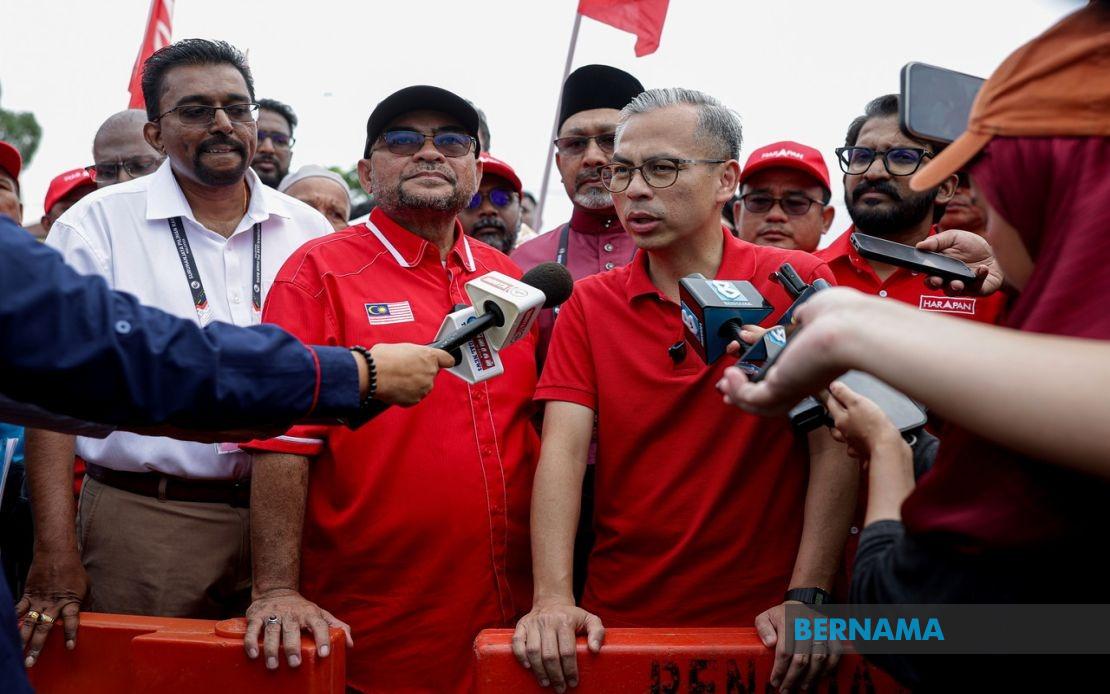
Pakatan Harapan's election machinery for the upcoming Negeri Sembilan state election is charting a course focused squarely on demonstrating the value of political continuity and the accomplishments of the incumbent administration. Communications Minister Datuk Seri Fahmi Fadzil unveiled this strategic direction following the completion of candidate nomination procedures in Jempol, signalling that the coalition intends to make the case that maintaining Menteri Besar Datuk Seri Aminuddin Harun's leadership represents the surest pathway to sustained prosperity for the state.
The economic narrative underpins PH's electoral pitch to voters. Fahmi highlighted a series of tangible achievements credited to Aminuddin's stewardship since assuming office in 2018, including expanded zakat collections that reflect increased religious compliance and community welfare, strengthened state revenue streams that expand government capacity to deliver services, and a consistent flow of foreign capital that signals investor confidence in Negeri Sembilan's economic stability. The construction of a new port represents infrastructure development with potential ramifications for regional trade corridors and logistics networks that could benefit businesses across Southeast Asia's western seaboard.
For Malaysian and regional observers, this emphasis on administrative continuity carries particular weight in an environment where state governments serve as laboratories for governance models. The PH coalition has faced scrutiny regarding its economic management credentials since returning to federal power in 2022, making sub-national success stories strategically valuable. Negeri Sembilan's performance metrics, if substantiated, would provide evidence that PH administrations can deliver measurable improvements in fiscal health and investment attraction—factors that resonate beyond the state's borders in a region increasingly focused on economic competitiveness.
The campaign strategy also reflects shrewd political positioning in a contest where PH faces multi-party competition. In the four-cornered contest for Jeram Padang, PH candidate G. Manivannan—a lawyer and Prime Minister Anwar Ibrahim's political secretary—will compete against Barisan Nasional incumbent Datuk Mohd Zaidy Abdul Kadir, Perikatan Bersatu's R. Sri Sanjeevan, and Dayana Dal, an Orang Asli candidate running under Asli banner. Fahmi's confidence in Manivannan's capacity to address youth employment concerns demonstrates how PH intends to translate macroeconomic achievements into tangible benefit narratives that resonate with younger demographics often alienated by abstract growth statistics.
Youth employment represents a critical vulnerability for any incumbent administration, and PH's explicit focus on this constituency suggests internal polling has identified job creation and economic opportunity as decisive factors among Negeri Sembilan voters. The coalition plans to present various state-level initiatives aimed at generating employment pathways and enterprise opportunities, attempting to demonstrate that continuity of administration translates into continuity of prosperity at the household level—a considerably more persuasive argument than institutional performance metrics alone.
The electoral landscape in Jempol parliamentary constituency reflects the fragmented opposition that has characterised Malaysian politics since 2020. Serting will witness a three-way contest between PH's Yaacob Mahmood, Perikatan incumbent Mohd Fairuz Mohd Isa, and Bersatu's Muhammad Noraffendy. Palong similarly features a three-cornered fight between BN's Datuk Mustapha Nagoor, PH's Muhammad Zahin Zinal Abidin, and Bersatu's Rebin Birham. Only Bahau presents a direct confrontation, pitting DAP's incumbent Teo Kok Seong against MCA's Chong Fui Ming. This splintered opposition presents tactical advantages for PH if the vote splits effectively, though it also creates unpredictability in constituencies where no single challenger enjoys overwhelming dominance.
Fahmi's public appeal for responsible campaigning and avoidance of sensitive communal issues reflects the delicate balance Malaysian electoral contests must maintain. His explicit invocation of the three Rs—religion, race, and the institution of royalty—underscores how politically volatile these dimensions remain even as electoral campaigns proceed. The appeal to netizens to avoid spreading misinformation and slander suggests PH recognises that digital platforms and social media have become primary battlegrounds in Malaysian electoral contests, where rumour and distortion can rapidly undermine carefully constructed policy narratives.
The two-week campaigning window compressed between nomination (July 18) and polling day (August 1) concentrates electoral activity into an intensive period, limiting time for candidates to build sustained engagement with voters. This compressed timeline advantages incumbents with established machinery and public recognition while disadvantaging challengers seeking to build profile in unfamiliar constituencies. For political watchers in Malaysia and the broader region, the Negeri Sembilan contest provides a mid-term assessment of whether PH's federal government enjoys adequate political momentum to sustain electoral success at state level, where governance performance becomes immediately tangible to voters.
The decision to foreground administrative continuity over partisan ideology reflects broader shifts in Malaysian electoral politics toward performance-based rather than identity-based voting calculus. Voters increasingly evaluate state administrations on concrete metrics—whether roads are maintained, whether development projects deliver promised benefits, whether public services function efficiently. PH's strategic wager is that Negeri Sembilan voters will validate Aminuddin's record sufficiently to warrant his re-election, effectively endorsing a pragmatic administrative approach over rhetorical appeals or factional positioning.
The inclusion of the sole Orang Asli candidate in the Jeram Padang race also signals evolving patterns in Malaysian electoral representation. Dayana Dal's candidacy under Asli banner indicates indigenous political mobilisation on issues of direct concern to Orang Asli communities, potentially fragmentation of the Malay-Muslim vote that traditionally consolidates around UMNO-led coalitions. Her presence in a four-cornered contest complicates vote calculations for all contenders, creating uncertainty about whether Orang Asli voters will prioritise indigenous representation, economic development promises, or established party loyalty.
The Election Commission has structured the election to allow early voting on July 28, with general polling set for August 1. This arrangement accommodates working voters and those with mobility constraints, though it also compresses the intensive campaigning phase into approximately ten days between nomination and early voting. For election observers, this timeline tests whether digital-native campaigning methods have sufficiently displaced traditional ground-level electioneering to favour parties with superior social media resources and messaging sophistication.
As Malaysia navigates the complex post-2022 political transition where PH governs federally but faces opposition control or fragmented administration in several states, the Negeri Sembilan election becomes a significant bellwether for PH's capacity to consolidate electoral support. A decisive victory would validate the coalition's claim to represent the future direction of Malaysian governance; a narrow outcome or defeat would suggest that federal power has not translated into adequate political capital at sub-national level. For regional observers tracking governance trends across Southeast Asia, the contest illustrates how local political dynamics in Malaysia's federal system create multiple arenas for competition and legitimacy-building.

