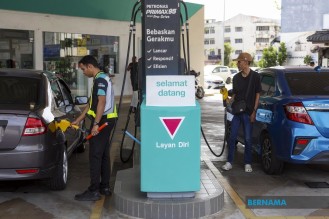
Petronas petrol stations across Malaysia will maintain sufficient fuel inventories extending into August, according to Datuk Seri Azalina Othman Said, Minister in the Prime Minister's Department (Law and Institutional Reform), following discussions at the National Economic Action Council's weekly session held in Kuala Lumpur. The reassurance comes as the government responds to concerns about potential supply disruptions amid global energy market volatility, particularly the ongoing regional conflict in West Asia affecting international crude oil availability.
The Petronas Dagangan Bhd network constitutes approximately 50 percent of Malaysia's domestic fuel demand, making its operational stability critical to the broader energy security framework. Petronas's official supply guarantees provide coverage until August, which the government views as sufficient time to implement long-term stabilisation measures. This declaration reflects coordination between the state-owned petroleum corporation and federal authorities in managing national energy resources during a period of pronounced geopolitical uncertainty affecting global oil markets.
The government has responded to energy security concerns by establishing a dedicated Crisis Management Task Force (PPPK) operating under the National Economic Action Council's oversight. This body maintains continuous surveillance of Malaysia's fuel, petroleum, and energy supply chains, extending beyond Petronas operations to encompass the broader national energy infrastructure. The task force's mandate encompasses not only monitoring supply adequacy but also formulating contingency strategies should global conditions deteriorate beyond current projections.
Beyond supply surveillance, the task force functions as a price control mechanism and enforcement body against irregularities. Officials emphasise that monitoring extends to preventing fuel smuggling and illicit trading activities that could compromise domestic availability or destabilise pricing structures. Such measures reflect recognition that supply security involves both physical inventory management and market integrity, particularly important given Malaysia's position as both a regional energy producer and consumer.
Diversification of crude oil sourcing represents a central component of the government's medium-term energy security strategy. While West Asian suppliers have historically dominated global markets and Malaysia's import profile, authorities are actively cultivating supply relationships with producers in West Africa and the Americas. These alternative sources provide geographic diversification that reduces vulnerability to single-region disruptions, though Petronas must verify that imported crude grades match domestic refining specifications and that commercial terms remain competitive relative to traditional suppliers.
The government's acknowledgement of potential extended global energy crisis reflects realistic assessment of geopolitical risks. By securing August coverage and simultaneously developing longer-term contingency frameworks, officials signal both confidence in near-term stability and preparedness for adverse scenarios. This dual approach addresses public concerns about supply disruptions whilst avoiding alarmism that could destabilise energy markets or fuel hoarding behaviour.
The reassurance followed parliamentary questioning from Khairil Nizam Khirudin (PN–Jerantut), who raised concerns regarding Petronas's previous statement that fuel guarantees extended only to June 2026. The discrepancy between Petronas's original timeframe and the government's extended August projection likely reflects administrative clarifications rather than fundamental changes to underlying supply conditions, though the government's expanded timeline suggests either updated inventory assessments or refined forecasting methodologies.
Malaysia's energy security challenges reflect broader Southeast Asian patterns whereby regional stability, commodity prices, and supply chain dynamics intersect in complex ways. As an energy exporter historically buffered from import dependency, Malaysia faces novel vulnerabilities from global market turbulence affecting pricing and investment cycles. The establishment of formal crisis management infrastructure demonstrates institutional recognition that energy security requires continuous active management rather than reliance on historical abundance.
For Malaysian consumers and businesses, the government's assurances provide near-term certainty regarding fuel availability and pricing stability. However, the emphasis on contingency planning and supply diversification indicates that authorities view current conditions as transitional rather than permanently resolved. Economic operators should anticipate continued government emphasis on energy efficiency, potential pricing adjustments reflecting international market movements, and possible restrictions on fuel exports or consumption if crisis conditions intensify.
The government's coordination between Petronas, the National Economic Action Council, and the Crisis Management Task Force reflects institutional frameworks developed during previous energy disruptions. These mechanisms enable rapid response to supply shocks whilst maintaining dialogue with petroleum producers and fuel retailers. International engagement regarding crude sourcing demonstrates that Malaysian energy security increasingly depends upon maintaining diplomatic relationships and commercial ties across multiple regions rather than concentration within single suppliers.

