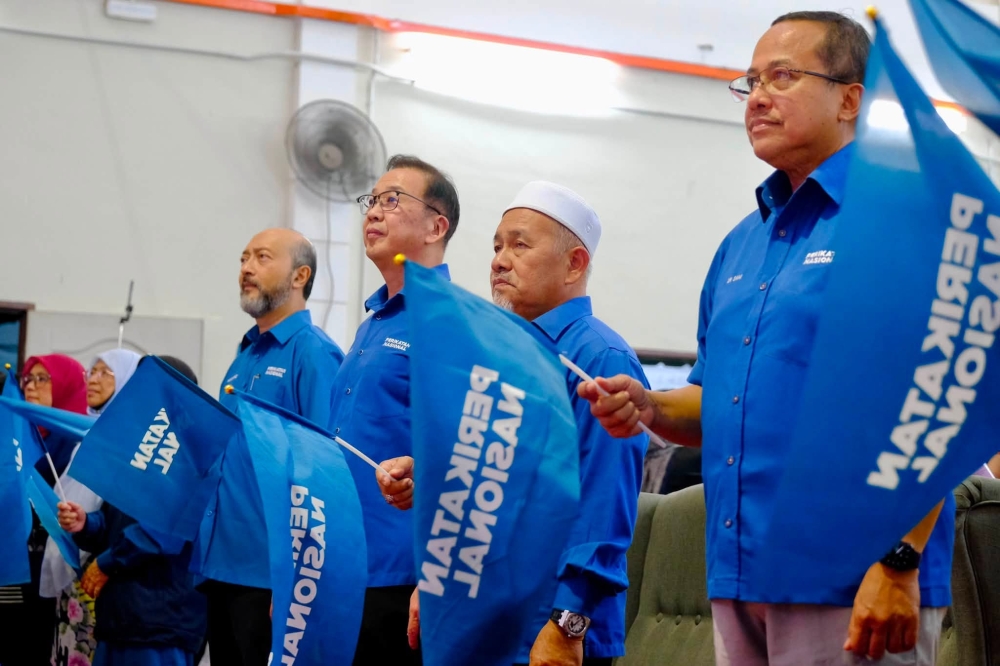
Perikatan Nasional chairman Datuk Seri Ahmad Samsuri Mokhtar has broached the possibility of maintaining the coalition's partnership with Barisan Nasional into the sixteenth general election, provided their recently negotiated agreement in Negeri Sembilan operates smoothly. The statement marks a significant moment in Malaysian coalition politics, signalling potential long-term stability in an otherwise fragmented political landscape that has undergone considerable realignment since the 2022 general election.
The Negeri Sembilan arrangement has emerged as a pivotal testing ground for collaborative governance between the two blocs. By allowing this state-level pact to demonstrate its viability, PN leadership appears to be suggesting that successful executive functioning could pave the way for national-level expansion of the alliance. This approach reflects a pragmatic assessment that demonstrated competence in delivering public services and maintaining political coherence would strengthen arguments for continuation at the ballot box.
For Malaysian observers, the proposal carries substantial implications for the country's political trajectory. The current PN-BN arrangement represents a departure from the two-bloc competition that characterised earlier electoral cycles, where these coalitions typically positioned themselves as opposing forces. The potential for extending this partnership suggests a recalibration toward a more consolidated national configuration, which could reshape voter expectations and campaign dynamics ahead of GE16.
The Negeri Sembilan pact itself has been closely watched across the country as a bellwether for inter-coalition cooperation. Success in this state, where both PN and BN maintain significant political strength, could demonstrate that coalitions with differing ideological foundations can function effectively together. Conversely, any instability or governance failures would likely diminish enthusiasm for similar arrangements at the federal level.
From a regional perspective, Malaysia's coalition experiments carry relevance across Southeast Asia. Countries in the region grapple with similar challenges of managing multi-party democratic systems while seeking stable governance. The Malaysian approach to building broader coalitions, while imperfect, offers lessons about negotiation, compromise, and the trade-offs required in pluralistic political systems.
The statement also reflects internal dynamics within PN itself. By framing continuation as conditional on Negeri Sembilan's success, the party avoids committing prematurely to an alliance that some factions may view with ambivalence. This conditional phrasing allows room for manoeuvre should circumstances change, while simultaneously signalling seriousness about the partnership to BN counterparts and to the electorate.
The timeline to GE16 remains significant. With several years potentially remaining before the next general election, the Negeri Sembilan arrangement will be subjected to considerable scrutiny. Any major stumbles in state administration, inter-coalition disputes over resource allocation, or electoral setbacks in by-elections within the state would complicate Ahmad Samsuri's suggestion of extension into the next national contest.
BN's perspective on this proposal will prove equally important. The coalition, still adjusting to its reduced circumstances following the 2022 election, faces internal pressures regarding partnerships with former adversaries. Some BN components may view extended alliance with PN as institutionalising diminished status, while others may recognise the practical value of joint governance in an increasingly competitive electoral environment.
The broader implication for Malaysian voters involves the evolution of choice architecture in national elections. If PN-BN continuation becomes established, voters accustomed to binary coalition competition may encounter a reshaped political menu. Opposition coalitions would need to adapt their strategies accordingly, potentially seeking their own consolidation or differentiation strategies to remain relevant.
For the states themselves, the arrangement creates variable political conditions across the peninsula. States governed by one bloc or the other may pursue divergent policy approaches, creating a natural experiment in comparative governance. Development outcomes, administrative efficiency, and public service delivery in PN-governed versus BN-governed versus opposition-governed states will inevitably become benchmarks for evaluating the coalition arrangement.
The mention of conditionality also deserves emphasis. Ahmad Samsuri's formulation suggests that the Negeri Sembilan test is genuinely significant, not merely rhetorical. Should the state government face crises in service delivery, corruption scandals, or severe internal coalition friction, the rationale for national extension would weaken substantially. This stakes-setting approach places considerable pressure on state-level administrators to deliver tangible results.
Looking ahead, the coalition will need to address several critical questions: How will power and resources be distributed between PN and BN components? Will cabinet positions, government contracts, and electoral seat allocations be determined by prior agreement or emerge through ongoing negotiation? How will disputes between coalition partners be resolved? Clear answers to these questions during the Negeri Sembilan period would strengthen the case for national extension.
Ultimately, Ahmad Samsuri's statement represents both an opening and a hedge. It signals genuine interest in sustained alliance while preserving flexibility should circumstances warrant different arrangements. For Malaysian politics, this measured approach reflects the pragmatic adaptations necessary in a system where outright electoral dominance by any single bloc has become increasingly elusive.

