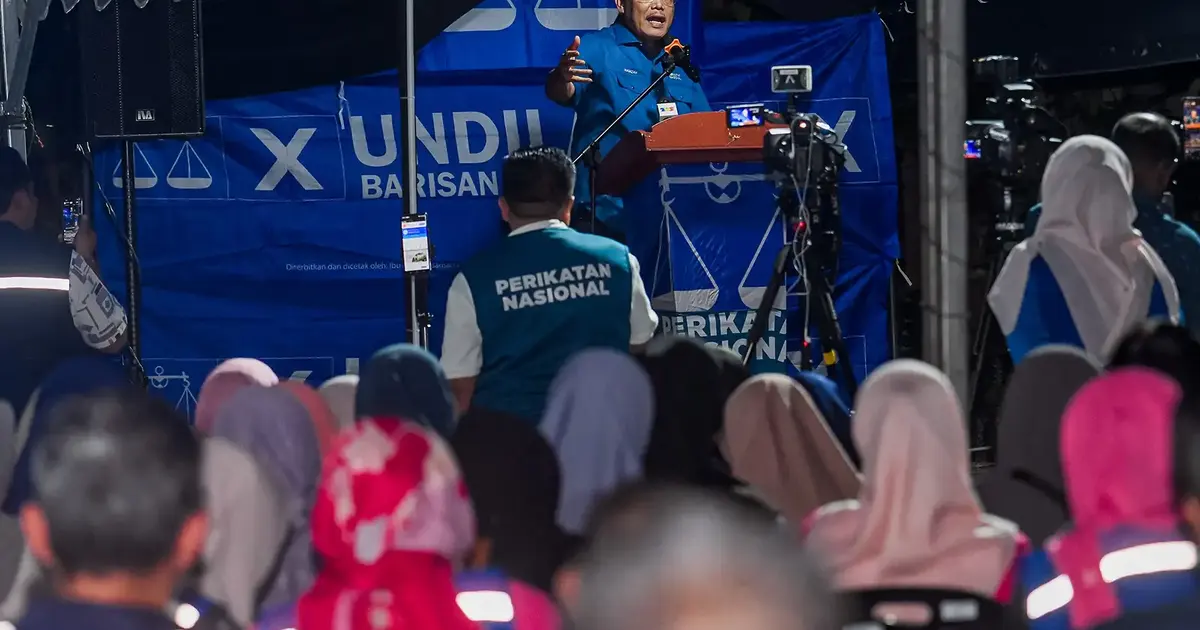
Perikatan Nasional has formally agreed to rebrand its electoral coalition with Barisan Nasional as 'Perikatan Barisan Nasional' for the upcoming Negeri Sembilan state election on August 1, according to a senior party official. The nomenclature signals a strategic fusion of Malaysia's two historically dominant political blocs as they seek to consolidate their grip on the state legislature through a coordinated campaign and unified governance structure.
Hamzah Zaman, who leads Wawasan—the component party that serves as PN's titular representative—disclosed that the coalition partners have settled on a power-sharing arrangement whereby Barisan Nasional will assume control of the Negeri Sembilan state administration should their joint ticket secure electoral victory. This arrangement represents a carefully calibrated compromise between PN and BN, reflecting broader efforts to present a united front to voters while simultaneously respecting each coalition's organisational integrity and political standing in the peninsula's central state.
The designation 'Perikatan Barisan Nasional' carries considerable symbolic weight beyond mere administrative convenience. In Malaysian political parlance, the term 'perikatan' explicitly denotes an alliance or federation of entities, suggesting that both PN and BN retain their individual identities and organisational structures whilst operating in concert for electoral and governance purposes. This distinguishes the arrangement from a full merger or complete absorption of one bloc by another, preserving the autonomy of component parties within each coalition and allowing them to maintain separate party machinery and political brands.
Negeri Sembilan presents a significant battleground in Malaysian state politics, and the August 1 election will test the viability of PN-BN cooperation at the sub-federal level. The state has traditionally been a BN stronghold, though recent electoral cycles have seen shifting voter preferences and increased competition from opposition coalitions. By formalising their alliance and agreeing on leadership parameters before campaigning begins, PN and BN aim to preempt internal contradictions that might otherwise emerge during the campaign or, more critically, during post-election negotiations if the coalition achieves a narrow or inconclusive mandate.
The explicit stipulation that BN will lead the state government appears designed to address concerns within the older coalition about its political standing in the post-Sheraton Move era. When Perikatan Nasional first coalesced around 2020, BN had suffered significant electoral reverses, and PN's ascendancy threatened to permanently alter the hierarchical relationship between Malaysia's traditional power brokers. By securing a commitment that BN will steer the Negeri Sembilan government, PN effectively signals its willingness to rehabilitate its older coalition partner's profile and credibility at the state level, even as PN retains substantial parliamentary presence and influence at the federal level.
For Hamzah Zaman and Wawasan, this arrangement underscores a pragmatic approach to coalition politics that prioritises electoral victory and governance stability over ideological purity. Wawasan, though significant within PN's structure, remains a relatively younger and less entrenched party compared to BN's constituent members, particularly the United Malays National Organisation (UMNO). By agreeing that BN will helm the state, Wawasan's leadership demonstrates flexibility that may enhance its bargaining position in future negotiations at the federal or other state levels.
The August 1 Negeri Sembilan election thus serves as a barometer for PN-BN cohesion and the durability of cooperative arrangements between coalitions that have historically competed fiercely. The formation of a unified 'Perikatan Barisan Nasional' brand suggests that both blocs are prepared to subordinate their differences on candidate selection, campaign messaging, and policy emphasis in pursuit of consolidated electoral gains. However, the pre-arranged stipulation that BN will govern the state also reveals inherent asymmetries and underlying tensions within the alliance that manifest as specific power-sharing protocols.
Such arrangements reflect broader trends in Malaysian politics wherein coalition flexibility and tactical cooperation have become increasingly prevalent. Rather than the winner-take-all dynamics of previous decades, contemporary Malaysian electoral politics increasingly features cross-coalition negotiations, power-sharing agreements, and pre-election settlements regarding ministerial portfolios and state leadership positions. The PN-BN pact for Negeri Sembilan exemplifies this evolution, formalising expectations before voters cast their ballots rather than leaving governmental roles to post-election haggling.
For ordinary Negeri Sembilan voters, the Perikatan Barisan Nasional alliance presents a unified choice centred on the joint platform and governance programme that PN and BN present collectively. The coalition's decision to position BN as the prospective state government leader offers voters clarity regarding administrative accountability and leadership structures should the alliance prevail. This transparency, whilst benefiting voters, also constrains the subsequent manoeuvring room available to PN and BN should unexpected electoral outcomes occur or if either coalition partner decides to renegotiate terms following the announcement of results.
The branding decision also carries implications for national politics beyond Negeri Sembilan's borders. A successful PN-BN coalition victory in this state election could furnish both blocs with momentum and precedent for deepening cooperation in other states or even renewing negotiations regarding federal power-sharing arrangements. Conversely, should the combined ticket underperform, both PN and BN will need to reassess the utility and political cost of their alliance format, potentially reverting to more adversarial positioning or seeking alternative coalition partners.

