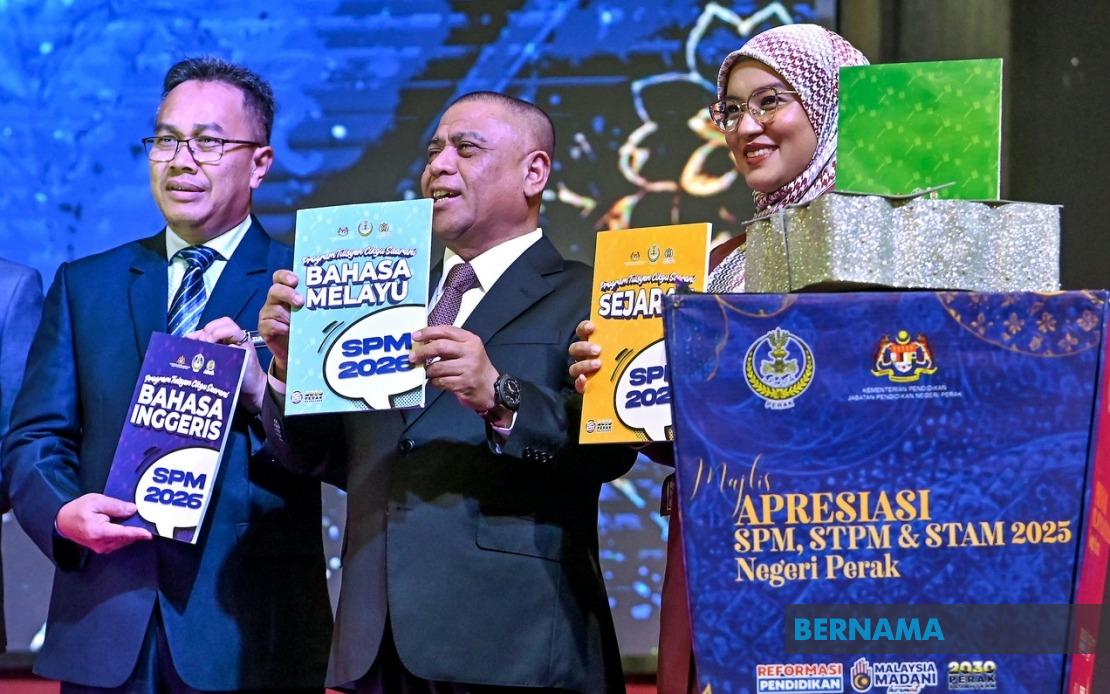
Perak has achieved its strongest performance on the Sijil Pelajaran Malaysia examination in over a decade, with a State Average Grade of 4.49 recorded for the 2025 cohort. The result marks the culmination of a three-year upward trajectory for the state's education system, signalling sustained momentum in academic achievement across the region. Menteri Besar Datuk Seri Saarani Mohamad announced the milestone at the 2025 Appreciation Ceremony for Perak SPM, STPM and STAM students, framing the outcome as evidence of coordinated effort among educators, administrators, and policymakers working to elevate educational standards.
The significance of Perak's performance lies not merely in absolute numerical improvement but in its broader implications for equity within the state's schooling system. The MB highlighted that the achievement gap separating urban and rural candidates has narrowed to just 0.04 grade points, representing meaningful progress towards educational parity. This convergence suggests that quality instructional opportunities and pathways to academic excellence are becoming increasingly accessible regardless of geographic location, a crucial consideration for a state encompassing diverse settlement patterns and varying resource distribution.
Saarani emphasised that the state's educational achievements demonstrate the effectiveness of strategic initiatives undertaken across multiple years. Rather than attributing success to any single intervention, he characterised the results as validation that the cumulative efforts, planning, and implementation by Perak's education community are yielding tangible outcomes. This framing acknowledges the complexity of educational improvement, which typically requires sustained commitment across curricula, teaching methodologies, student support systems, and institutional capacity-building.
Beyond the SPM results, Perak demonstrated competitive strength in pre-university qualifications. The state recorded a Cumulative Grade Point Average of 2.91 in the Sijil Tinggi Persekolahan Malaysia examination, surpassing the national benchmark of 2.88. This differential performance at the upper secondary level carries implications for tertiary educational access and competitiveness in university admissions across Malaysian institutions. The data indicates that Perak students are not only performing adequately on national examinations but increasingly positioning themselves advantageously for higher education entry.
The STPM results included a notable distinction: 116 Perak candidates achieved a perfect CGPA of 4.00 out of 1,336 such achievers nationwide, representing approximately 8.7 percent of national top performers. This concentration of excellence among Perak students, relative to the state's population share, underscores the presence of high-performing clusters within the state's schools and suggests effective identification and support mechanisms for advanced learners. For a state competing with better-resourced urban centres, this performance represents a meaningful achievement in educational competitiveness.
Perak's Islamic education examination outcomes also reflected strong performance. The Sijil Tinggi Agama Malaysia recorded a State Average Grade of 3.03, with 36 candidates obtaining the Mumtaz distinction grade. These results indicate that the state's religious education programmes, whether administered through dedicated institutions or integrated school curricula, are successfully cultivating both knowledge and scholarly excellence among participants. The specific tracking of Mumtaz grades suggests careful monitoring and recognition of exceptional achievement in Islamic studies.
The Menteri Besar articulated a perspective on academic achievement that extends beyond quantified examination metrics. Saarani noted that student success should be understood as a collective accomplishment involving contributions from multiple stakeholders, including educators, families, and entire school communities. This holistic view acknowledges that examination performance, while measurable and important, emerges from complex social and institutional ecosystems rather than individual student effort alone. It frames educational achievement as inherently relational, emphasising the interdependency of various actors in supporting student advancement.
The recognition ceremony itself honoured 266 recipients spanning students, educators, schools, and District Education Offices, reinforcing institutional commitment to celebrating and incentivising excellence. By publicly acknowledging diverse forms of contribution—from individual student achievement to institutional and administrative excellence—the state signals that educational improvement requires engagement across the entire system. Such ceremonial practices serve both symbolic and practical functions, reinforcing cultural norms around educational aspiration and providing material recognition that may motivate continued effort.
For Malaysian education observers and policymakers, Perak's trajectory offers instructive value. The state's success in closing urban-rural achievement gaps while simultaneously improving absolute performance levels demonstrates that geographic disadvantage need not produce insurmountable educational disparities. This pattern suggests that strategic resource allocation, capacity development, and focused institutional effort can materially reshape educational outcomes even in contexts of varied socioeconomic circumstances. As Malaysia continues efforts to strengthen educational equity while improving overall quality, Perak's experience provides practical evidence that such dual objectives need not be mutually exclusive.

