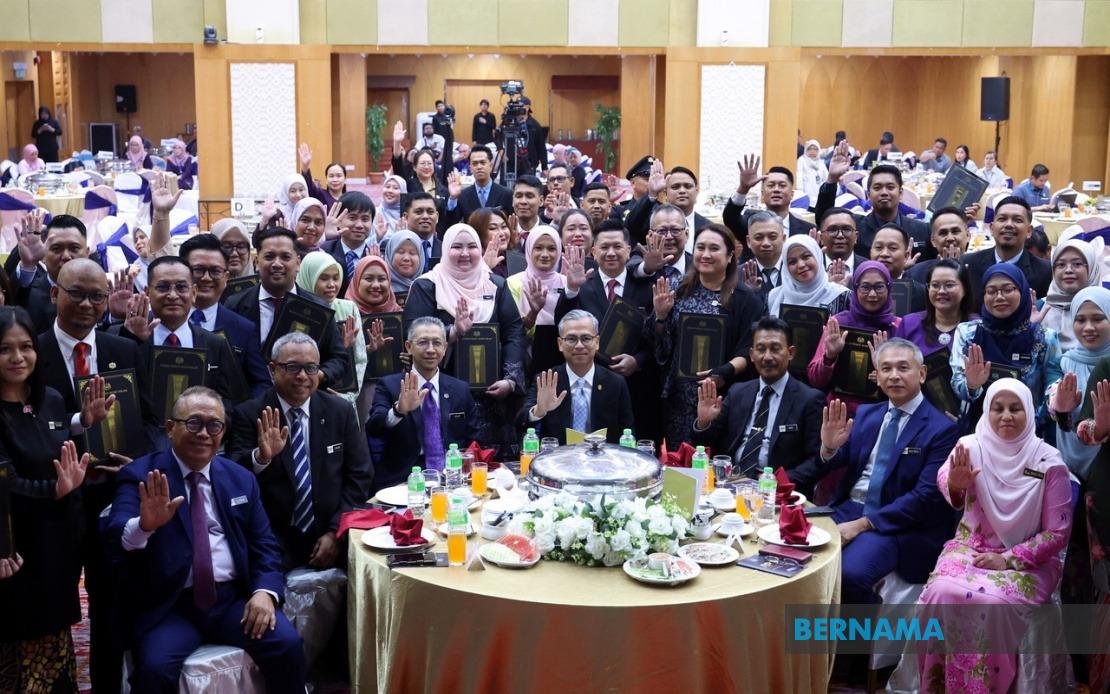
The MADANI administration remains steadfast in its commitment to what officials term the 'people's economy'—ensuring that national economic progress genuinely improves the living standards of ordinary Malaysians across all demographic groups. Communications Minister Datuk Seri Fahmi Fadzil made this assertion during an official engagement in Kota Kinabalu, emphasising that statistical growth alone cannot measure governmental success without corresponding improvements in citizens' material circumstances.
While Malaysia has recorded positive macroeconomic indicators at both national and state levels—encompassing investment inflows, government revenue, foreign reserves, GDP expansion, and trade volumes—Fahmi stressed that these figures remain abstract unless they directly benefit households. The minister's remarks reflect a broader recalibration of how the government frames its economic narrative, moving beyond traditional metrics of growth to focus on household welfare and personal financial security.
Fahmi cited the government's targeted diesel subsidy programme, known as BUDI MADANI, as a concrete example of this philosophy in action. The scheme demonstrates awareness of geographical and socioeconomic disparities across the nation. In Sabah and Sarawak particularly, where vast distances separate population centres and travel between districts often requires substantial expenditure, subsidy programmes take on heightened significance compared to urban areas. The minister acknowledged that Prime Minister Datuk Seri Anwar Ibrahim and the Cabinet actively monitor such regional variations when designing and implementing economic policies.
The distinction Fahmi drew between national-level economic excellence and individual prosperity reveals the government's recognition that statistical achievement at the macro level can obscure real hardship at the household level. He characterised the 'people's economy' as economic activity tangible to citizens themselves—the kind directly affecting purchasing power, affordability of essential goods and services, and personal financial stability. This framing suggests the government recognises potential disconnect between headline economic growth and voter perceptions of government competence.
Govt agencies bear responsibility for clear policy communication, Fahmi stressed during the Communications Ministry's Sabah and Labuan Zone Excellent Service Awards ceremony. He argued that ministries and government departments must ensure policies receive comprehensive and accurate explanation to prevent public misinterpretation or confusion. This assertion carries particular weight given that targeted subsidy schemes, despite serving legitimate equity purposes, have historically generated confusion and criticism when details regarding eligibility, application procedures, and implementation timelines remain obscure.
The emphasis on explaining subsidies and social programmes reflects broader challenges facing the MADANI administration. Previous governments have struggled with policy communication, particularly regarding assistance programmes meant to aid lower-income groups. When beneficiaries lack clear understanding of how to access benefits, or when policy details shift across regions, public confidence erodes even when programmes function as intended. Fahmi's comments suggest awareness that economic policy success depends not merely on sound design but also on transparent, effective public communication.
Regional context significantly shapes policy implementation, Fahmi indicated. Sabah and Sarawak present distinctive circumstances—lower population density, greater distances between administrative centres, higher transport costs, and more limited infrastructure—that require adapted approaches compared to peninsular states. Fuel subsidies thus carry amplified importance in these regions, where transport costs consume larger portions of household budgets and where practical necessity often demands longer journeys for commerce, employment, and government services. This geographic reality demands that national economic policy accommodate regional variation.
The minister's remarks also implicitly acknowledge that economic globalisation and structural changes have created winners and losers within Malaysia's economy. While certain sectors and regions experience robust growth, others struggle. For government legitimacy, ensuring that aggregate prosperity translates into broad-based household benefit matters more than optimising individual macroeconomic indicators. The MADANI narrative increasingly emphasises inclusive growth over mere headline GDP expansion.
Fahmi's comments were delivered during an official awards ceremony recognising public service excellence, a platform that allowed him to reinforce messaging about government priorities and values. By connecting service excellence at departmental level to the broader objective of translating economic growth into household welfare, he framed public service within the larger MADANI governance philosophy. This rhetorical linking suggests the administration views civil service motivation and public service quality as integral to achieving people-centred economic outcomes.
The communications minister's emphasis on policy clarity and accurate information dissemination also reflects lessons learned from earlier policy implementation challenges. When the government introduced previous subsidy schemes or economic measures without sufficient explanation, public confusion sometimes generated criticism despite positive intent. By stressing ministerial responsibility for comprehensive communication, Fahmi signals that the MADANI administration intends to avoid similar pitfalls through proactive public engagement and detailed policy explanation.
For Malaysian readers, particularly those in East Malaysia and rural peninsular areas, Fahmi's message carries significance. It suggests the government recognises that distance, geography, and local circumstance create distinct economic realities requiring tailored policy responses rather than uniform national approaches. The emphasis on subsidies reaching households based on genuine need rather than administrative convenience indicates responsive governance.
Moving forward, the success of this 'people's economy' approach will depend on consistent policy implementation across regions and sustained effort in communicating programme details effectively. Economic statistics, however encouraging, will ultimately be judged against household lived experience and personal financial security across the breadth of Malaysian society.

