Penang's long-awaited Mutiara Line Light Rail Transit project is entering an active construction phase, with Malaysia Rapid Transit Corporation Sdn Bhd announcing a series of coordinated road closures beginning this week. The initiative, set to run through the end of October, represents a significant step in developing the region's public transport infrastructure but will require commuters and businesses in George Town to navigate temporary disruptions to their daily routines.
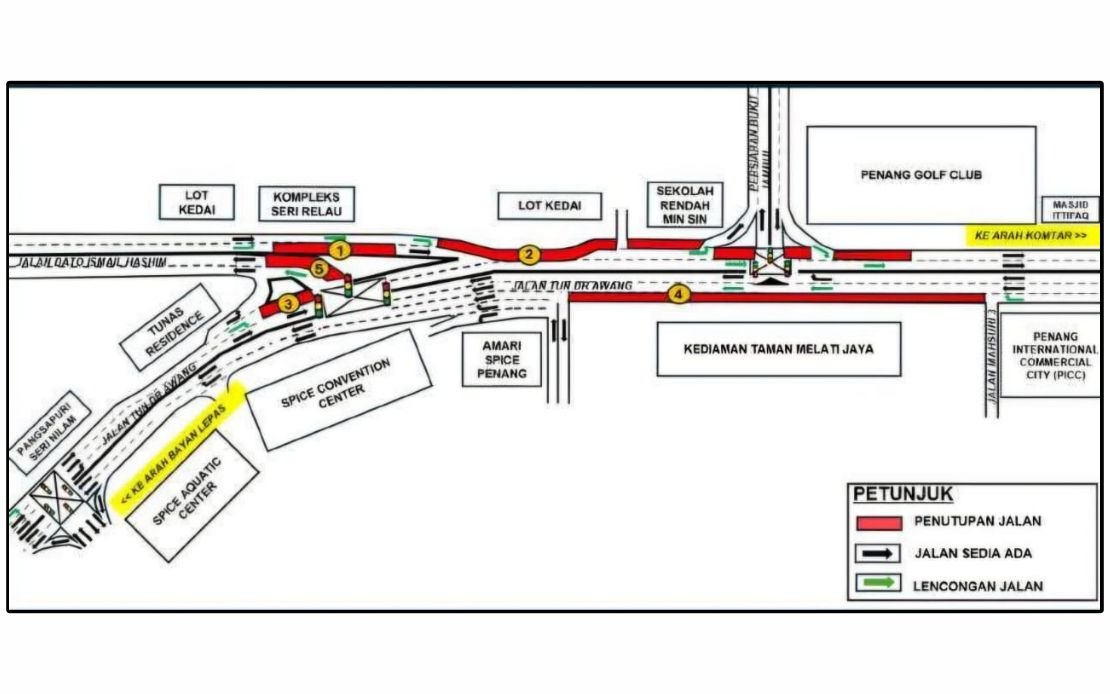
The scope of the disruption extends across a strategically important corridor in the heart of Penang's capital. The affected zone spans from the Sri Relau Complex through to the Penang Golf Club, encompassing sections of both Jalan Tun Dr Awang and Jalan Dato Ismail Hashim. These routes are critical arteries for traffic flowing towards and away from Komtar, the state's administrative hub, making the timing and management of closures particularly sensitive to public convenience. MRT Corp has structured the work to minimise disruption by implementing closures only during daylight business hours, from 8.30 am to 4.30 pm each day across the 72-day construction window.
The preliminary works are specifically designed to prepare the foundation for the Mutiara Line's physical infrastructure in this neighbourhood. Drainage improvements and road widening initiatives fall under Package CMC1 of the broader Mutiara Line development, suggesting these modifications are essential precursors to actual rail line construction. Such underground and surface-level preparatory work is typically invisible to the public but represents critical investment in urban planning that will support both the new transit system and improved road capacity once completed.
MRT Corp has delineated the closure pattern into four distinct segments to allow traffic flexibility. The right lane of Jalan Dato Ismail Hashim in front of Sri Relau Complex, heading towards Komtar, will be closed, as will the left lane beginning from shop lots near SJK (C) Min Sin and extending through to the Penang Golf Club in the same direction. Additionally, the left lane at the traffic light intersection where Jalan Dato Ismail Hashim meets Jalan Tun Dr Awang will be unavailable, along with the leftmost lane on Jalan Tun Dr Awang near the Taman Melati Jaya residential area heading towards Bayan Lepas. This staggered approach ensures that at least one direction of traffic remains passable along most sections, though drivers should anticipate increased congestion and longer travel times.
For businesses operating in the affected precincts, the closures present both immediate operational challenges and longer-term benefits. Retail establishments near Sri Relau Complex and the school facilities in the area may experience reduced customer accessibility during the daytime closure hours, potentially pushing commercial activity to evenings and weekends. However, the successful completion of the Mutiara Line represents a transformative opportunity for George Town, as improved public transport connectivity typically enhances property values and foot traffic in commercial zones once the infrastructure becomes operational.
MRT Corp has invested in comprehensive traffic management measures to mitigate safety risks and guide motorists through the construction zone. Signboards, traffic cones, and deployed flagmen will be stationed throughout the affected areas, providing real-time direction and information to drivers navigating the temporary landscape. This active management approach, combining static signage with human presence, reflects international best practices in construction site traffic control and demonstrates recognition that merely closing lanes without robust guidance systems creates hazardous conditions.
The Mutiara Line itself represents a substantial commitment to Penang's long-term transport development, with these preliminary works signalling momentum toward actual construction of the rail corridor. For Malaysian cities increasingly grappling with congestion and air quality concerns, such rapid transit projects offer potential solutions to urban mobility challenges. The phased approach—beginning with ground preparation and infrastructure foundation work—is standard practice that ultimately delivers more reliable project timelines and sustainable outcomes compared to hastily initiated construction.
Public cooperation will be essential for the project's smooth progression. MRT Corp has urged motorists to exercise heightened caution when transiting the affected zones and to strictly adhere to directional signage. Commuters are advised to consider alternative routes or adjust travel times, particularly during peak hours when the closure's impact will be most pronounced. Those relying on public transport should note that the concurrent construction activity may also affect bus routes in the vicinity, potentially necessitating service modifications or temporary rerouting.
For residents and businesses seeking clarity on specific impacts to their circumstances, MRT Corp has established dedicated communication channels. The MRT Careline, accessible at 1-800-88-6782, provides telephone support, while email inquiries can be directed to [email protected]. This dual-channel approach recognises that different stakeholders have varying informational needs and preferences, and maintaining responsive communication during construction disruptions builds public confidence in the project's management and ultimate delivery.
The August 20 commencement date marks a critical juncture in the Mutiara Line's development trajectory. Successful execution of these preliminary works will likely determine the feasibility of staying within project timelines and budgets for subsequent construction phases. For Penang's broader economic and urban planning objectives, completion of rapid transit infrastructure is increasingly viewed as essential for remaining competitive in Southeast Asia's evolving urban hierarchy, where liveable, well-connected cities attract investment and talent. The temporary inconvenience of these three months thus represents a calculated investment in the state's future connectivity and competitiveness.

