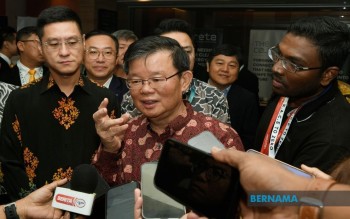
The Penang Climate Mitigation Fund has captured substantial interest from the manufacturing sector, with two dozen enterprises seeking access to preferential financing designed to accelerate environmental transitions. Chief Minister Chow Kon Yeow announced that five applications are currently undergoing formal assessment, signalling momentum in the programme's early implementation phases. The fund represents a collaborative effort between Penang's state administration and Alliance Bank, initially capitalised with RM20 million—comprising RM5 million from state coffers and RM15 million from the financial institution—though discussions have already begun regarding potential expansion to RM100 million.
The initiative operates under the broader Penang Green Industry Programme framework and introduces a tiered approach to climate finance accessibility. Small and medium enterprises alongside mid-tier companies can secure loans reaching RM500,000, complemented by direct grants, professional sustainability evaluations, and ongoing advisory support from technical specialists. This layered assistance acknowledges that capital constraints represent only one barrier to green transition; many manufacturers lack the expertise to identify which interventions yield the strongest environmental and financial returns. The Penang Green Council provides institutional scaffolding, helping factory operators map sustainability requirements and sequence implementation strategies across their operations.
Chow's framing of clean energy transition as a competitive imperative rather than purely environmental obligation carries particular weight for Penang's industrial ecosystem. The state generated RM436.9 billion in electrical and electronics exports during the most recent reporting period, accounting for approximately sixty-eight percent of Malaysia's total E&E sector shipments. This concentration creates both vulnerability and opportunity: multinational corporations increasingly embed carbon performance expectations into procurement decisions, making supplier compliance with renewable energy targets a market prerequisite rather than a voluntary distinction. Companies that fail to demonstrate access to clean energy sources or credible decarbonisation pathways risk exclusion from international supply chains, regardless of their conventional competitive advantages.
The calculus motivating corporate location decisions has undergone fundamental transformation across Southeast Asia. Whilst talent availability, transport networks, facilities quality, and operational costs remain material considerations, multinational investors now systematically evaluate electricity sourcing transparency and greenhouse gas accounting methodologies. Supply chain sustainability requirements—increasingly mandated by parent corporations responding to investor pressure and regulatory frameworks in developed markets—cascade through tier-one and tier-two suppliers. Penang's manufacturing base faces intensifying demands from multinational electronics companies requiring documented renewable energy utilisation and steadily declining Scope 2 emissions profiles. The Climate Mitigation Fund essentially provides industrial operators practical mechanisms to meet these evolving customer specifications whilst simultaneously addressing state-level sustainability commitments.
Penang's energy policy architecture, crystallised in the November 2024 Penang Energy Framework, establishes ambitious but attainable targets for sectoral transformation. The framework commits the state to reducing energy intensity by twenty-five percent whilst increasing renewable energy's contribution to the regional power mix to at least ten percent by the end of this decade. These objectives emerged from detailed assessment of Penang's geographic constraints and industrial characteristics. Land scarcity fundamentally shapes renewable deployment options; conventional utility-scale solar farms cannot expand indefinitely across a densely populated urban and industrial state. Rooftop solar installations therefore constitute the primary scalable pathway, prompting regulatory changes requiring new commercial and industrial buildings to dedicate at least seventy-five percent of roof surfaces to photovoltaic generation or satisfy equivalent renewable energy sourcing obligations based on TNB tariff classifications.
Beyond rooftop installations, Penang's authorities are systematically evaluating alternative renewable technologies suited to the state's particular topography and infrastructure landscape. The Penang Water Supply Corporation has initiated feasibility studies examining floating solar arrays across its reservoir network, an approach that simultaneously exploits underutilised water surface area and reduces evaporative losses. Silicon Island, Penang's major industrial development initiative, will incorporate renewable energy generation throughout its infrastructure, including a dedicated Green Tech Park powered by solar systems. These complementary initiatives create redundancy and diversification within renewable deployment strategies, reducing dependence on any single technology and accommodating varying site-specific conditions across industrial facilities.
Energy efficiency constitutes an equally critical component of Penang's decarbonisation architecture, working synergistically with renewable energy deployment. The state has introduced energy intensity standards enabling systematic measurement, comparative benchmarking, and continuous improvement of electricity consumption across commercial and industrial operations. Government buildings and local authority facilities undergo systematic assessment to identify renewable energy and efficiency enhancement opportunities. The administration has established a five percent renewable energy minimum for eligible new government and local authority facilities, whilst encouraging existing public infrastructure to pursue comparable targets. This approach creates demonstration effects, signalling state commitment to clean energy transition whilst generating operational experience and performance data that private sector operators can evaluate.
Penang's climate and energy policies deliberately align with federal government frameworks, particularly the National Energy Efficiency Action Plan version 2.0, which targets an 11.6 percent reduction in national energy demand by 2035. This vertical coordination between state and national initiatives strengthens implementation prospects, as complementary regulatory frameworks and investment incentives reinforce rather than contradict. Malaysian manufacturers operating across multiple state jurisdictions encounter more coherent policy environments when state-level objectives harmonise with federal decarbonisation goals. Penang's approach simultaneously supports national climate commitments whilst addressing the state's distinctive industrial composition and geographic constraints, demonstrating how regional policies can operationalise broader national sustainability agendas.
The Climate Mitigation Fund's emergence within this policy context reflects sophisticated sequencing of regulatory obligation and financial enablement. New building standards establishing renewable energy requirements on rooftop installations would create compliance burdens for manufacturers lacking sufficient capital or technical expertise absent accompanying financial mechanisms. The fund bridges this implementation gap, transforming regulatory mandates into practical undertakings. For facilities failing to meet performance standards through internal resources, the RM500,000 financing ceiling accommodates installation of photovoltaic systems across most small to mid-tier industrial properties, particularly when combined with depreciation benefits and operational cost reductions from lower electricity consumption.
The programme's early traction—evidenced by twenty-five applications and five formal assessments—suggests manufacturers recognise both regulatory imperatives and competitive advantages inherent in early transition. Companies achieving sustainability certifications and documented renewable energy integration strengthen supplier relationships with multinational anchors in Penang's electronics sector. As global corporate sustainability requirements intensify, early adopters of renewable energy and efficiency improvements position themselves advantageously within supply chains increasingly filtered by environmental performance criteria. The Climate Mitigation Fund essentially democratises access to green transition pathways that previously remained available primarily to large corporations with sufficient capital for unsubsidised renewable investments.
The fund's potential expansion to RM100 million reflects confidence in programme mechanics and demand indicators, though scaling will require sustained resource commitment and possibly deeper Alliance Bank engagement. Widening the financial envelope would accommodate additional manufacturers seeking to transition during peak competitive windows—periods when supply chain pressures intensify and window of opportunity for preferential positioning within multinational supplier networks remains open. Penang's industrial base, concentrated in electronics and increasingly diversified into semiconductor assembly and advanced manufacturing, requires accessible decarbonisation mechanisms to maintain competitiveness within globally integrated supply chains. The Climate Mitigation Fund represents an institutional innovation addressing this imperative, though ultimate success depends on deployment velocity and integration with complementary state investments in renewable generation capacity, grid infrastructure modernisation, and technical workforce development.

