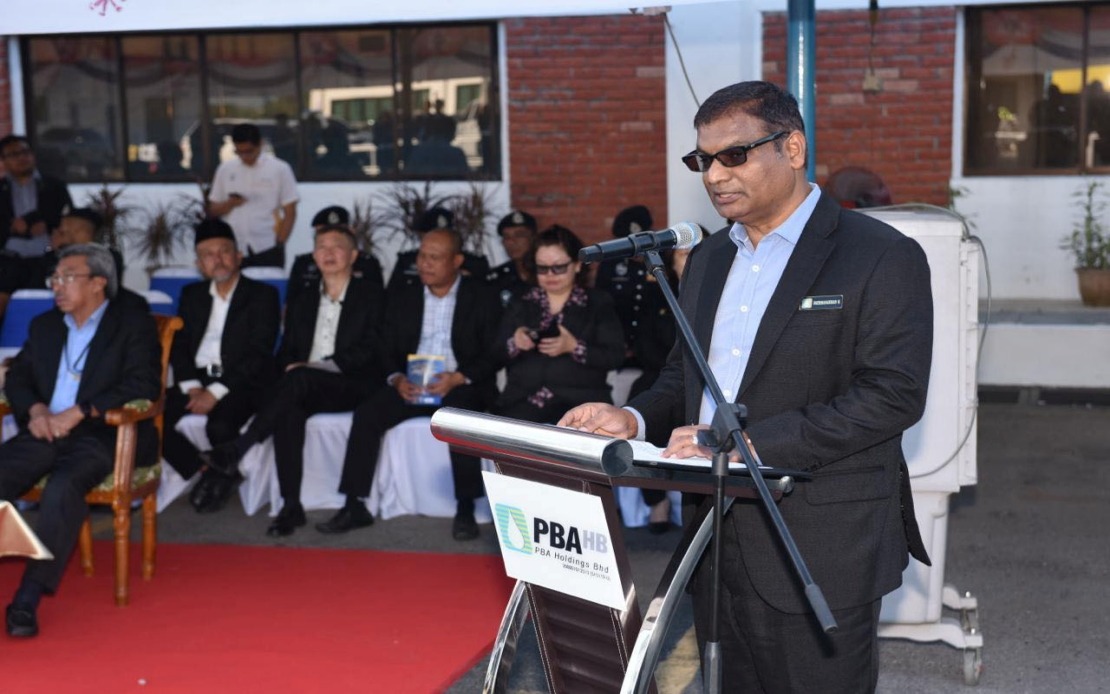
Penang Water Supply Corporation (PBAPP) is moving forward with plans to construct a new water treatment facility capable of producing 80 million litres daily in Seberang Perai Selatan, with operations expected to commence in 2027. The initiative forms a crucial component of the state's strategy to address mounting water pressures driven by accelerating industrial and residential expansion across the southern district. According to PBAPP chief executive Datuk K. Pathmanathan, the plant represents a medium-term response to anticipated supply challenges, with construction following a Build-Operate-Transfer framework that will source raw water from Sungai Kerian.
The project reflects deepening concerns about water sustainability in Seberang Perai Selatan, where consumption patterns have shifted dramatically over recent years. Current data shows the district hosts 87,611 registered water users drawing approximately 116.8 million litres daily as of 2025, accounting for roughly 13.5 per cent of Penang's overall consumption. These figures understate future demand, however, as several major projects in their development or planning stages will fundamentally reshape the district's water requirements. The anticipated surge in demand underscores why PBAPP and state leadership under Chief Minister Chow Kon Yeow have prioritised building infrastructure ahead of critical shortages that could otherwise constrain economic expansion.
The scale of industrial transformation underway in Seberang Perai Selatan explains the urgency driving the treatment plant announcement. Batu Kawan Industrial Park 3, a RM2.2 billion development spanning approximately 165 hectares, is projected to require around 220 million litres daily once operational in the 2030s. This single facility alone would nearly triple current district-wide consumption. Additional commercial developments including SkyWorld Cassia and the planned Siliconware Precision semiconductor manufacturing complex will compound water demand further. For Malaysian policymakers focused on positioning the nation as a regional semiconductor hub, such industrial water requirements have become non-negotiable planning considerations that water authorities must anticipate years in advance.
PBAAPP has already demonstrated responsiveness to immediate pressures through interim measures implemented since 2024. A compact treatment facility commissioned in March of the previous year at a cost of RM8.1 million currently produces up to 6.4 million litres daily from Sungai Kerian, serving approximately 4,000 users. While deliberately temporary in nature, intended to function across a three-year window, this smaller plant illustrates how the larger 80 MLD facility fits within PBAPP's broader sequencing strategy. The progression from modest interim infrastructure to the 2027 plant reflects realistic planning that acknowledges both immediate needs and medium-term capacity gaps.
Beyond the 2027 facility, PBAPP has sketched an ambitious long-term roadmap extending into the 2030s. The Water Contingency Plan 2030 envisages a separate Sungai Kerian treatment plant with 114 million litres daily capacity entering service by 2030, providing additional supply assurance and diversification. Most significantly, the Perak-Penang Water Project represents the most transformative element of this strategy, expected to deliver between 300 and 500 million litres daily of treated water piped from Perak state into Seberang Perai Selatan and Seberang Perai Tengah starting in 2031. This interstate water transfer project would fundamentally alter supply patterns across northern Penang and warrants particular attention from Southeast Asian water security observers, as it exemplifies how urbanised states increasingly depend on transfers from agricultural and less developed regions.
The phased infrastructure programme reveals sophisticated planning that treats water supply not as a single problem requiring one solution, but rather as an evolving challenge demanding multiple overlapping interventions. The 80 MLD plant operational by 2027 provides breathing room during the critical industrial expansion years of the late 2020s. The additional 114 MLD from Sungai Kerian by 2030 strengthens resilience through redundancy and geographic distribution. The eventual arrival of 300-500 MLD from Perak after 2031 represents the permanent solution ensuring Penang's water security through the remainder of this decade and beyond. This layered approach suggests serious engagement with supply forecasting rather than ad-hoc crisis management.
Central to understanding PBAPP's strategy is recognition that Seberang Perai Selatan's growth reflects broader national economic positioning decisions. The semiconductor manufacturing expansion, high-technology industrial parks, and residential developments are deliberate outcomes of Malaysian industrial policy seeking to elevate the country's standing in global technology supply chains. Water infrastructure becomes inseparable from these economic aspirations. Without adequate supply certainty, such investments either locate elsewhere or operate at constrained capacity, diminishing returns on development expenditure and regional competitive advantage. PBAPP's capital investments in treatment plants therefore represent not merely utility operations but foundational infrastructure underpinning national economic strategy.
The reliance on Sungai Kerian as the primary raw water source across multiple facilities warrants consideration regarding long-term sustainability and river ecosystem health. While the original statement does not address water quality, watershed protection, or seasonal flow variation, these factors will become increasingly relevant as cumulative abstraction from the river rises. The eventual dependence on Perak transfers suggests PBAPP recognises potential limitations in purely local sources, though inter-state water agreements introduce complexity regarding allocation rights and political cooperation across state boundaries. For Malaysian water security observers, the Perak-Penang Water Project represents a precedent-setting arrangement that other state combinations may eventually need to replicate as urbanisation concentrates in particular regions.
Datuk K. Pathmanathan's characterisation of the programme as supporting "sustainable and resilient water supply solutions" reflects contemporary international framing around water infrastructure. Sustainability increasingly means balancing supply expansion with conservation and environmental stewardship, while resilience implies diversification, redundancy, and responsiveness to climatic variability. Yet the emphasis on ensuring "development should not be limited by water shortages" suggests a growth-prioritising logic where supply expansion follows demand rather than demand management constraining expansion. This reflects Malaysian policy preferences aligned with achieving Vision 2030 economic targets, though it contrasts with water-scarce jurisdictions globally that have embraced demand restraint and efficiency improvements as complementary strategies.
The timeline extending to 2031 positions Penang's water infrastructure transformation as a medium-term project requiring sustained capital investment and administrative continuity across multiple government cycles. Early project initiation for the 80 MLD plant indicates intention to commence operations within the current state administration's mandate. Yet the 2031 completion target for the Perak-Penang project extends beyond typical political planning horizons, suggesting that either the project enjoys cross-party support or that Penang's leadership believes the region's economic importance renders it politically durable regardless of electoral outcomes. For investors considering long-term operations in industrial parks or semiconductor facilities in Seberang Perai Selatan, PBAPP's announced programme provides necessary assurance that water will not become a constraining factor during their investment lifetime.
For Malaysian and regional observers tracking infrastructure development, the Penang water initiative exemplifies how mature city-states and rapidly urbanising regions increasingly treat utility infrastructure as strategic assets rather than routine municipal services. PBAPP's positioning of adequate water supply as essential to Penang's economic trajectory reflects recognition that physical infrastructure—particularly for essential services like water—determines regional competitiveness in attracting and retaining investment. The programme also illustrates how Malaysian states are increasingly proactive in announcing multiyear infrastructure roadmaps, shifting from reactive crisis responses toward forward-planning frameworks. Whether the announced timelines prove achievable depends on construction efficiency, funding availability, and sustained political commitment across election cycles.

