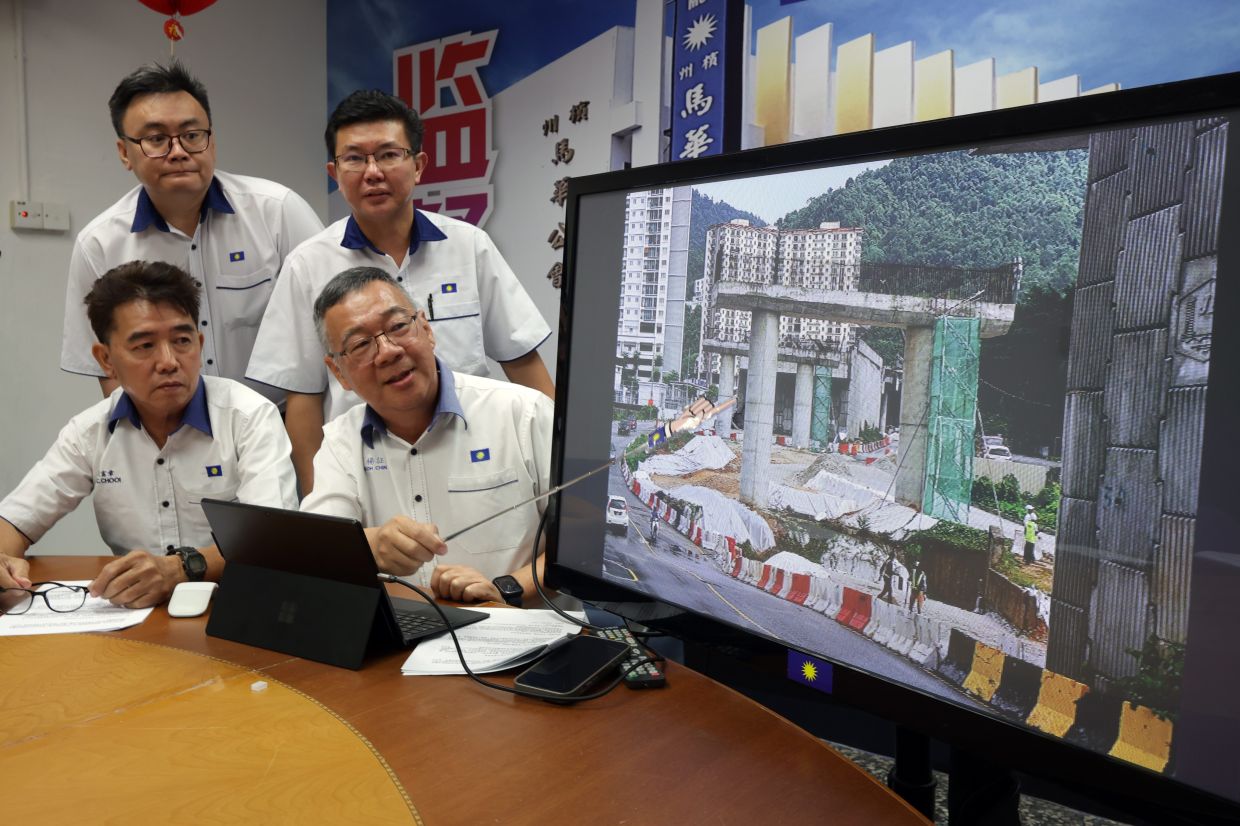
The Penang Malaysian Chinese Association has escalated pressure on the state government over what it characterises as misleading progress reports on a major infrastructure project, demanding comprehensive disclosure of financial and technical documentation or face complaints to federal oversight agencies. The organisation has questioned the credibility of reported advancement on the Air Itam-Tun Dr Lim Chong Eu Expressway bypass, a 6-kilometre toll-free corridor that forms part of the larger Penang undersea tunnel and paired roads initiative. The standoff reflects deeper concerns about project accountability in a state where infrastructure development has become increasingly politicised and subject to public scrutiny.
Yeoh Chin Kah, the MCA's secretary, framed the controversy not as a mere matter of construction delays but as a fundamental governance issue affecting public trust. He emphasised that the party's grievance extends beyond the predictable timeline extensions that have plagued the project since its original 2024 completion target was pushed back twice, with the latest deadline now set for April 12, 2027. His position signals that opposition parties and community groups are watching how state authorities manage and communicate about high-visibility projects, particularly where public funds and significant residential populations are directly affected.
The numerical discrepancy at the heart of the dispute is striking. Progress reportedly jumped from 80 percent in May to 89 percent by December, a leap of nine percentage points in seven months that the MCA finds implausible given observed site conditions. According to a July 1 site inspection conducted by party members, multiple sections remained substantially incomplete, including Valley Road, Changkat Tembaga, and Jalan Thean Teik. The MCA's specific observations—bridge piers in place but absent bridge beams and deck structures, incomplete road surfacing, unfinished guardrails and noise barriers, and outstanding mechanical and electrical work across numerous segments—paint a picture fundamentally misaligned with an 89 percent completion assessment.
This type of discrepancy between reported progress metrics and observable site conditions raises questions about how completion percentages are calculated and reported in major Malaysian infrastructure projects. Different methodologies—whether based on financial expenditure, milestone completion, or physical construction advancement—can yield dramatically different results. The MCA's challenge suggests that the state may be using metrics that do not align with how the general public understands project completion, creating a credibility gap that threatens confidence in government reporting more broadly. For Malaysian readers following infrastructure development, this dispute illustrates why independent verification and transparent reporting standards matter.
The MCA has provided the state government a seven-day deadline to produce payment records, consultant certification documents, and project assessment reports. This specific demand targets the paper trail that typically substantiates progress claims and contractor compliance. The ultimatum carries real consequences: if the documentation is not forthcoming, the MCA intends to lodge formal complaints with both the National Audit Department and the Malaysian Anti-Corruption Commission. The party has also announced plans to establish a dedicated monitoring committee focused on tracking reported progress and verifying payment compliance going forward. Such moves suggest that political opposition to the state government is intensifying around this project.
Paya Terubong assemblyman Wong Hon Wai responded to the MCA's challenge by reaffirming the state's position, contending that the project has actually achieved 91 percent completion and remains aligned with the April 2027 deadline. He cited a June 30 meeting with the construction team as confirmation of this figure and outlined specific milestones expected in coming months, including the launch of twelve bridge beams on the Gelugor side between July and August, with six additional beams scheduled for the fourth quarter. Wong's response indicates that the state government, through its assemblyman, is doubling down on its progress claims rather than addressing the substantive observations raised by the MCA.
The technical details Wong provided offer some clarification on current work stages. Bridge beams on the Bandar Baru Air Itam side have reportedly been fully installed, though he acknowledged that road opening would not follow immediately upon construction completion. Ongoing work on deck slabs and parapets represents a logical progression in bridge construction sequencing. However, Wong's explanation that a Road Safety Audit conducted by a relevant government agency must precede opening, followed by Public Works Department advisories on timing, introduces additional procedural steps and potential delays that were not reflected in his overall completion percentage. This bureaucratic layering may explain some of the discrepancy between construction completion and actual usability.
The Air Itam bypass project carries substantial significance for the Penang metropolitan area, with projections indicating that approximately 300,000 residents in Air Itam, Bandar Baru Air Itam, and Paya Terubong stand to benefit from reduced congestion and shorter travel times. The expressway will link Lebuhraya Thean Teik in the newer development area with the existing Tun Dr Lim Chong Eu Expressway through a combination of elevated viaducts, underground tunnels, and ground-level roads. This multi-modal approach reflects sophisticated urban planning designed to minimise land acquisition and environmental disruption while maintaining traffic flow. For these communities, the project represents essential infrastructure necessary to accommodate ongoing urbanisation and residential growth in the northern Penang corridor.
The repeated timeline extensions—from 2024 to 2027, representing a three-year delay—have inevitably tested public patience and raised questions about contractor competence, supervision effectiveness, and whether realistic timelines were established originally. In the Malaysian context, infrastructure delays have become sufficiently common that citizens approach revised completion dates with considerable scepticism. The MCA's intervention reflects this broader cynicism while attempting to apply pressure through formal accountability mechanisms. The party's decision to threaten complaints to federal oversight bodies suggests that internal state-level dispute resolution has proven unsatisfactory.
For Malaysian readers concerned with infrastructure governance, this situation illustrates the importance of demanding transparent, independently verifiable reporting on major projects. The gap between official progress metrics and observable site conditions, if sustained, erodes institutional credibility across all government-managed initiatives. Penang, as a state with relatively sophisticated administration and engaged civil society, serves as a microcosm for how accountability pressures operate in Malaysian governance. The coming seven days will demonstrate whether the state government opts for transparency or defensiveness, setting an important precedent for how similar disputes are handled elsewhere.
The underlying issue transcends the specific bypass project. As Malaysian infrastructure continues to expand and urban populations grow, ensuring that government reports on project progress align with observable reality becomes crucial for maintaining public trust in state institutions. The MCA's challenge, whatever its political motivations, has identified a legitimate governance concern that extends beyond partisan calculation. Whether the state government responds constructively to these demands will signal to other communities and oversight bodies how seriously Penang treats accountability in major development initiatives, particularly those funded by public resources and affecting hundreds of thousands of residents.

