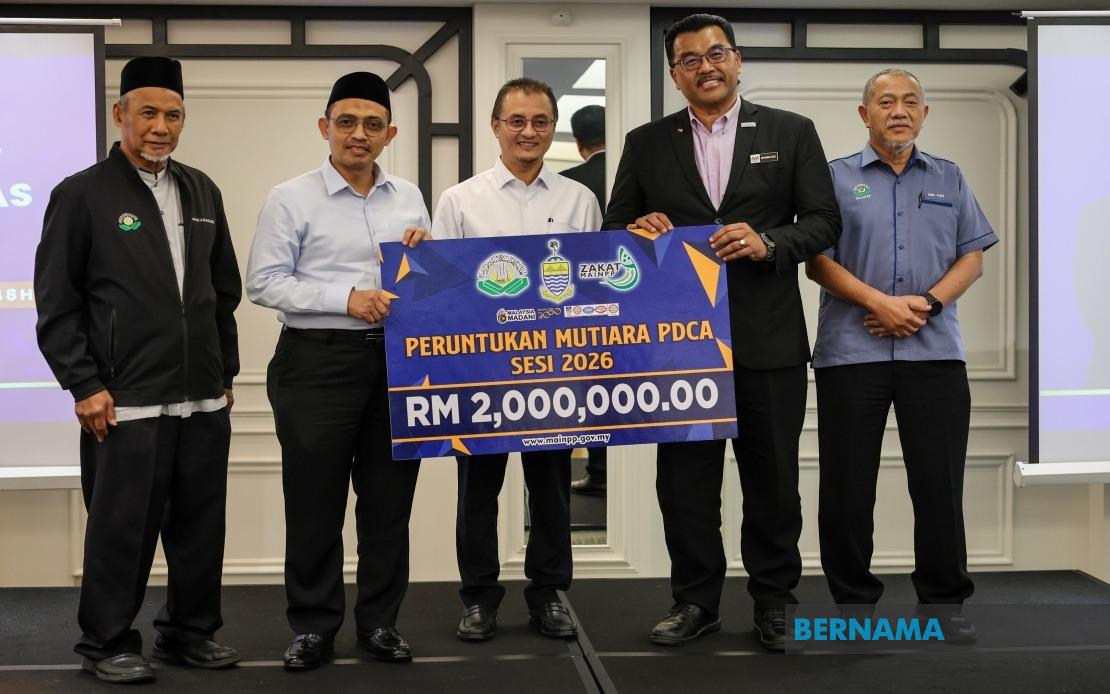
The Penang State Islamic Religious Council (MAINPP) is channelling RM2 million into its flagship academic support initiative this year, extending free tuition and educational resources to over 7,400 Bumiputera pupils and students distributed across government schools throughout the state. The commitment, announced by Penang Deputy Chief Minister I Datuk Dr Mohamad Abdul Hamid, underscores the mounting emphasis placed by state authorities on narrowing achievement gaps among disadvantaged learners, particularly those from lower-income households who lack access to private tuition services.
The Mutiara Didik Cemerlang Akademik (MPDCA) Programme, which has operated since 2006, represents a collaborative effort spanning multiple state and federal agencies. Beyond MAINPP itself, the initiative draws support from the Penang State Education Department (JPNPP), the Penang Bumiputera Participation Coordination Division under the Prime Minister's Department Implementation Coordination Unit, and the Penang Regional Development Authority (PERDA). This multi-agency framework reflects an institutional recognition that sustained educational improvement requires coordinated action across bureaucratic boundaries and stakeholder groups.
The 2026 iteration of the programme will deploy 698 trained coordinating teachers across a substantial network of 71 primary schools and 38 secondary schools. This infrastructure expansion demonstrates how the initiative has matured from a pilot intervention into an embedded component of Penang's education ecosystem. The breadth of participation suggests that the programme has successfully integrated itself into mainstream schooling structures rather than remaining a peripheral add-on, which could enhance its sustainability and impact over time.
For primary learners preparing for their Year Six assessments, MPDCA concentrates resources on four foundational subjects: Bahasa Melayu, English, Mathematics and Science. This targeted approach reflects pedagogical understanding that mastery of core competencies at earlier stages creates a platform for more specialised learning in subsequent years. Secondary students pursuing the Sijil Pelajaran Malaysia (SPM) qualification gain access to a substantially broader curriculum encompassing 13 subjects, including advanced offerings such as Additional Mathematics, Physics, Chemistry and Biology alongside humanities and language subjects.
Beyond conventional academic subjects, the programme extends to curricula offered in government-aided religious schools, incorporating three Integrated Dini Curriculum subjects: Dini-Lughatul Arabiyyah Mu'asirah (LAM), Dini-As Syariah and Dini-Usuluddin. This inclusive design reflects Penang's religiously diverse demographic composition and acknowledges that Islamic educational institutions serve significant cohorts of Bumiputera students requiring comparable support mechanisms. The inclusion of religious curriculum alongside secular subjects also reflects broader Malaysian policy frameworks that integrate Islamic knowledge within broader human development objectives.
Historical data compiled by JPNPP indicates that MPDCA has delivered measurable positive outcomes since its inception. Participating students have demonstrated improved academic performance and achievement rates relative to comparable cohorts, suggesting that the intervention model generates genuine educational gains rather than merely providing supplementary instruction. This evidence base provides institutional justification for continued and expanded investment, though more granular performance metrics comparing MPDCA participants against non-participants would strengthen empirical support for programme expansion.
Datuk Dr Mohamad Abdul Hamid's announcement of the RM2 million allocation occurred alongside disclosure of other MAINPP educational investments totalling significantly higher amounts. The council has simultaneously allocated RM22.36 million for Higher Education Bursaries, RM6.3 million for the Permulaan IPT (Initial Higher Education) Scheme, RM3 million for Early Schooling Aid and RM3 million for School Uniform Aid. Collectively, these investments constitute a comprehensive educational support architecture spanning early childhood through tertiary education, targeting economic barriers that impede Bumiputera progression through the Malaysian education pipeline.
Teachers directly engaged with MPDCA delivery emphasise the programme's practical value in classroom settings. Hartina Arjan, a Bahasa Melayu educator at Sekolah Kebangsaan Permai Indah, highlights how systematically developed learning modules enable students from heterogeneous academic backgrounds to access quality instruction without financial barriers. She notes that the programme's modular design deliberately cultivates speaking, reading and writing competencies that prepare learners for both Classroom-Based Assessment (PBD) and end-of-year examinations, creating alignment between formative and summative evaluation requirements.
The perspective of educators working in religious school contexts adds further dimension to the programme's impact narrative. Sadiah Roslan, teaching at Sekolah Rendah Islam Al-Masriyah Halimatun in Bukit Mertajam, emphasises that MPDCA has particularly benefited students originating from economically disadvantaged families who would otherwise lack affordable access to supplementary tuition. She characterises the updated pedagogical approach—incorporating interactive methodologies and quiz-based activities—as generating marked improvements in student engagement and classroom participation, translating into measurable academic advancement.
From a Malaysian policy perspective, Penang's MPDCA investment reflects broader national commitment to ensuring that Bumiputera educational opportunities do not depend primarily on household income. The Bumiputera framework aims to advance socioeconomic standing across indigenous Malay-Muslim populations through targeted interventions, and education remains foundational to this objective. Programmes like MPDCA operationalise these policy goals through direct classroom intervention, providing concrete mechanisms through which constitutional protections translate into tangible learner benefits.
The programme's longevity—spanning two decades since 2006—demonstrates institutional resilience and political commitment transcending individual electoral cycles. In Malaysian governance contexts where education initiatives frequently suffer from discontinuity as administrations change, MPDCA's sustained operation suggests it has attained sufficient stakeholder support and demonstrable results to resist dismantling. This stability creates conditions where educators and students can develop confidence in the initiative's persistence, encouraging fuller engagement rather than viewing it as a temporary intervention.
Looking toward broader Southeast Asian contexts, Penang's approach offers relevant models for other jurisdictions grappling with educational equity challenges. The integration of multiple government agencies, the scaling across numerous schools and teachers, and the explicit focus on low-income Bumiputera learners demonstrate how state-level systems can operationalise equity commitments through systematic resource allocation and coordination. The emphasis on developing pedagogical materials and teacher training rather than simply providing cash transfers reflects understanding that sustainable achievement gains require capacity building alongside financial inputs, a principle with applicability across diverse developing contexts throughout the region.

