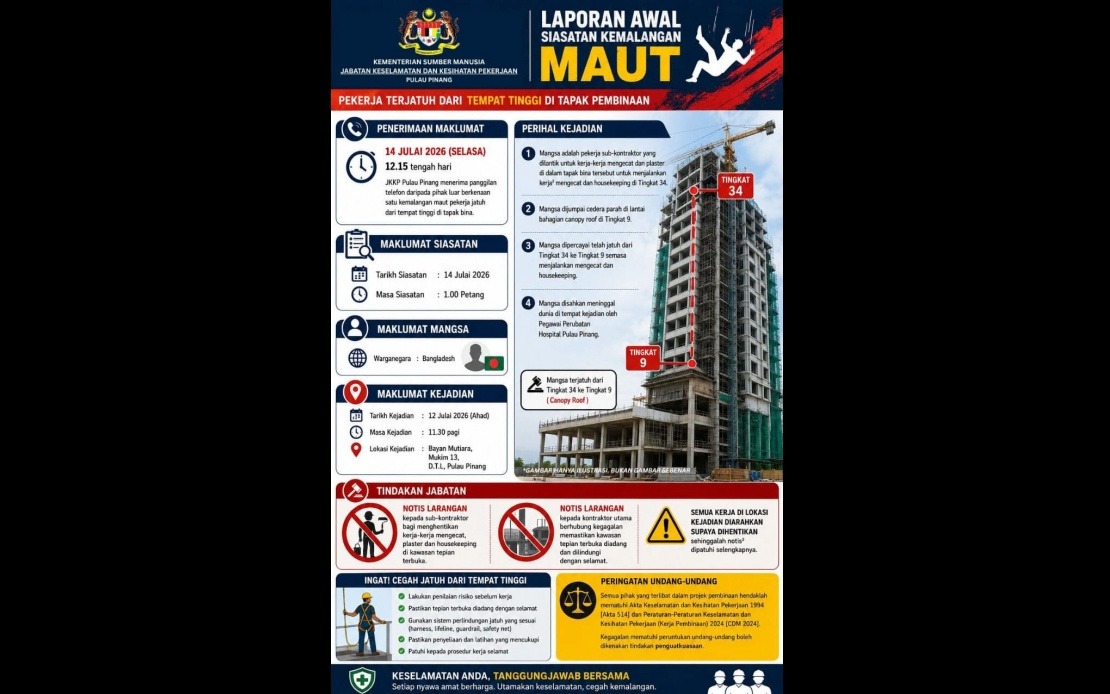
Occupational safety inspectors in Penang have launched a formal investigation into the death of a Bangladeshi construction worker who plummeted approximately 25 storeys from a high-rise building under development in the Bayan Mutiara district. The incident, which occurred on July 15, marks another serious workplace tragedy in Malaysia's bustling construction sector and has prompted immediate regulatory action to prevent similar occurrences.
The Penang Department of Occupational Safety and Health (DOSH) received initial notification of the incident at 12:15 pm through an external source, triggering a swift deployment of investigating officers to the Bayan Mutiara site. Upon arrival, the team began piecing together the circumstances that led to the worker's death, examining evidence and interviewing witnesses to reconstruct the sequence of events. The preliminary findings paint a tragic picture of a workplace mishap that escalated into a fatal outcome within seconds.
According to Penang DOSH director Hairozie Asri, the deceased worker was part of a subcontracting team tasked with painting, plastering, and housekeeping duties across the construction site. At the time of the incident, he was positioned on the 34th floor performing his assigned work when something went catastrophically wrong. Instead of falling directly to ground level, the victim struck a canopy roof structure at Level 9, where medical personnel from Penang Hospital subsequently confirmed his death.
The specific nature of how the worker fell remains under investigation, though the height involved—roughly equivalent to a 25-storey drop—and the significant injuries sustained suggest the force of the impact was overwhelming. The investigation will scrutinise whether appropriate fall-prevention measures were in place, whether the worker was using safety equipment, and whether site protocols were being followed. These details matter enormously for determining liability and identifying systemic failures that contributed to the tragedy.
Responding decisively to the incident, DOSH issued multiple prohibition notices to both the subcontractor handling the painting and plastering operations and the main contractor overseeing the overall project. The subcontractor has been explicitly barred from continuing painting, plastering, and housekeeping work in any open-edge areas of the structure—a critical restriction given that such work in elevated, unprotected zones represents extreme occupational hazard. This targeted prohibition reflects the specific nature of the incident and aims to prevent identical circumstances from recurring.
The main contractor also received a prohibition notice, though the directive focuses on halting all work activities linked to the accident location until comprehensive safety compliance has been demonstrated. This broader suspension effectively freezes operations at the site, creating significant financial pressure and schedule disruptions that serve as both a penalty and incentive for the company to implement rigorous corrective measures. No work can resume until every requirement specified in the prohibition notices has been fulfilled and verified by inspectors.
Migrant workers in Malaysia's construction industry face disproportionate occupational risks compared to their local counterparts, a reality reflected in mortality and injury statistics that consistently highlight their vulnerability. Bangladeshi workers comprise a substantial portion of Malaysia's migrant labour force and are frequently assigned to the most dangerous tasks, including high-altitude work in building construction. Language barriers, unfamiliarity with local safety standards, and economic desperation that discourages workers from reporting hazards all compound these risks, creating a systematic disadvantage that deserves sustained policy attention.
The Penang incident underscores persistent gaps in workplace safety culture within Malaysia's construction sector, despite regulatory frameworks and enforcement mechanisms already in place. While DOSH's swift response demonstrates institutional capacity to react to tragedies, questions about prevention remain. Were comprehensive risk assessments conducted before work commenced? Were safety harnesses and fall-arrest systems properly installed and maintained? Were workers adequately trained and supervised? These preventive questions often receive insufficient attention until after someone dies.
For project developers, contractors, and subcontractors, such incidents translate into substantial costs extending far beyond immediate legal liability. Work stoppages, regulatory investigations, potential criminal charges, reputational damage, and insurance implications create powerful business incentives to prioritise safety from the outset. Yet these incentives have repeatedly proven insufficient to eliminate preventable workplace deaths in Malaysia's construction industry, suggesting that stronger enforcement, more severe penalties, and structural changes to how safety responsibility is allocated may be necessary.
The Penang DOSH investigation will likely take several weeks to complete, potentially uncovering additional findings about systemic deficiencies at the site. These findings will inform enforcement decisions and may trigger broader industry reviews if patterns emerge suggesting sector-wide compliance failures. For the worker's family in Bangladesh and colleagues who witnessed the tragedy, the investigation offers limited consolation, but it represents the formal mechanism through which the Malaysian state acknowledges the loss and attempts to extract lessons that might prevent future deaths.
This incident also highlights ongoing vulnerability within Malaysia's migrant worker population, who contribute substantially to national economic growth yet frequently operate in conditions that inadequately protect their safety and wellbeing. As construction activity continues accelerating across the region, the treatment of migrant workers in these industries will increasingly attract scrutiny from international labour organisations and civil society groups monitoring compliance with global workplace standards and human rights obligations.

