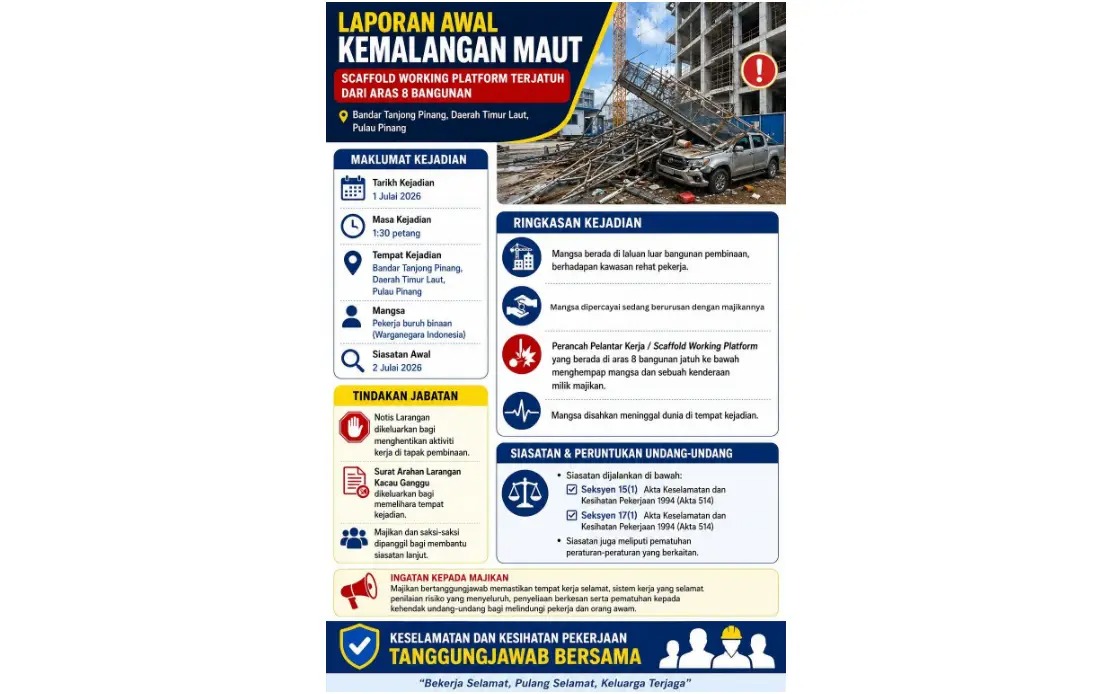
The Penang branch of the Department of Occupational Safety and Health (DOSH) has formally prohibited all work activities at a Bandar Tanjong Pinang construction site following a fatal accident that claimed the life of an Indonesian worker. The prohibition notice, issued in the aftermath of the July 1 incident, represents a significant regulatory intervention aimed at preventing further injuries while authorities complete their investigation into what transpired.
According to DOSH's statement, the fatal accident occurred at 1.30 pm when a scaffolding working platform detached from the eighth floor of the building under construction. The platform fell and struck the worker, who was positioned at a lower level on an external walkway adjacent to a workers' rest area. The force of the falling platform was severe enough to also strike a vehicle belonging to the employer, underscoring the considerable mass and velocity involved in the incident.
The timing and location of the accident reveal a critical vulnerability in site management. The worker was engaged in discussion with his employer on the external walkway when the platform fell, suggesting that work zone protocols and safety barriers may not have adequately separated active work areas from zones where personnel were conducting routine business. This configuration raises questions about whether appropriate spatial separation existed between elevated construction activities and areas frequented by ground-level workers.
Beyond the immediate work stoppage, DOSH has implemented a non-disturbance order that preserves the scene in its original condition. This forensic approach is essential for determining the precise cause of the platform's failure. Investigators are examining whether the collapse resulted from structural deficiency in the scaffolding system, inadequate installation or maintenance, failure of attachment points, or some combination of these factors. Such preservation protocols are standard in fatal workplace investigations and provide the evidentiary foundation for subsequent enforcement actions.
The investigation is currently focused on potential breaches of the Occupational Safety and Health Act 1994 (Act 514), particularly Sections 15(1) and 17(1), which establish the fundamental duties of employers to ensure safe work systems and the provision of safe plant and equipment. These provisions form the backbone of Malaysia's occupational safety framework and carry substantial penalties for violations. DOSH is calling upon both employers and witnesses to provide detailed accounts of how the scaffolding was installed, maintained, and monitored.
For Malaysian and Southeast Asian construction industry observers, this incident underscores persistent challenges in scaffolding safety across the region. Penang, as a major industrial and commercial hub, has experienced significant construction activity in recent years. The presence of migrant workers—as evidenced by the Indonesian nationality of the victim—is commonplace throughout Malaysia's construction sector, and such workers frequently face heightened risks due to language barriers, unfamiliarity with local safety standards, and sometimes inadequate training in the specific hazards they encounter.
The regulatory environment in Penang has been actively enforcing workplace safety standards, and DOSH's swift response signals a commitment to holding contractors accountable. However, the frequency of serious construction accidents across Malaysia suggests that compliance gaps remain widespread. Developers, main contractors, and subcontractors often operate in competitive environments where cost pressures may inadvertently influence safety prioritization. DOSH's public reminder that all workplace activities must be properly planned and executed safely is directed at an industry that continues to grapple with embedding safety culture at all organizational levels.
The investigation will likely examine the administrative and management failures preceding the platform's collapse. This extends beyond the structural or mechanical aspects to encompass questions of supervisor oversight, toolbox meetings, work permits, and whether hazard assessments were conducted before the work commenced. Additionally, investigators will consider whether the scaffolding system was certified for the loads it was designed to bear and whether regular inspections had been performed in accordance with regulatory requirements.
From an enforcement perspective, DOSH's statement indicates that legal action will follow if violations are substantiated. This could result in substantial fines for the responsible company or individual, potential criminal charges against senior management if gross negligence is established, and possible contractual consequences affecting the firm's ability to secure future projects. The construction industry in Malaysia is sufficiently competitive that such regulatory interventions carry material commercial consequences, creating incentives for improved safety compliance.
The incident also highlights the importance of safety in the broader Malaysian economic context. Construction activity drives employment and economic growth, but fatalities and serious injuries undermine productivity, raise insurance costs, and create social costs borne by workers' families and their communities. As Malaysia seeks to maintain its competitiveness in regional manufacturing and infrastructure development, workplace safety becomes an economic imperative alongside a moral obligation.
For workers in similar high-risk occupations—particularly migrant workers who may lack strong advocacy—this incident serves as a sobering reminder of workplace vulnerabilities. Industry organizations, union representatives, and government agencies have ongoing responsibility to ensure that workers understand their rights, can report hazards without fear of retaliation, and have access to information about safe work practices in languages they understand.
The Penang DOSH investigation will likely yield findings that extend beyond this single incident, potentially informing broader industry guidance on scaffolding safety standards and best practices. As construction continues to expand across Penang and throughout Malaysia, the lessons extracted from this fatal accident will be critical in preventing similar tragedies and reinforcing the fundamental principle that no project is so urgent that safety can be compromised.

