Puteri Mas Aishah Ramyusnali has transformed something most people take for granted—sunlight—into a medium for deeper artistic and environmental inquiry. The 24-year-old Penang-born artist has spent the past three years mastering cyanotype, a photographic printing process that relies entirely on natural light and chemical reaction to produce distinctive blue-toned images. What began as a technical skill has evolved into a philosophical exploration of how humans relate to the natural world, fundamentally reshaping her creative vision and artistic practice.
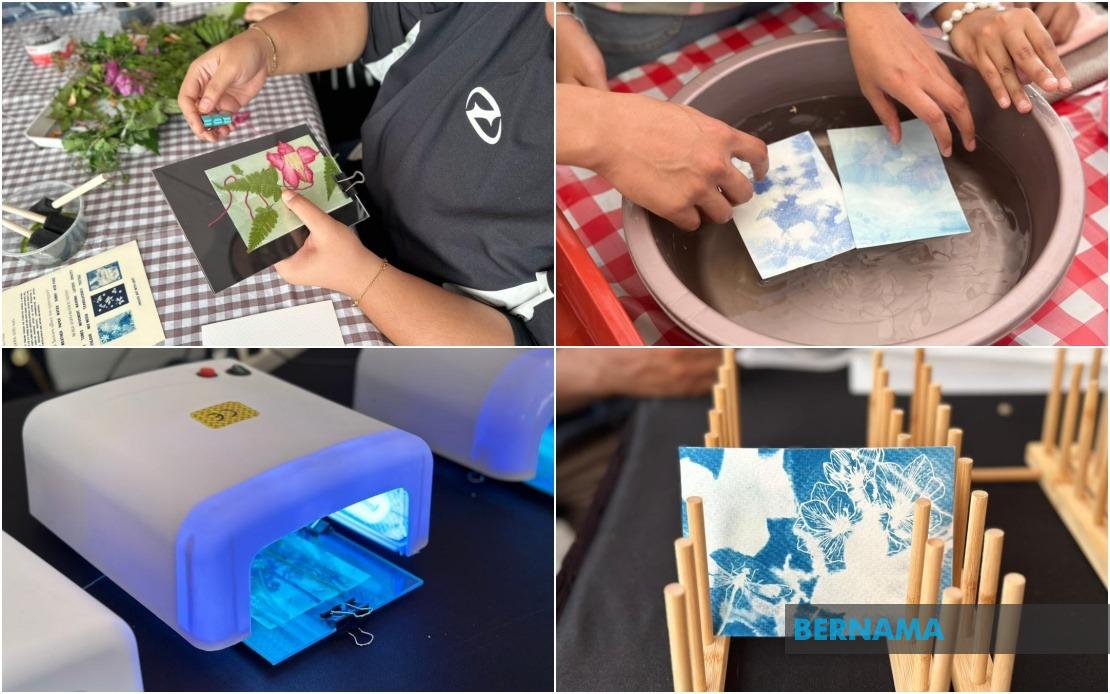
Cyanotype, at its core, is deceptively simple yet profoundly dependent on environmental variables. Once organic materials—leaves, flowers, or other objects—are arranged on light-sensitive paper and exposed to sunlight for 10 to 15 minutes, the work then enters an equally crucial phase. The paper must be washed in sequences of acidic and alkaline water, during which the vivid blue image gradually materialises on the surface. This multi-stage process means that nature exerts direct influence at every step, making it impossible for the artist to exercise complete control over the outcome. Instead, Puteri Mas Aishah must collaborate with weather patterns, UV intensity, and atmospheric conditions to realise her vision.
The variability of these environmental factors has taught her valuable lessons about interconnectedness that extend beyond the studio. She has become acutely aware of daily weather forecasts, UV index readings, and water quality—elements that most contemporary artists rarely consider central to their practice. Higher ultraviolet exposure typically yields more saturated and concentrated blue hues, while overcast skies produce softer, lighter variations. This direct dependency on natural forces means no two prints are ever identical, even when using the same composition. For Puteri Mas Aishah, this unpredictability is not a limitation but an essential feature that mirrors the unpredictable nature of human existence within ecological systems.
Her journey into cyanotype began during industrial training, a period when she was tasked with introducing the art form to the public through interactive workshops. Initially apprehensive about conducting hands-on sessions without direct supervision from academic mentors, she nonetheless moved forward, discovering that public engagement rekindled her passion for the medium. These workshops became transformative experiences not only for participants but also for herself, as she learned to communicate complex artistic and environmental concepts to diverse audiences. This early success catalysed her deeper involvement in the discipline, eventually leading to regular collaborations with various art studios and galleries across Shah Alam in Selangor.
Currently pursuing a Master of Fine Arts and Technology degree at Universiti Teknologi MARA, Puteri Mas Aishah continues to conduct workshops while developing her artistic voice. Her work featured at the RIUH Pi HAWANA Carnival, hosted at the PICCA Convention Centre in Butterworth, where she articulated her broader vision for the role of art in society. She deliberately positions cyanotype not merely as an aesthetic pursuit but as a gateway for reconnecting with environmental realities that modern life often obscures. Through hands-on engagement with the process, participants experience firsthand how weather, water, and light physically determine artistic outcomes.
Her advocacy carries particular resonance in contemporary Malaysia, where rapid urbanisation and industrialisation have widened the distance between populations and natural systems. By framing art as a mechanism for environmental consciousness rather than purely decorative or commercial enterprise, she challenges prevailing attitudes that marginalise creative disciplines as peripheral to serious social concerns. Young people, whom she specifically hopes to reach, often encounter art through educational curricula that emphasise technical skill acquisition over philosophical engagement with the living world. Puteri Mas Aishah's practice offers an alternative pathway where artistic production becomes inseparable from ecological awareness.
The cyanotype process itself serves as a pedagogical tool with broader implications for how communities might understand their relationship with natural systems. Workshops structured around this technique inevitably teach participants about light, chemistry, and material properties, but more importantly, they demonstrate that human creativity necessarily depends upon working within natural constraints rather than against them. This message arrives at a critical juncture when climate change, water scarcity, and resource depletion increasingly demand that societies recalibrate their assumptions about human dominion over nature. Cyanotype, by design, resists such domination and instead models cooperative engagement.
The accessibility of cyanotype as a medium contributes significantly to its pedagogical potential within Malaysian contexts. Unlike many contemporary art forms requiring expensive equipment or specialised facilities, cyanotype demands only basic supplies—photosensitive chemicals, water, and sunlight. This democratic quality means workshops can be conducted across diverse settings, from elite art institutions to community centres in less-resourced neighbourhoods. Puteri Mas Aishah's expansion of workshops through collaborations with multiple venues reflects awareness that environmental consciousness cannot remain confined to privileged artistic circles but must permeate broader social consciousness.
Her vision extends beyond individual artworks to encompass what might be termed an environmental aesthetics—a way of seeing and creating that privileges interconnectedness over isolation, contingency over control, and collaboration with natural forces over their subjugation. In conversations about art and society, she deliberately reframes the discipline as fundamentally relevant to everyday existence rather than something trivial or decorative. This reframing proves especially necessary in cultural contexts where artistic pursuits often face dismissal as luxuries rather than necessities. By demonstrating that art practice can address core environmental and social concerns, she contributes to elevating the discipline's perceived importance.
For Malaysian audiences and the broader Southeast Asian region, Puteri Mas Aishah's work offers a localised yet globally resonant model of how creative practice might facilitate deeper environmental engagement. Her background, training, and current work all remain rooted within Malaysian institutions and communities, grounding her artistic voice in specific cultural and geographical contexts while addressing universal questions about human-nature relationships. As environmental challenges intensify across the region, such cultural interventions gain increasing significance, suggesting pathways through which societies might cultivate ecological consciousness not through mandates or statistics alone but through embodied creative experiences that transform how people perceive and inhabit their surroundings.