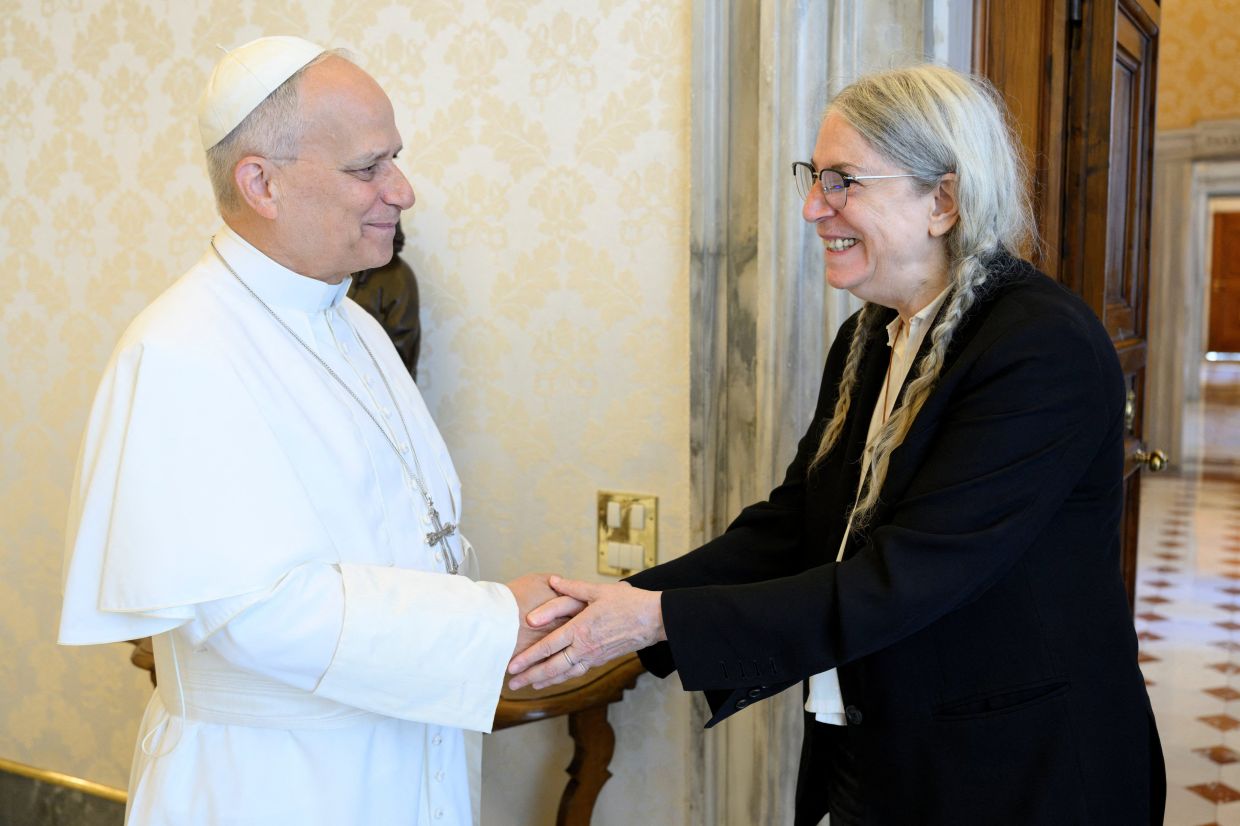
Rock legend Patti Smith found herself in rare company on Friday when she entered the Apostolic Palace for a private audience with Pope Leo XIV. The encounter between two cultural figures from Chicago proved more intimate than formal protocol might suggest, with Smith's characteristic understated elegance setting the tone for what Vatican officials described as a deeply personal exchange. As the pioneering musician took her seat across from the pontiff at his desk, she greeted him simply with a soft "Hi," a moment that contrasted sharply with the grandeur of her surroundings and the significance of the meeting itself.
Smith's increasing presence at the Vatican reflects a relationship built on genuine mutual respect and shared values rather than official ecclesiastical standing. The artist, who wore a crucifix necklace and her signature braids to the Friday meeting, has cultivated this connection through Rev Antonio Spadaro, the undersecretary in the Vatican's culture ministry, who has become instrumental in facilitating her engagement with the Holy See. Despite having no formal affiliation with the Catholic Church, Smith has been drawn deeply into Vatican circles through her profound admiration for Pope Francis and what she described as his "gentle, open, and steadfast sense of humanity." This spiritual alignment, though existing outside traditional denominational boundaries, has granted her unique access to the upper echelons of the Vatican's cultural life.
For Malaysian and Southeast Asian observers, Smith's journey towards the Vatican holds particular significance as a case study in how artistic and spiritual pursuits transcend institutional religion. Her willingness to engage with papal leadership while remaining outside Catholic membership demonstrates a cosmopolitan approach to faith that resonates increasingly with younger and more diverse populations across the region who seek spiritual meaning without rigid doctrinal constraints. Smith's example suggests that cultural institutions, even those as ancient as the Roman Catholic Church, are adapting to accommodate individuals who embody spiritual values without requiring formal religious conversion.
The Friday audience lasted approximately 40 minutes, according to Spadaro's account, a duration suggesting substantive conversation rather than perfunctory ceremonial greeting. Spadaro himself attended the meeting, and his characterization of the encounter as feeling "like a conversation between two people discovering they were old friends, sharing memories woven from words and music, dreams, visions, and hopes" reveals the emotional depth of the exchange. Rather than the formal distance typically maintained during papal audiences, the interaction appeared remarkably relaxed and mutually enriching, suggesting that Leo and Smith engaged on terms of intellectual and creative equality despite the vast differences in their formal positions and responsibilities.
Smith's musical legacy, particularly her 1979 composition, resonated immediately with the pontiff during their discussion. When she referenced the tune, Leo responded with genuine enthusiasm, telling her simply that "That was marvelous," indicating that he was not merely familiar with her work but had engaged with it seriously enough to form substantive opinions. This exchange elevated their conversation beyond diplomatic pleasantries into genuine artistic appreciation, highlighting how creative expression serves as a universal language capable of bridging even the most unlikely personal and professional divides.
The timing of their Friday meeting connected to a broader pattern of Smith's deepening involvement with Vatican cultural initiatives. Earlier in 2025, on May 8—notably the anniversary of Leo's election—Smith performed during the inauguration of the Holy See's pavilion at the Venice Biennale, one of the world's most prestigious contemporary art showcases. This performance underscored the Vatican's recognition of Smith as a significant cultural figure capable of representing papal values and aesthetics to the international art community, positioning the Church not as an antiquated institution but as an active participant in contemporary artistic discourse.
Smith's relationship with papal leadership extends backward through recent Church history, revealing a consistent spiritual resonance with successive pontiffs. Her historical connection to Pope John Paul I, alongside her more recent and extensively documented bond with Pope Francis, demonstrates an unusual consistency of engagement across different papal administrations. When Francis died on April 21, 2025, Smith memorialized him through poetry rather than conventional eulogy, composing a poem that compared the late pontiff to a dandelion—"humble yet strong," she wrote. In this eulogy, she described the natural world and poetry itself as having lost "their champion," a characterization that elevated Francis beyond institutional religion into the realm of universal human values.
For the global Catholic community and observers of Vatican affairs, Smith's presence signals important messages about the Church's evolving relationship with secular culture and artistic expression. Rather than maintaining rigid boundaries between sacred and profane, between believer and non-believer, the Vatican under Leo appears willing to engage with cultural figures on their own terms, recognizing that spiritual wisdom and artistic vision need not be constrained by formal institutional membership. This openness has significant implications for how the Church might position itself in increasingly pluralistic societies across Southeast Asia, where religious affiliation and cultural identity operate with far greater fluidity than in traditionally Christian-majority nations.
The Friday meeting also arrived in the context of Leo's broader engagement with performing arts and music. Just two days earlier, on Wednesday, July 29, the pontiff had attended a concert performed in his honour by renowned Italian tenor Andrea Bocelli, suggesting an intentional strategy of positioning the papacy as actively supportive of artistic endeavor and musical excellence. These successive engagements with world-class performers indicate that Leo's pontificate is consciously cultivating a public image that values cultural sophistication alongside spiritual authority, appealing to constituencies that might otherwise regard the Church as disconnected from contemporary creative life.
Smith's departure from the Apostolic Palace mirrored her arrival in its simplicity. As she concluded her conversation with Leo, she offered another characteristic understated farewell: "Bye. Bye."—words that Spadaro recorded with evident appreciation for their authenticity and lack of pretension. In that simple goodbye lay perhaps the deepest truth about the entire encounter: two people from Chicago, separated by vastly different life paths and institutional roles, had connected as human beings across the formality of papal protocol. For those watching from Southeast Asia, where hierarchical respect and informal warmth sometimes exist in tension, Smith and Leo's interaction offered a subtle lesson in how genuine human connection can flourish even within the most ceremonial contexts.

