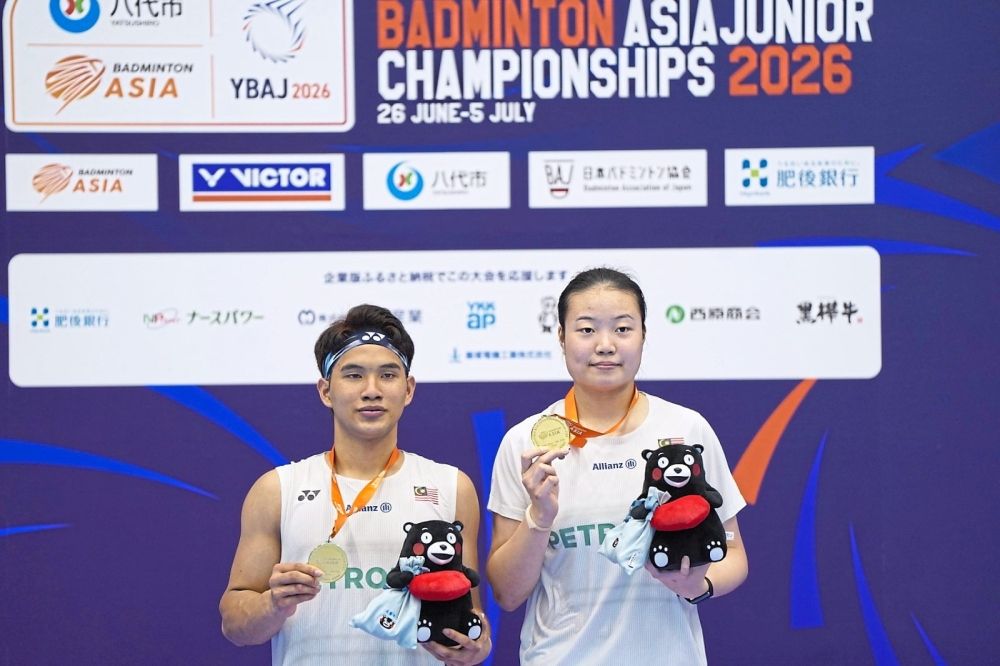
Malaysia has finally ended a nearly two-decade championship drought in mixed doubles at the Asian Junior Badminton Championships. Ahmad Redzuan Zulwaqqarizal and Low Zi Yu defeated China's Zheng Weigang and Li Menghan 21-15, 22-20 in the final held in Yatsushiro, Japan yesterday, reclaiming the title that had eluded Malaysian shuttlers since 2007 when Tan Wee Kiong and Woon Khe Wei won it in Kuala Lumpur. The victory represents a significant breakthrough for the national junior badminton programme, which has struggled to produce mixed doubles medallists at Asia's premier junior competition in recent years.
The match unfolded as a tightly contested affair, with the Malaysian pair finding themselves in a precarious position during the decisive second game. At one point, Redzuan and Zi Yu stood just two points away from clinching the title, but the Chinese challengers demonstrated remarkable resilience, clawing their way back to force a decider. The pressure-cooker finish at deuce required both Malaysian players to dig deep into their reserves of composure and tactical acumen. Their ability to maintain focus when it mattered most ultimately proved decisive, as they held their nerve to secure victory in 43 minutes of compelling badminton.
Zi Yu attributed the triumph to strategic patience and mental discipline rather than flashy shot-making. In post-match remarks, the young shuttler emphasised that staying composed at crucial junctures separated the two pairs on the day. The turning point came at 20-20 in the second game, where Redzuan and Zi Yu managed their emotions and decision-making far more effectively than their opponents. Beyond the technical aspects of the contest, Zi Yu highlighted the psychological lift provided by their teammates' support from the sidelines, illustrating how team dynamics can influence individual performance even in head-to-head competition. This supportive environment, maintained even after teammates had suffered earlier eliminations, created a positive atmosphere that buoyed the Malaysian pair through the gruelling final stretch.
For Redzuan specifically, this championship carries exceptional personal significance given his previous struggles at the continental junior competition. The Terengganu-born player made his debut at the Asian Junior Championships in 2023 in Yogyakarta, competing in both boys' doubles and mixed doubles, but departed early from both events without making an impact. He returned to Yogyakarta in 2024 expecting to build on his experience, only to encounter more disappointment. Most recently, at the 2025 edition in Surakarta, Redzuan again failed to advance far in the competition. Three consecutive early exits might have discouraged many junior athletes, but Redzuan used those setbacks as motivation for improvement rather than reasons to doubt his potential. The breakthrough victory therefore represents vindication of his persistence and suggests a significant upward trajectory in his development as a badminton player.
Redzuan's measured response to his success reflects the mentality required to succeed at elite junior level. Rather than celebrating with unbridled enthusiasm, he acknowledged satisfaction with how he executed the technical and tactical elements he had refined during training sessions. This indicates a player focused on process and continuous improvement rather than merely chasing results. At the same time, he recognised that even with an Asian junior title secured, substantial work remains before he can graduate to senior competition at the international level. This perspective suggests Redzuan possesses the temperament needed to transition successfully to higher echelons of professional badminton, where complacency often arrests promising careers before they fully develop.
Zi Yu, the 15-year-old Malaysian, added a bronze medal in girls' doubles to her mixed doubles achievement, demonstrating the versatility increasingly demanded of junior badminton players. She and Genevie Lim fell just short of reaching the girls' doubles final, losing 21-16, 17-21, 17-21 to Japan's second-seeded pair of Aoi Banno and Yuzu Ueno in the semi-finals. Managing two events simultaneously at a major championship requires considerable physical stamina, tactical flexibility, and mental fortitude. Yet Zi Yu appeared unfazed by the dual demands, attributing her composed approach to having capable partners who could perform independently on court. Her willingness to relinquish the need to dominate proceedings in both partnerships and instead focus on her own technical execution demonstrates emotional intelligence beyond her years.
Zi Yu's partnership philosophy offers insight into how young badminton players can thrive when juggling multiple competitions. By trusting the abilities of both Redzuan in mixed doubles and Lim in girls' doubles, Zi Yu freed herself from the burden of carrying matches single-handedly. This collaborative approach, wherein she provided encouragement when partners struggled but otherwise maintained focus on individual contribution, represents best practice in team sports. The semi-final defeat in girls' doubles to a Japanese seeding of higher pedigree provides valuable tournament experience, exposing Zi Yu to top-tier opponents before she moves into senior competition. Such early exposure at championship level builds resilience and teaches tactical lessons that emerge only through genuine competitive adversity.
The Asian Junior Championships in Yatsushiro featured broad competition across all five disciplines, with champions crowned in men's singles, men's doubles, women's singles, women's doubles, and mixed doubles. The results across the event painted a picture of regional dominance by established badminton powers, with Chinese, Japanese, and Taiwanese players claiming multiple titles. Hong Tianyue of China captured the men's singles crown, defeating Indonesia's Fardhan Joe 21-18, 21-19, whilst Taiwan's Huang Tzu-yuan and Lin Sheng-ming secured men's doubles with a dominant 21-10, 21-13 victory over fellow Taiwanese pair Chen Ping-hsuan and Lee Wei-ting. These results underscored the high standard of junior badminton currently being produced across Asia.
In the women's competition, China again demonstrated its depth with Yin Yiqing winning the singles title over compatriot Zhang Yixin 21-17, 21-15, showcasing the bench strength available to Chinese badminton. Japan's Aoi Banno and Yuzu Ueno claimed women's doubles honours with a thrilling 21-13, 9-21, 23-21 victory over their Japanese rivals Ria Haga and Rio Yamakita, a result that highlighted how closely matched the region's top junior talent has become. Across these results, Malaysia's mixed doubles breakthrough stands out as the nation's sole gold medal from the championships, making the Redzuan-Zi Yu victory all the more significant for national badminton development.
The implications of Malaysia's mixed doubles title extend beyond mere medal tallies. The victory signals that the national badminton academy system, despite facing resource constraints compared to wealthier neighbours like China and Taiwan, continues producing competitive junior talent capable of prevailing on Asia's biggest junior stage. Redzuan's journey through three championship cycles before breaking through suggests patience, structured progression, and strategic tournament planning can eventually yield results even in a brutally competitive region. For Low Zi Yu, success at mixed doubles at just 15 years old indicates Malaysia may have identified another potential future senior player capable of competing internationally. The challenge now lies in ensuring both players receive the coaching, competition opportunities, and support necessary to translate junior success into sustained senior achievements, a transition where many promising youngsters stall.

