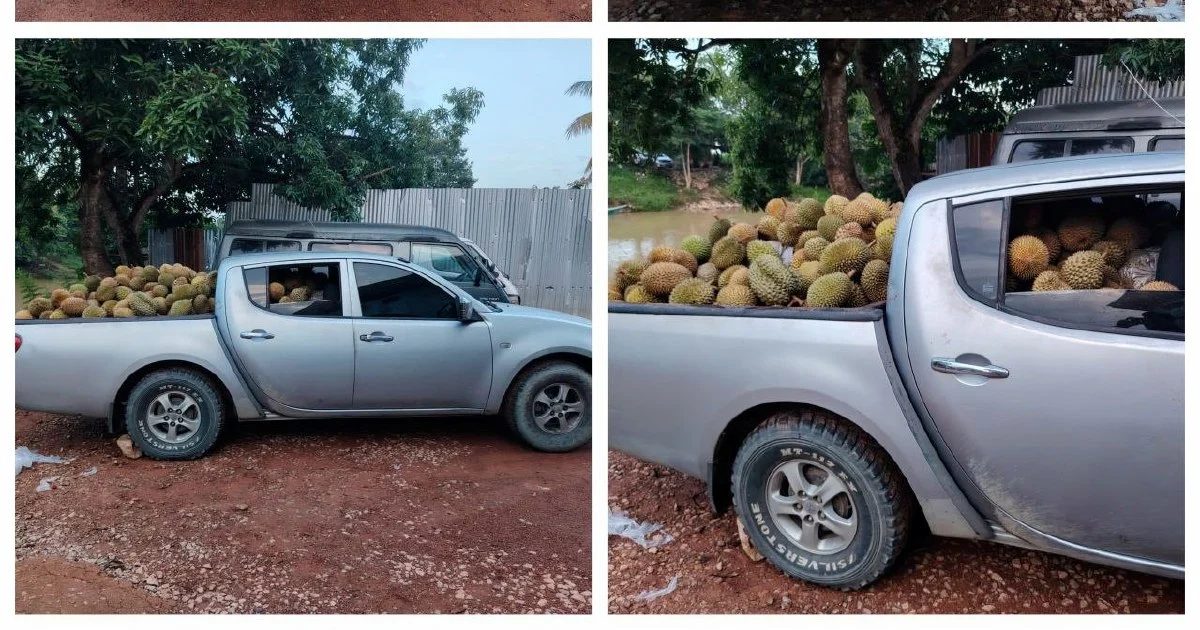
A young man's brief foray into supplementary income ended with his detention at a checkpoint in Rantau Panjang last night when authorities uncovered a large consignment of illicitly transported durians in his vehicle. The 22-year-old driver, who had accepted part-time work that promised modest daily wages between RM60 and RM70, was apprehended with approximately 700 kilograms of the pungent fruit suspected to have crossed international borders illegally.
The incident underscores a persistent problem affecting Malaysia's border regions, particularly in states like Kelantan where porous boundaries with Thailand have long facilitated the movement of contraband goods. Durians, despite their notoriety for their distinctive smell, represent a valuable commodity that attracts smugglers seeking to bypass tariffs and regulations that govern legitimate cross-border trade. The scale of the seizure—700 kilograms—suggests an organized operation rather than opportunistic smuggling, indicating that networks continue to exploit economically vulnerable individuals willing to transport goods for minimal compensation.
The dynamics of this case reveal a troubling recruitment pattern common in smuggling operations across Southeast Asia. Desperate for income, young job seekers accept positions offering quick cash without fully understanding the legal consequences or the nature of their cargo. The paltry daily rate of RM60 to RM70 stands in sharp contrast to the value of the goods being moved, indicating that the actual beneficiaries—likely logistics coordinators and warehouse operators higher up the supply chain—retain substantially larger profits while frontline participants absorb most of the legal risk.
Smugglers favour agricultural products like durians because they move quickly, generate substantial margins, and exploit regulatory gaps between nations with differing quality standards and pricing structures. Thailand's durian production, combined with strong demand in Malaysia and Singapore, creates economic incentives for clandestine operations. Cross-border trade in durians has been a recurring headache for Malaysian customs authorities, who must balance enforcement efforts against the volume of legitimate commerce that passes through checkpoints daily.
The Rantau Panjang border crossing, situated in Kelantan along the Malaysia-Thailand frontier, has historically served as a flashpoint for smuggling activities. Its geographic position makes it a natural transit hub, and the concentration of checkpoints, while enhancing enforcement capacity, also creates congestion that occasionally allows contraband to slip through. Authorities maintaining these borders face perpetual challenges: interdicting genuinely illegal shipments while facilitating the movement of legitimate trade that sustains regional commerce and livelihoods.
For the arrested driver, the consequences are severe and extend well beyond the immediate legal proceedings. Employment in transport roles often requires a clean criminal record, and a smuggling conviction would effectively bar him from legitimate driving positions across Malaysia and potentially throughout the region. This creates a paradox: economic desperation drives individuals into smuggling, yet capture ensures long-term economic marginalization. Family dependents may lose a household income earner, and rehabilitation prospects diminish significantly.
The case also illustrates how criminal networks operating across Southeast Asia exploit information asymmetries and desperation. The driver likely knew little about his cargo, its origins, or the destination—a common practice designed to compartmentalize operations and minimize individual liability should arrests occur. Such insulation of upper-tier operatives from frontline couriers reflects the sophisticated organizational structures now characteristic of smuggling enterprises in the region, far removed from the image of isolated smugglers.
Malaysia's customs and law enforcement agencies, coordinating through entities like the Royal Malaysian Customs Department, have intensified border surveillance in recent years, deploying technology and intelligence-sharing mechanisms with Thai counterparts. Yet each seizure—however significant—represents merely one shipment among many. The sheer profitability of cross-border smuggling, combined with relatively modest penalties compared to potential gains, ensures that supply remains robust.
For Malaysian consumers, such smuggling operations carry hidden costs beyond the legal implications. Smuggled durians circumvent quality inspections and health certifications, potentially introducing products that have not met Malaysian food safety standards. This poses risks to public health and unfairly disadvantages legitimate producers who invest in compliance and proper handling. The price suppression caused by cheaper smuggled goods also undercuts farmers operating within regulated frameworks.
The arrest at Rantau Panjang serves as a reminder that Malaysia's borders, despite sustained enforcement efforts, remain permeable to determined smugglers. Addressing the root causes—eliminating price differentials between markets, strengthening regional cooperation, and tackling the recruitment of vulnerable individuals—requires comprehensive approaches that extend beyond individual arrests. Until economic incentives diminish or enforcement becomes prohibitively expensive for operators, checkpoints will continue ensnaring young people seeking modest supplementary income, redirecting them toward incarceration rather than opportunity.

