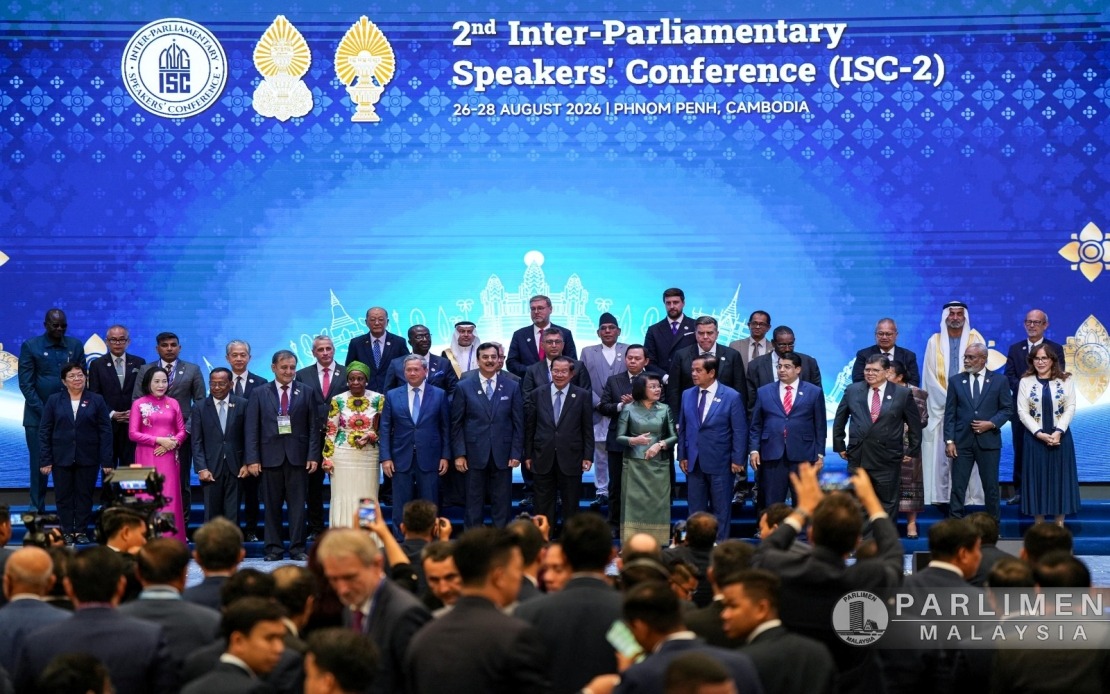
The legislature must assume greater responsibility in confronting the world's most pressing challenges—from armed conflicts to climate crises—rather than allowing governments to shoulder these burdens alone, Malaysia's Dewan Rakyat Speaker Tan Sri Dr Johari Abdul argued at a major regional parliamentary gathering in Phnom Penh this week. Speaking at the Second Inter-Parliamentary Speakers' Conference, which concluded Friday after three days of deliberations, Johari emphasised that legislatures possess distinctive capabilities and perspectives that executive branches often lack, and that their integration into diplomatic and peace-building efforts could fundamentally reshape how nations respond to transnational threats.
The conference, co-hosted by Cambodia's National Assembly and Senate under the banner "Solidarity for Peace and Shared Prosperity: Strengthening International Law and Resolving Conflicts Peacefully," brought together parliamentary leaders to examine how legislatures can more effectively contribute to international stability. Johari's intervention reflected growing recognition among lawmakers that the traditional division between executive diplomacy and legislative oversight has become outdated in an era characterised by interconnected crises spanning security, economics and the environment. He articulated a vision where parliamentarians cease being peripheral observers of foreign policy and instead become active participants in crafting responses to global tensions.
Central to Johari's argument is the observation that legislatures often possess deeper insight into the lived experiences of ordinary citizens affected by conflict and geopolitical instability. Whereas executive branches may analyse international disputes through narrowly political or strategic lenses, parliaments remain closer to grassroots concerns—displaced families, disrupted education systems, fractured communities and the intergenerational trauma that accompanies violence. This grounded perspective, when married with the executive's strategic knowledge, creates a more comprehensive understanding of what genuine peace requires. The speaker suggested that this complementary relationship, rather than institutional competition, offers the most promising pathway toward building genuinely durable solutions.
Parliamentary diplomacy, in Johari's framing, serves a unique function that formal governmental channels cannot replicate. When bilateral relations deteriorate and official negotiations freeze, legislators can maintain the quiet conversations necessary to prevent complete breakdown. These informal parliamentary-to-parliamentary exchanges create spaces where candid dialogue remains possible even when official relations become strained, where representatives can acknowledge disagreements without immediately escalating toward confrontation. This mechanism proves particularly valuable during periods when conventional diplomacy has reached an impasse, as it preserves communication pathways and reminds both sides that dispute need not inevitably culminate in conflict.
For Southeast Asia specifically, Johari drew connections between parliamentary engagement and the region's foundational principles. ASEAN was established on the conviction that regional peace requires continuous dialogue, consultation and mutual respect for sovereignty and territorial integrity. These principles have enabled the region to maintain relative stability despite historical tensions and competing strategic interests. Malaysian parliaments, Johari argued, can reinforce ASEAN's commitment to peaceful resolution mechanisms by strengthening inter-parliamentary connections that encourage solutions grounded in international law and mutual respect rather than power politics. This approach becomes increasingly vital as geopolitical divisions deepen globally and regional actors face pressure to align with competing blocs.
The broader context underscores why this message carries weight beyond ceremonial significance. Global conflict patterns have grown markedly more intricate, with traditional state-to-state disputes now intertwined with proxy conflicts, non-state actors and transnational networks. International institutions designed to maintain peace and security face unprecedented strain, their authority questioned and their mechanisms sometimes circumvented. In this fractured landscape, the accumulation of diplomatic channels and dialogue platforms—including those facilitated by parliaments—becomes valuable insurance against miscalculation and escalation. Even modest improvements in understanding between legislators from competing nations can ripple outward, influencing constituent opinion and political cultures in ways that formal negotiations sometimes cannot.
Johari's emphasis on international law as a foundation for dispute resolution carries particular significance for smaller and medium-sized nations like Malaysia. A rules-based international order, anchored in respect for sovereignty and the peaceful settlement of disputes, provides smaller states with protections that power-based approaches would deny. Legislatures, being more representative of diverse national constituencies, often exhibit greater commitment to universal legal principles than executives constrained by immediate strategic calculations. By strengthening parliamentary involvement in international affairs, nations reinforce mechanisms that protect their long-term interests even when short-term political temptations might suggest alternative paths.
The conference's inclusion of Pakistan as the inaugural host nation and Indonesia as next year's host reflects the growing institutional maturity of parliamentary networks in Asia. These gatherings move beyond symbolic expressions of solidarity toward substantive discussion of legislative mechanisms for addressing concrete crises. The rotating venue arrangement ensures that regional perspectives shape the agenda rather than allowing established powers to dominate discourse. For Malaysia and other Southeast Asian parliaments, participation in this emerging forum offers opportunities to influence international norms regarding conflict prevention and the legislature's role in foreign policy, establishing precedents that future generations of lawmakers can build upon.
Implementing Johari's vision requires institutional innovation at both national and international levels. Parliaments must develop dedicated mechanisms for international engagement beyond ceremonial visits and formal statements. Legislators require access to intelligence briefings and policy analysis comparable to executive branch resources, enabling them to participate substantively rather than peripherally in major decisions affecting peace and security. International parliamentary bodies must transition from discussion forums into coordination mechanisms capable of rapid response when crises emerge. These changes demand political will from sitting executives, who must accept diminished unilateral control over foreign policy in exchange for broader legitimacy and more resilient decision-making.
The implications for Malaysia are significant. As a moderate, multi-ethnic democracy playing an increasingly active regional and international role, Malaysia benefits from institutional arrangements that broaden the consensus supporting foreign policy decisions. Parliamentary ownership of peace and security issues strengthens public understanding and backing for diplomatic initiatives, which proves essential when pursuing complex settlements involving competing interests. Furthermore, Malaysian legislators' participation in international parliamentary networks enhances the nation's soft power, positioning Malaysia as a thoughtful voice advocating for rules-based order and dialogue-centered approaches to conflict resolution—attributes increasingly valuable as regional tensions mount and smaller nations seek to maintain space for independent action.
Moving forward, the challenge lies in translating rhetorical commitment into structural change. Parliaments must demand greater access to information and decision-making processes regarding international affairs. Executive branches must genuinely welcome legislative input rather than treating parliament as a rubber stamp for predetermined positions. International parliamentary forums must develop mechanisms for turning discussion into coordinated action. The success of these reforms will ultimately determine whether parliaments can meaningfully influence the trajectory of international relations or remain peripheral observers as crises unfold. Johari's intervention at the Phnom Penh conference represents a step toward recognising that lasting peace requires more than executive agreements—it demands the participation and ownership of legislatures that represent the peoples whose security is ultimately at stake.

