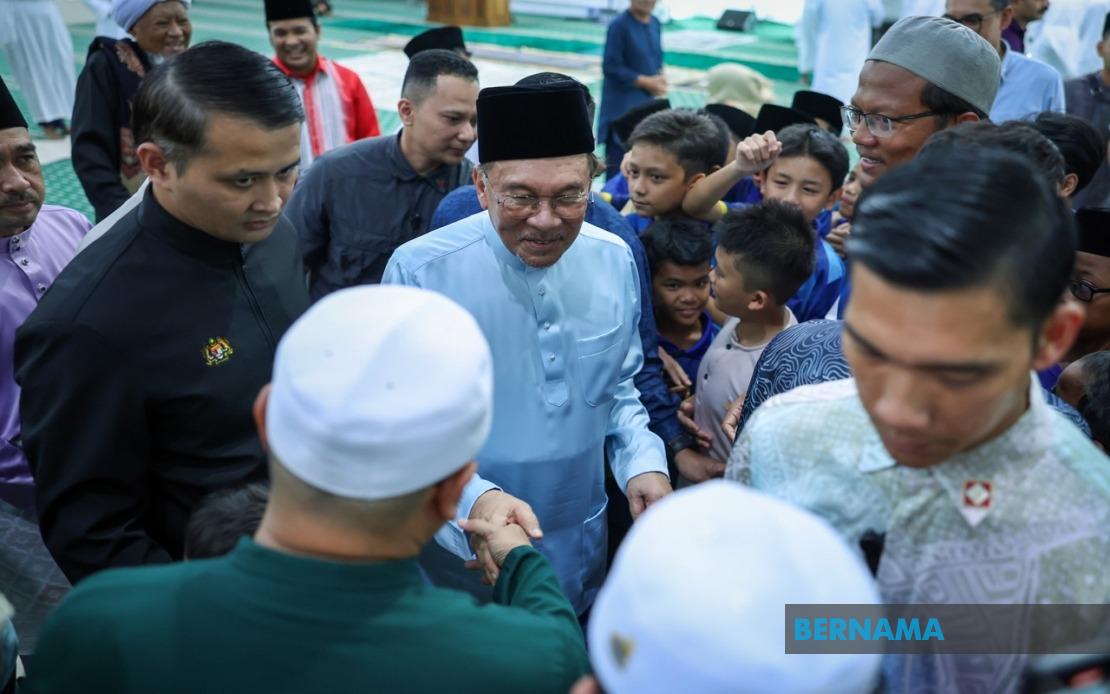
Prime Minister Datuk Seri Anwar Ibrahim has drawn a clear distinction between constituency funding and personal MP entitlements, stating firmly that government allocations to parliamentary constituencies exist primarily to improve the welfare and living conditions of the people who reside there. Speaking to journalists after Friday prayers at Masjid Ar-Rasyidin in Alor Gajah on August 7, Anwar sought to clarify long-standing confusion about the purpose and distribution of such funds, emphasising that elected representatives do not have proprietary claims over these resources.
The Prime Minister explained that constituency allocations should be deployed to address tangible community needs rather than serve as discretionary funds under MP control. He illustrated the intended use of these monies by citing examples such as educational facilities, religious institutions, drainage infrastructure improvements, and other pressing local development priorities. By grounding his explanation in concrete examples, Anwar attempted to reframe the narrative around government spending in constituencies, positioning it as a mechanism for delivering public goods rather than personal political capital for individual MPs.
Anwar's remarks directly addressed grievances raised by several parliamentarians who have publicly claimed that the government has restricted their access to constituency funds. His statement that "allocations do not necessarily have to be given to MPs" represented an implicit acknowledgment of the tension between MPs' expectations and the government's interpretation of how these funds should be managed. This distinction carries significant implications for how Malaysia's constituency development model operates and challenges any assumption that MPs enjoy unilateral authority over such spending.
The Prime Minister further indicated that the government intends to enforce this principle consistently, even when dealing with opposition-aligned MPs. He stated that should funding be allocated to a constituency whose representative sits in opposition, the government would bypass the MP entirely and channel resources directly to beneficiary communities. This approach signals a deliberate policy shift toward circumventing potential partisan gatekeeping and ensuring funds reach intended recipients regardless of an MP's political alignment or willingness to cooperate.
Anwar's emphasis that this principle had existed previously suggested the policy was not a novel creation but rather a restoration or reinforcement of an established framework. He noted that MPs from previous administrations would have been familiar with these guidelines, implying that current complaints about withheld funding may reflect either a departure from long-standing practice or a misunderstanding of the legitimate scope of MP authority. This historical framing attempted to position the government's stance as conventional rather than punitive.
For Malaysian constituents, particularly those in opposition-held seats, Anwar's clarification potentially offers reassurance that development projects and essential services need not depend on their MP's political relationship with the federal government. This could effectively insulate community development from partisan fluctuations, ensuring that schools, religious institutions, and infrastructure improvements proceed based on need rather than political loyalty. However, it also raises questions about how bypass mechanisms would function in practice and whether direct government distribution might reduce accountability.
The principle articulated by Anwar reflects broader global governance tensions regarding how local development funds should be allocated and controlled. Many democracies grapple with balancing the role of elected representatives as advocates for their constituencies against the need to ensure equitable distribution of public resources. Malaysia's apparent move toward treating MPs as coordinators rather than controllers of constituency funding represents a significant recalibration of this relationship, with potential consequences for how parliamentary representation functions at the grassroots level.
During the same briefing, Anwar addressed a separate matter concerning PKR deputy president Nurul Izzah, his daughter, who had requested a temporary step-down from her position. He characterised her absence as driven by other commitments requiring her immediate focus rather than indicating any rupture within the party. By framing her temporary departure as a personal scheduling matter rather than a leadership or policy dispute, Anwar attempted to minimise speculation about internal party dynamics or any perception of nepotistic controversy surrounding her transition.
Anwar's assertion that Nurul Izzah "remains active in the party" despite her formal step-down suggested her absence would be temporary and that she maintained ideological commitment to PKR's direction. This distinction between formal position and substantive involvement reflected an effort to prevent her temporary disengagement from being interpreted as withdrawal of support for her father's administration or loss of influence within the party structure.
These remarks, delivered by Minister in the Prime Minister's Department (Religious Affairs) Senator Dr Zulkifli Hasan and Melaka Police chief Datuk Dzulkhairi Mukhtar in attendance, occurred within a carefully managed political communication context. The venue of a mosque after Friday prayers, traditionally a setting associated with religious and community cohesion rather than partisan politics, framed Anwar's message as one of governance principle and public interest rather than political attack.
The funding clarification signals potential forthcoming disputes as various MPs adjust their expectations regarding access to constituency resources. Opposition parliamentarians may interpret the policy as confiscatory, while government-aligned MPs might view it as legitimising their authority over federal spending within their constituencies. How this principle is operationalised in practice will likely determine whether it achieves Anwar's stated goal of ensuring resources reach constituents efficiently or whether it becomes another flashpoint in Malaysia's increasingly fractious parliamentary politics.
The remarks also hint at broader governance challenges facing the Malaysian government as it manages coalition politics with multiple parties holding parliamentary representation. Establishing clear, consistently applied principles for resource distribution across constituencies represents a mechanism for reducing patronage disputes and establishing more predictable, rule-based governance. Whether such principles can survive the inevitable pressure from MPs expecting greater financial autonomy remains an open question as Malaysia's political system continues evolving.

