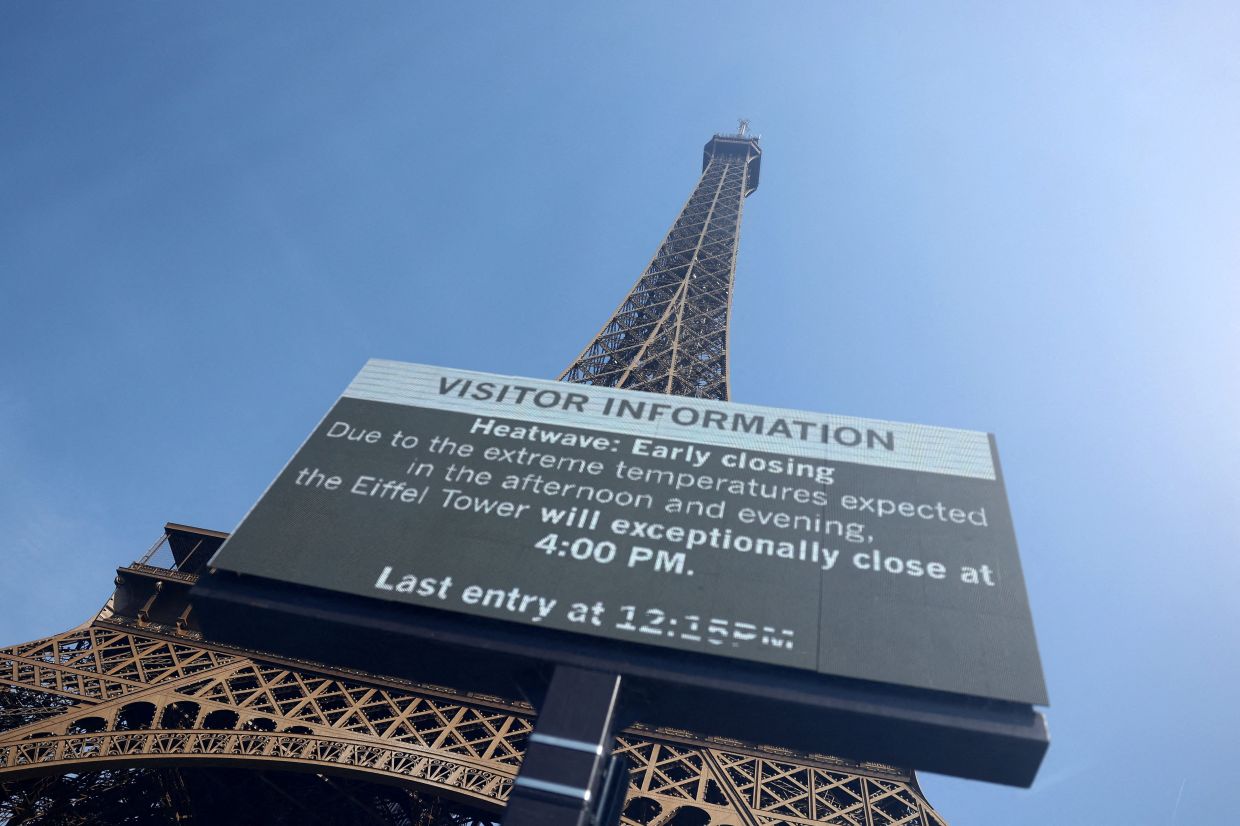
A punishing heatwave engulfing France this week has upended the holiday plans of thousands of international visitors, forcing the unscheduled closure of Paris's most celebrated attractions and leaving tourists grappling with extreme conditions that have made sightseeing nearly impossible. The Eiffel Tower and the Louvre museum both shuttered their doors earlier than scheduled on June 23, the day France recorded its highest temperature since meteorological records began in 1947, leaving disappointed crowds sweating beneath the broiling Parisian sun with few alternatives.
The impact extends far beyond operational logistics. Maite Blazques, a Spanish nurse who had carefully saved for months to share a memorable trip with her six-year-old son, found her meticulously planned itinerary rendered obsolete within days of arrival. The 35-year-old from Madrid had envisioned guided walks through the historic Marais district, a leisurely river cruise along the Seine, and an ascent to the top of the iconic tower—staples of any first-time Paris visit. Instead, she was forced to completely reimagine her family's holiday around heat-avoidance rather than cultural exploration, a compromise that left her visibly dispirited as she navigated the capital with her young child in tow.
The Eiffel Tower's operator announced the monument would make an "exceptional" early closure at 4pm on June 23, and indicated that curtailed operating hours were likely to continue throughout the heatwave. The 324-metre latticed-steel structure ordinarily welcomes seven million visitors annually and typically remains open well past midnight during peak season, making such interruptions virtually unprecedented in modern tourism. For many visitors, missing the tower's evening illumination or sunset views represents a significant loss, since these are often the defining moments of a Paris visit for international tourists.
American tourist Tamara Dancer experienced the disruption firsthand when her afternoon guided tour was cancelled without notice, transforming what should have been an enriching cultural experience into a frustrating scramble for alternative activities. The cancellations underline how vulnerable the tourism industry remains to climate extremes, with venues operating on razor-thin margins during peak season that evaporate when environmental conditions become hazardous to staff and visitors alike. For those who have invested considerable time and money in planning European holidays, such last-minute disruptions amount to more than mere inconveniences—they represent a loss of anticipated experiences that cannot always be recaptured.
Those who ventured into the streets armed themselves with parasols, wide-brimmed hats, and portable fans in desperate attempts to manage the relentless heat radiating from pavements. John Beeler, a 45-year-old American engineer, described the experience as "awful," noting that the temperature made even basic activities like walking and using public transportation feel suffocating. He and his wife relocated to an air-conditioned hotel room, a solution available only to tourists with flexible budgets and the means to book last-minute accommodation changes. Such adaptations highlight how climate extremes disproportionately affect visitors with limited resources, who lack the flexibility to escape to climate-controlled environments.
Drake Winners, a 66-year-old retiree from London, articulated a fundamental truth about Parisian tourism: the city reveals itself through walking. He observed that oppressive heat renders this essential mode of exploration virtually impossible, forcing visitors into indoor alternatives they had not planned. Museums and churches became de facto refuges rather than destinations chosen for their intrinsic appeal, a significant shift in how cultural tourism functions during climate extremes. Winners was among the fortunate who gained access to the Louvre, the world's most frequented museum attracting approximately nine million annual visitors, though even this sanctuary offered limited respite.
The Louvre itself, however, faces its own climate-related vulnerabilities. Museum management acknowledged that the vast palace, expanded by successive French monarchs and presidents over centuries, lacks sufficient climate adaptation infrastructure to withstand prolonged heat events. This institutional vulnerability assumes particular significance given that the institution houses priceless artworks whose preservation depends on stable temperature and humidity levels. The revelation underscores a broader reckoning: Europe's most treasured heritage sites were designed for historical climatic conditions that no longer prevail, yet retrofitting them for future extremes requires substantial investment and technical innovation that proceeds slowly.
The Louvre's climate struggles form part of a cascade of operational challenges the institution has confronted over the past twelve months. Beyond heat vulnerability, the museum has endured a brazen theft of artworks valued at approximately US$100 million (RM414 million), a significant water infiltration incident, and various other maintenance emergencies. These accumulated difficulties suggest that European cultural institutions face mounting pressures from multiple directions simultaneously, with climate change adding to existing vulnerabilities rather than standing as an isolated problem.
Across mainland France, more than half the territory remains under the weather service's highest alert classification, prompting widespread closures and visitor warnings at tourism destinations nationwide. Mont Saint-Michel, the spectacular tidal island fortress in Normandy and France's most-visited tourist attraction outside the capital region, issued explicit recommendations for visitors to postpone their trips during the red alert period. Such advisories represent an inversion of normal tourism promotion, with destination authorities explicitly discouraging visits rather than encouraging them—a posture that carries economic implications for communities dependent on seasonal tourism revenue.
The heatwave presents a harbinger of how climate change will reshape tourism patterns across Europe and globally. As extreme weather events become more frequent and intense, the tourism industry must grapple with fundamental questions about seasonality, infrastructure resilience, and the viability of maintaining outdoor attractions during peak heat periods. For Malaysian and Southeast Asian visitors planning European holidays, the incident serves as a reminder that travel planning must now account for climate volatility, with flexible itineraries and backup indoor activities becoming essential rather than optional. The normalisation of heat-induced closures at iconic sites may gradually reshape expectations about when and how to experience European heritage, potentially dispersing visitor flows across broader temporal windows rather than concentrating them in traditional peak seasons.

